Welcome to the second and final module of our course, "Applied Linguistics in Practice." In our previous lesson, we concluded our tour of theoretical linguistics by exploring the difference between semantics (literal meaning) and pragmatics (intended meaning). That discussion highlighted a key question: how does our abstract knowledge about language connect to how we actually use it in the real world?
This lesson picks up right where we left off, marking our transition from theoretical to applied linguistics. We will begin by tackling a foundational debate about the very nature of this field. Our goal is to contrast the traditional view of applied linguistics as a simple extension of linguistic theory with the modern view of it as a broad, interdisciplinary field that addresses real-world problems.
The Traditional View: "Linguistics Applied"
Historically, the relationship between theoretical and applied linguistics was seen as a one-way street. Theoretical linguistics would produce theories about language structure, and applied linguistics would simply "apply" them to practical issues, especially in language teaching. This perspective is often called "linguistics applied."
The following video introduces this classical view and outlines its core principles.
Applied linguistics: Definition, history & scope
The video "Applied linguistics: Definition, history & scope" by Hassan Ait Bouzid provides a clear breakdown of the two main perspectives on the field. We'll start with the first one.
Please watch the segment from the classical view. As you watch, focus on the three main principles the presenter outlines for this "linguistics applied" perspective: It is practical: It uses existing theories, it doesn't create new ones. It is unilateral: It only uses knowledge from linguistics. It requires fundamental linguistic knowledge: The practitioner is, first and foremost, a linguist.
As the video explains, this traditional view sees applied linguistics as a direct branch of its parent discipline. Another common way to frame this is to think of theoretical linguistics as the "science" and applied linguistics as the "engineering." The science discovers the principles, and the engineering uses those principles to build things and solve problems. Under this view, the problems addressed are typically those that can be solved with purely linguistic knowledge, such as issues of grammar, spelling, or developing writing systems.
The Modern View: An Interdisciplinary Field
Over time, many scholars began to feel that the "linguistics applied" model was too narrow. They argued that real-world language problems are often complex and messy, requiring insights from many different fields, not just linguistics. This led to the development of a more modern, expanded view of applied linguistics.
This contemporary perspective sees applied linguistics as an interdisciplinary field that stands on its own. It still uses linguistic knowledge, but it also freely draws from other disciplines like psychology, sociology, education, and computer science to understand and solve language-related problems.
Let's return to the same video to see how it presents this modern view.
Applied linguistics: Definition, history & scope
We'll now watch the next segment of the same video, which presents the contrasting contemporary perspective.
Please watch from the interdisciplinary view. Pay attention to how this view differs from the traditional one. Note the key ideas: Linguistic knowledge alone is often not enough. Applied linguistics can develop its own theories. It is a dynamic, growing, and collaborative field.
This interdisciplinary nature means that the scope of modern applied linguistics is vast. Instead of just focusing on teaching methodology, it now encompasses a wide array of subfields that tackle diverse problems.
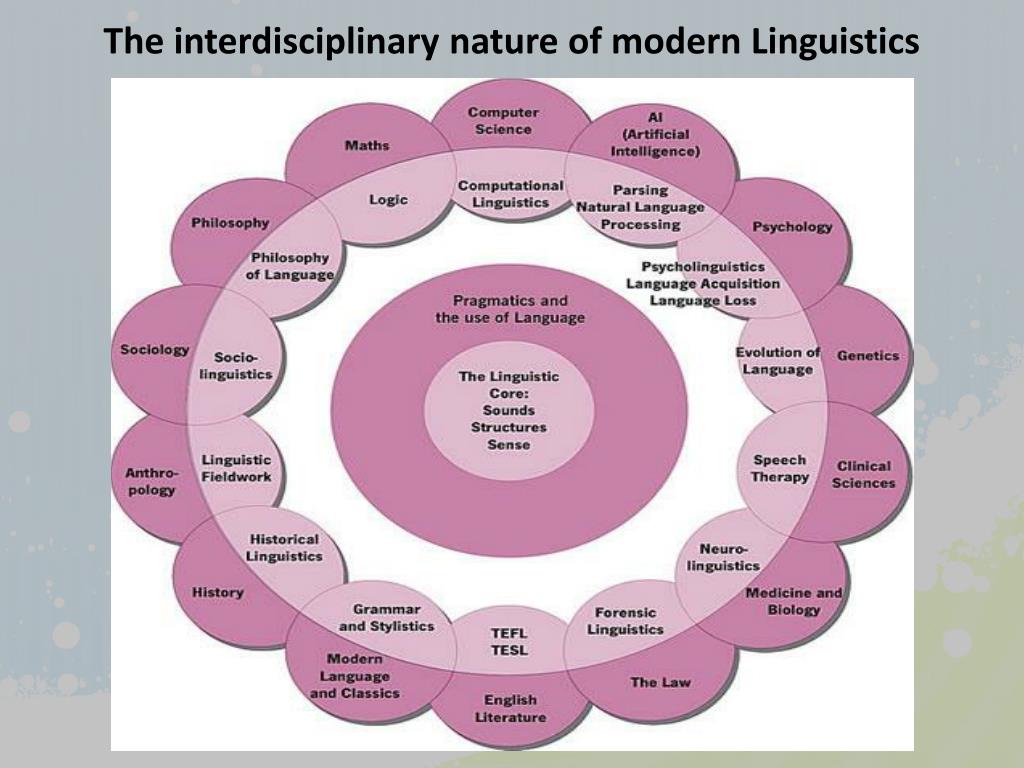
The video you watched lists several of these areas, including:
- Language assessment
- Language policy and planning
- Language pathology (speech therapy)
- Translation
- Language and technology
Synthesizing the Two Views
The tension between these two perspectives is a defining feature of the field. The scholar Henry Widdowson captured this distinction by coining two separate terms:
- Linguistics Applied: The traditional approach where linguistic theory is applied to a problem. The focus is on the language system itself, and the goal is often to validate or use a linguistic theory.
- Applied Linguistics (proper): The modern, interdisciplinary approach that starts with a real-world problem and brings whatever tools are necessary—from linguistics or other fields—to solve it. Here, the focus is on language use in context.
The infographic below provides an excellent visual summary of this crucial distinction.

As the infographic shows, the key difference lies in the starting point.
- Linguistics Applied starts with a theory (e.g., from syntax or phonology) and looks for a place to apply it.
- Applied Linguistics starts with a problem (e.g., "Why are these students struggling with this specific grammar point?") and then seeks out relevant theories, whether from linguistics, psychology, or education, to find a solution.
Conclusion
In this lesson, we have explored the evolution of applied linguistics by contrasting its two dominant conceptualizations. Understanding this distinction is key to navigating the field and its literature.
Key Takeaways:
- The traditional view ("linguistics applied") sees the field as a branch of theoretical linguistics, responsible for applying linguistic theories to practical problems. It is unilateral and theory-driven.
- The modern view sees applied linguistics as an independent, interdisciplinary field that draws on multiple disciplines (e.g., psychology, sociology) to solve complex, real-world language problems. It is problem-driven and can generate its own theories.
- This distinction helps explain the vast and growing scope of applied linguistics today, which ranges from language teaching to forensic analysis and artificial intelligence.
In our next and final lesson, we will build directly on this modern, interdisciplinary view. We will survey some of the most prominent real-world applications of linguistics, focusing on language learning theories and the different ways we acquire language.