Introduction
Welcome to our new lesson. In our previous discussion, we contrasted the bikini styling approaches in blockbusters, independent films, and streaming series. We concluded that streaming platforms, with their long-form narrative structure and high production values, have become a key venue for hyper-curated, character-driven costume design, with shows like The White Lotus leading the way.
Today, we will build directly on that foundation. Your learning outcome is to identify key bikini styling trends prominent in streaming-era content of the 2010s–2020s. We will move beyond the why and into the what, cataloging the specific aesthetics that define on-screen swimwear in our current media landscape. These trends often mirror broader cultural shifts, from the rise of "quiet luxury" to the joyful chaos of maximalism.
The Dominant Trends in Streaming-Era Swimwear
The last decade has seen a diversification of on-screen bikini aesthetics. While the classic triangle bikini remains a staple, streaming content has popularized several distinct and often opposing trends. Let's break down four of the most prominent.
1. Quiet Luxury
This aesthetic signals wealth and sophistication through understatement. It eschews loud logos and flashy details in favor of impeccable fit, high-quality materials, and a muted, elegant color palette. Given your background in social research, you'll recognize this as a form of cultural capital—signaling status to those "in the know."
Visual Hallmarks:
- Colors: Solid, neutral, and earth tones (e.g., olive, rust, black, cream).
- Silhouettes: Classic and clean (simple triangle, bandeau, or minimalist one-pieces).
- Details: Focus on fabric texture (ribbed, crinkled) over embellishment. Any hardware is subtle and refined.
A perfect example of this is seen in the 2022 film Triangle of Sadness, a satire on the world of the super-rich.
2. Maximalism and Dopamine Dressing
In direct opposition to quiet luxury, maximalism embraces a "more is more" philosophy. This trend is characterized by bold colors, clashing patterns, and architectural details designed to spark joy and make a memorable visual statement.
Visual Hallmarks:
- Colors: Bright neons, jewel tones, and vibrant, saturated hues.
- Patterns: Loud florals, animal prints, psychedelic swirls, and graphic designs.
- Details: Ruffles, strategic cut-outs, extra straps, and statement hardware.
The film Glass Onion: A Knives Out Mystery provides an excellent case study in its character Birdie Jay.
Shop the Swimsuits From Glass Onion: A Knives Out Mystery
This article from Popsugar breaks down the symbolic swimwear in 'Glass Onion.' We'll focus on Birdie Jay's look as a prime example of maximalist dopamine dressing.
Please read the section titled 'Birdie Jay's Orange Bikini in "Glass Onion: A Knives Out Mystery"'. Note the costume designer's intent to create a 'head-turning moment' and the description of the character's 'no "too much"' vocabulary. The choice of an orange, ruffled bikini from Andrea Iyamah is deliberate and impactful.
Birdie's look is the antithesis of subtlety. It's designed for an entrance, embodying a personality that thrives on being the center of attention.
3. Curated Vintage and Retro Revival
This trend involves reinterpreting styles from past decades, particularly the 1960s and 70s, through a modern lens. It's not about wearing authentic vintage pieces as much as it is about adopting retro silhouettes, prints, and moods with contemporary fabrics and styling.
Visual Hallmarks:
- Silhouettes: High-waisted bottoms, halter-neck tops.
- Patterns: Psychedelic swirls, Pucci-esque prints, and retro florals.
- Styling: Often paired with vintage-inspired accessories like cat-eye sunglasses and headscarves.
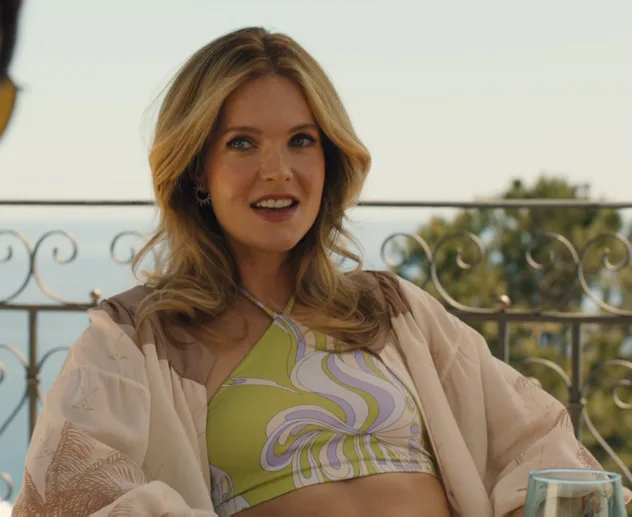
4. The Blurring of Swimwear and Ready-to-Wear
Increasingly, the line between swimwear and everyday clothing is disappearing. In streaming content, bikini tops are frequently styled as crop tops, and one-pieces function as bodysuits, integrated into complete outfits. This reflects a major trend from social media and runway fashion.
Visual Hallmarks:
- Bikini tops worn under open shirts, sheer tops, or even blazers.
- The use of athletic wear, like sports bras, as functional swimwear.
- Elaborate one-pieces that are indistinguishable from bodysuits when paired with skirts or pants.
The character of Peg in Glass Onion is a textbook case of this functional, hybrid approach.
Shop the Swimsuits From Glass Onion: A Knives Out Mystery
Let's return to the Popsugar article on 'Glass Onion' to look at a different character who exemplifies this blurring of categories.
Please read the section titled 'Peg's Black and White Sports Bra in "Glass Onion: A Knives Out Mystery"'. Pay attention to how the costume designer explicitly states they wanted a 'capsule wardrobe' where a sports bra could 'play as swimwear' out of necessity and versatility.
Case Study: How The White Lotus Showcases Every Trend
The White Lotus is the definitive text for streaming-era bikini trends because its ensemble cast allows costume designer Alex Bovaird to explore each of these aesthetics through different characters, often within the same season.
Let's watch an analysis of Season 2's costumes and then break down how the key female characters personify the trends we've just defined.
The White Lotus Season 2: Costume Design Analysis
This detailed analysis from Costume CO examines the character-driven costumes of 'The White Lotus' Season 2. It provides specific brand names and designer insights that reveal the strategy behind the swimwear choices.
Please watch the following segments, focusing on how the swimwear and resort wear choices define each character: Harper (00:15:35 - 00:15:59): Note the variety of her choices, including a Mavi bikini from a 'Sicilian collection' and a classic black one-piece evoking 'Old Hollywood glamor.' Daphne (00:15:59 - 00:16:32): Listen for the description of her 'beachy Hampton's Yummy Mummy Vibe' and the mention of her Prada two-piece. Portia (00:17:32 - 00:21:18): This is a deep dive into Gen Z maximalism. Pay close attention to her 'audacious' mash-up of styles, budget-friendly brands (Zara, Urban Outfitters), and specific bikini looks like the Reyna Olga zebra top and the House of Sunny printed bikini set. Mia & Lucia (00:22:37 - 00:25:21): Track their style evolution from 'cheap' and 'Euro trash' to splurging on luxury items like a La Perla swimsuit, embodying an aspirational arc.
Now, let's connect these characters to our trends, using further insights from a Vogue interview with the costume designer.
'The White Lotus's' Costume Designer Breaks Down Season 2's Key ...
This Vogue article gives us direct quotes from Alex Bovaird about her intentions for the characters in Season 2.
Please read the three short sections about Harper, Daphne, and Lucia & Mia. Focus on the key phrases used to describe their style and the specific brands mentioned: For Harper, note the mention of Loewe bags and a 'little Loewe swimsuit,' alongside vintage pieces, aiming for a 'sharp and chic' look. For Daphne, identify the brands like Zimmerman and Gucci, and the specific mention of a 'vintage Moschino swimsuit.' For Lucia & Mia, see how their 'Pretty Woman moment' leads to Dior swimsuits and bikinis with Sicilian motifs.
Based on these resources, we can map the characters to the trends:
- Harper Spiller (Quiet Luxury): As a newly wealthy lawyer, Harper is "uptight and very spot-on stylish." Her swimwear, including a chic Loewe swimsuit and classic vintage bikinis, is understated yet expensive. It's a deliberate, intellectual approach to wealth, avoiding the ostentation she judges in others.
- Daphne Sullivan (Polished Maximalism & Retro Revival): Daphne's "yummy mum vibe" is a breezy, confident maximalism. Her wardrobe of Prada, Gucci, and a retro-patterned halter embodies this. The mention of a "vintage Moschino swimsuit" confirms her use of curated retro styles to build a playful, effortlessly wealthy persona.
- Portia (Gen Z Maximalism & Swimwear as RTW): Portia is the chaotic heart of modern trends. Her style is a "haphazard" mix of thrifted items and budget brands. Her tendency to wear a zebra-print bikini top with an upside-down shrug perfectly illustrates the blurring of swimwear and ready-to-wear, all filtered through a confused, trend-chasing Gen Z lens.
- Lucia and Mia (Aspirational Maximalism): These characters perform a "Pretty Woman" style arc. They begin with cheap, "off-key" looks and, upon acquiring money, immediately splurge on status-symbol maximalism: Dior swimsuits, sparkly Clio Peppiatt dresses, and bold patterns. Their swimwear is a direct expression of their ambition and desire to fit into the world of the White Lotus.
Conclusion
As we've seen, the streaming era has ushered in a rich and varied landscape for on-screen swimwear. The trends are not monolithic; instead, they exist in conversation and opposition, allowing costume designers to paint incredibly nuanced portraits of character and social class.
Key Takeaways:
- Four dominant trends in streaming-era swimwear are Quiet Luxury, Maximalism/Dopamine Dressing, Curated Vintage/Retro Revival, and the Blurring of Swimwear and Ready-to-Wear.
- Quiet Luxury signals wealth through subtlety (muted colors, classic cuts), while Maximalism does so through joyful excess (bold patterns, bright colors).
- Retro Revival reinterprets past styles for a contemporary look, and the blurring of categories sees swimwear integrated into everyday outfits.
- Prestige series like The White Lotus serve as masterclasses in these trends, using different characters to embody each distinct aesthetic, thereby enriching the narrative.
In our next lesson, we'll investigate the engine driving many of these trends: social media. We will explore how platforms like Instagram and TikTok are shaping the bikini aesthetics that appear in film and television, creating a powerful feedback loop between influencer culture and on-screen costume design.