Introduction
Welcome to our third lesson in the "Action & Attitude" module. In our previous session, we established a crucial distinction between "sport-inspired" and "athleisure" bikini aesthetics. We identified the key visual signifiers—such as racerback cuts, neoprene fabric, and color-blocking—and used the film Blue Crush to analyze an authentic, sport-specific look.
Today, we transition from the cinematic world of athletes to the high-energy aesthetic of the pop music video. Our goal is to analyze how athletic cuts and bold color-blocking are used in pop music videos to signify energy and empowerment. We will investigate how these design elements, often detached from their original athletic function, are repurposed to create powerful visual statements about dynamism, confidence, and female solidarity.
1. The Language of Color and Cut in Pop Videos
A three-minute music video is a dense format for visual storytelling. Every choice must be impactful and communicate its message quickly. In this context, athletic cuts and bold colors become a powerful shorthand.
-
Bold Color: Saturated and high-contrast colors—neons, primary hues, metallics—are essential for grabbing and holding the viewer's attention amidst rapid cuts and complex choreography. Aesthetically, these colors create a sense of vibrancy, excitement, and energy.
-
Athletic Cuts: As we discussed, cuts borrowed from sportswear (scoop necks, wider bands, zip-fronts) prioritize security and movement. When placed in a non-athletic context like a music video, their meaning shifts. They no longer signify "I am playing volleyball"; instead, they project an image of strength, discipline, and readiness for action—in this case, often demanding dance performances. They become a symbol of physical capability and, by extension, empowerment.
The fusion of these two elements creates a distinct visual identity common in pop: empowered energy. To see how this is consciously leveraged in fashion, let's look at a recent trend report.
Sustainability And Female Empowerment Lead The Way At Miami Swim Week 2025
The following article from Forbes reviews recent trends from Miami Swim Week. It directly connects the use of vibrant colors and athletic designs to the theme of female empowerment. This provides an industry perspective on the aesthetics we see on screen.
Please read the short descriptions for the brands 'Bombshell Sportswear,' 'Mars the Label,' and 'Everlast.' You can find them by searching for those names in the article. Pay close attention to the language used to describe their collections, such as 'vibrant colours,' 'main character energy,' and the 'literal embodiment of female strength.'
As you can see from the reading, designers are explicitly using these elements to help women "stand out" and embody strength. Brands like Bombshell Sportswear use vibrant lime and watermelon shades for confidence, while Everlast's boxing-inspired athletic cuts are described as a "literal embodiment of female strength." This confirms that the connection between these designs and a feeling of empowerment is intentional.
2. Case Study: Dua Lipa, "New Rules" (2017)
Let's now analyze how these principles come together in a quintessential modern pop music video. Dua Lipa's "New Rules" was a massive global hit, and its visual identity was key to its success. The video's narrative centers on female friends supporting each other and establishing rules for moving on from a toxic relationship—a clear theme of empowerment. The bikini styling is integral to this message.

Observe the image above and the one below.
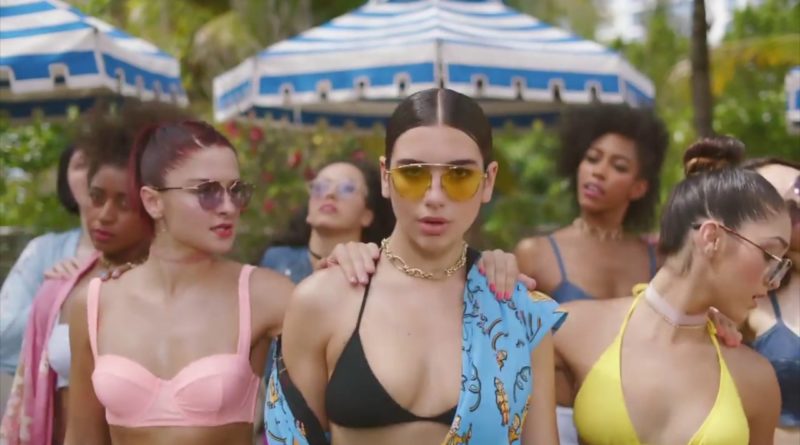
Let's deconstruct the styling choices and their meaning:
- Color Palette: The video uses a mix of bold and pastel colors. The bikini tops—in shades of black, yellow, pink, and purple—create bright pops of color that stand out against the more muted tones of the hotel setting. This creates a vibrant energy that aligns with the pop track's tempo.
- Cuts and Styles: The tops are relatively simple—mostly triangle and bandeau styles. While not overtly "athletic" in the vein of a racerback, their function here is similar. They are worn for choreographed dancing, allowing for freedom of movement while creating a cohesive group look. The empowerment comes not from a specific athletic cut, but from the collective act of wearing them together.
- Styling Context: The key here is that the bikini tops are styled as casual tops, paired with high-waisted shorts, track pants, and open shirts. This is a classic athleisure move. By removing the bikini from a poolside or beach context, the styling asserts a sense of ownership and redefines it as a piece of everyday, empowered fashion. It’s worn for themselves and each other, not for an external gaze.
The overall message is one of collective strength. The bikinis function as the uniform for their supportive "team," and the bright, energetic colors visually represent the confidence they build in one another.
3. Cultural Roots: Bold Color as Liberation
The use of bold color in swimwear to signify power and visibility has deep cultural roots, particularly within Black culture. What we see in mainstream pop is often an echo of aesthetics pioneered by Black female artists who used fashion to claim space and challenge norms.
For a deeper analysis of this, let's turn to an article that discusses the significance of the bikini in music videos and media for Black women.
The article 'All of Us Had a Taste' by Fariha Róisín provides a powerful analysis of how the bikini has been used by Black women as a tool for economic, sexual, and social liberation. It will give us a richer context for understanding the link between bold swimwear and empowerment.
Please read the three sections highlighted. The first discusses 2000s music videos as an 'education on... visibility' and power. The second details Lil' Kim's iconic 'chartreuse' bikini. The third analyzes Megan Thee Stallion's use of bold colors like 'electric blue' and 'fuschia' as symbols of freedom. Focus on how specific color choices are linked to themes of desire, power, and self-definition.
This reading powerfully illustrates that for artists like Lil' Kim, Foxy Brown, and Megan Thee Stallion, a brightly colored bikini is not just a fashion choice. It is a deliberate act of self-representation. A "chartreuse" or "tangerine" bikini becomes a political and aesthetic statement, yoked to claiming desire, visibility, and economic freedom in an industry that has often tried to control their image. This adds a critical layer of understanding to the aesthetics of empowerment we see in music videos today.
Conclusion
In this lesson, we have focused on how specific design choices in bikinis function within the context of pop music videos. We've moved beyond simple identification of styles to analyze their symbolic meaning.
Key Takeaways:
- In pop music videos, bold colors are used to convey energy and capture attention, while athletic cuts are used to signify strength and readiness for performance.
- The combination of these elements creates a potent aesthetic of empowered energy, a trend confirmed by contemporary fashion designers.
- In Dua Lipa's "New Rules," bikini tops are styled as part of a collective uniform, supporting a narrative of female solidarity and empowerment.
- The use of bold swimwear as a statement of power has a rich history, particularly among Black female artists who have long used it as a tool for liberation and visibility.
In our next and final lesson of this module, we will conduct a comprehensive case study. We will analyze the bikini styling in the Charlie's Angels franchise, tracing the blend of halter-neck glamour and sport-inspired aesthetics across different eras and actresses. This will allow us to synthesize everything we've learned about bikinis that communicate "Action & Attitude."