Welcome back. In our previous lesson, we constructed the foundational map of adrenal steroidogenesis, tracing the three major highways from cholesterol to the final products: aldosterone (salt), cortisol (sugar), and androgens (sex).
Today, we will populate that map with its most important traffic controllers. Our objective is to pinpoint the exact locations of the three most clinically significant enzymes: 17α-hydroxylase, 21-hydroxylase, and 11β-hydroxylase. Understanding where these enzymes work is the absolute key to logically deducing the effects of their deficiency in Congenital Adrenal Hyperplasia (CAH). This step moves us from just knowing the map to understanding how the traffic flows, and what happens when there's a roadblock.
The Enzyme-Driven Assembly Line
Think of the steroidogenesis pathway as a factory assembly line. The intermediates are the partially built products, and the enzymes are the specific workers or machines that perform each step. A deficiency of an enzyme is like a machine breaking down—production halts at that point.
Let's look at a more detailed version of our pathway map. This diagram includes the names of the enzymes that catalyze each reaction.
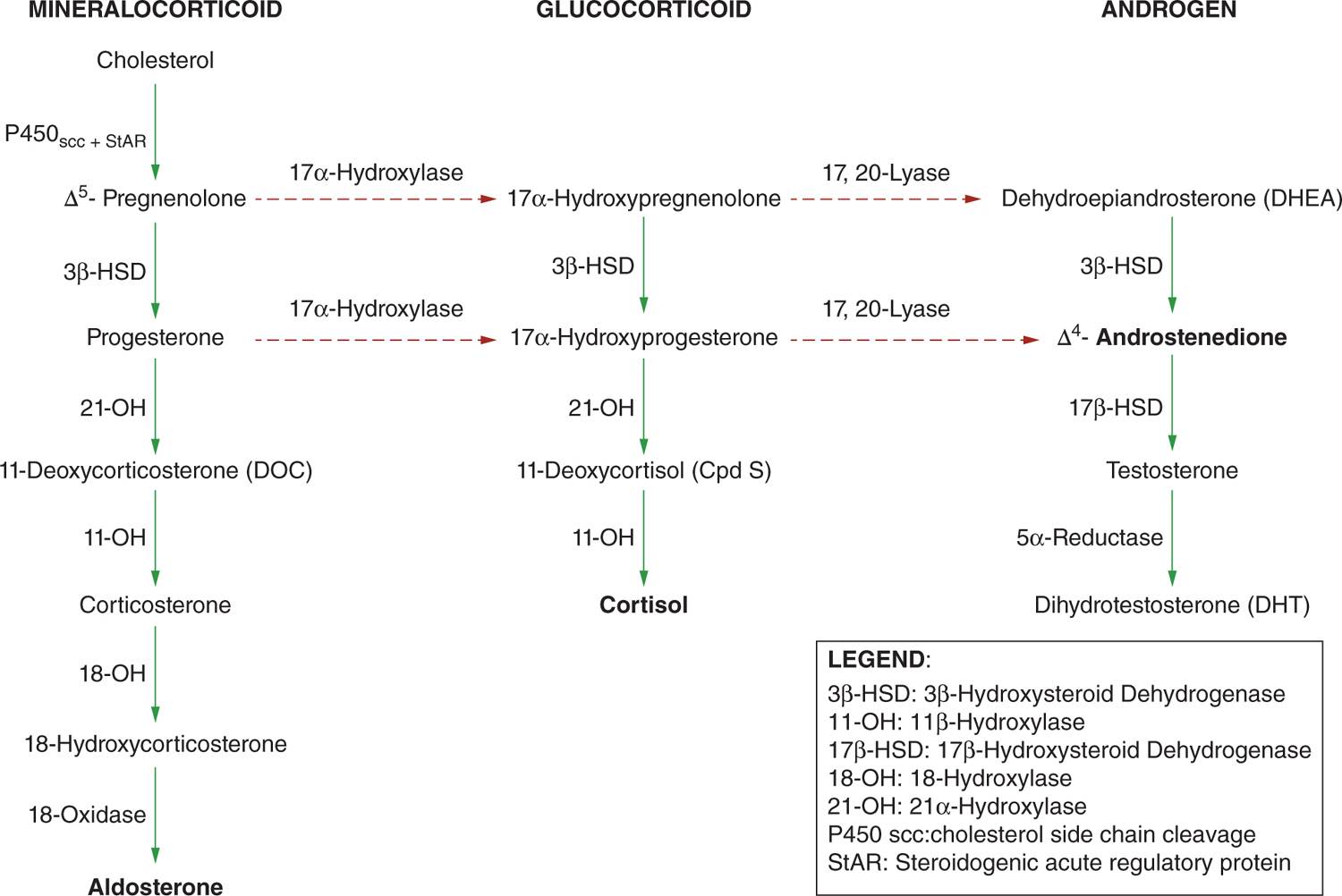
Our focus will be on just three of these enzymes, which are responsible for over 99% of CAH cases.
The Downstream Workers: 21-Hydroxylase and 11β-Hydroxylase
The first two enzymes are best understood together. Both 21-hydroxylase and 11β-hydroxylase function as downstream workers in the production of both mineralocorticoids and glucocorticoids.
Look at the diagram "Adrenal steroidogenesis pathway with enzymes" again:
- 21-Hydroxylase: Find Progesterone in the mineralocorticoid ("Salt") pathway and 17-OH Progesterone in the glucocorticoid ("Sugar") pathway. Notice that 21-hydroxylase performs the very next step in both columns, converting them to 11-Deoxycorticosterone (DOC) and 11-Deoxycortisol, respectively.
- 11β-Hydroxylase: Now look one step further down those same two columns. 11β-hydroxylase performs the subsequent step, converting DOC and 11-Deoxycortisol into their downstream products, eventually leading to aldosterone and cortisol.
So, a simple rule emerges: 21-hydroxylase and 11β-hydroxylase work in sequence, late in the game, to finalize the production of aldosterone and cortisol. They are not involved in the androgen ("Sex") pathway.
The following resource from Epomedicine provides another clear view of this pathway. Take a moment to locate 21-hydroxylase and 11-hydroxylase on their diagram.
Congenital Adrenal Hyperplasia Basics : Explained with Mnemonics | Epomedicine
This article presents the steroidogenesis pathway with a focus on the key enzymes.
Scroll down to the large diagram titled Adrenal steroidogenesis. On this chart, trace the path from Progesterone to Aldosterone and from 17-OH Progesterone to Cortisol. Confirm for yourself that both 21-OH and 11-OH are required for these two paths, but are absent from the androgen synthesis path on the right.
The Critical Switch: 17α-Hydroxylase
The third key enzyme, 17α-hydroxylase, plays a very different role. It is not a downstream worker; it is an upstream switch. Its job is to divert precursors away from the default mineralocorticoid pathway and into the glucocorticoid and androgen pathways.
Refer back to the detailed "Adrenal steroidogenesis pathway with enzymes" diagram:
- Notice how 17α-hydroxylase acts on Pregnenolone and Progesterone. It adds a hydroxyl group at the 17-position, creating 17-OH Pregnenolone and 17-OH Progesterone.
- These "17-hydroxy" compounds are the entry points for the glucocorticoid and androgen pathways.
Therefore, the rule for this enzyme is: 17α-hydroxylase is the gatekeeper for both the "Sugar" and "Sex" hormone pathways. Without it, the flow of precursors is entirely restricted to the mineralocorticoid pathway.
This short video provides a very direct, high-yield visualization for exam purposes. The presenter uses a simplified box model to show you exactly where to place these three numbers—17, 21, and 11—to create a functional mental map.
USMLE STEP 1: Adrenal Cortex deficiencies with question
In this USMLE Step 1 review video, Dr. Randy Neil demonstrates a powerful, simplified model for understanding enzyme deficiencies.
Watch the segment from the beginning, where he physically places the numbers for the three enzymes onto the adrenal cortex layers. Then, watch the summary at the end from the final recap to solidify this simple but effective framework.
Summary of Enzyme Locations
To consolidate your mental model, let's place everything on the simplified pathway diagram from MyEndoConsult. This is an excellent version to practice drawing from memory.

Here is a summary of the enzyme placements:
| Enzyme | Location and Function | Pathways Involved |
|---|---|---|
| 21-Hydroxylase | Downstream step in both Salt and Sugar synthesis. | Mineralocorticoid, Glucocorticoid |
| 11β-Hydroxylase | Final downstream step in both Salt and Sugar synthesis. | Mineralocorticoid, Glucocorticoid |
| 17α-Hydroxylase | Upstream switch that shunts precursors from the Salt pathway into the Sugar and Sex pathways. | Glucocorticoid, Androgen |
Conclusion
In this lesson, we have taken our map of the adrenal steroidogenesis pathways and precisely located the three enzymes most critical for your exams: 21-hydroxylase, 11β-hydroxylase, and 17α-hydroxylase. You should now be able to place them correctly on the pathway and state their primary roles.
- 21-hydroxylase and 11β-hydroxylase are the finishers for the aldosterone and cortisol lines.
- 17α-hydroxylase is the crucial switch that opens the gate to the cortisol and androgen lines.
Having mastered the "where," we are now perfectly positioned to understand the "what happens when." In our next lesson, we will establish the single most important principle for diagnosing CAH: what happens to the pathway when one of these enzymes is deficient. We will see how a block at any of these points leads to a predictable pattern of precursor accumulation and product deficiency, which is the key to all CAH pathophysiology.