Welcome to our next lesson. In our previous session, we mastered in-place array manipulation, using pointers to reverse, rotate, and partition arrays with constant space complexity. We saw how these techniques are fundamental for writing memory-efficient code. Today, we'll see just how versatile those patterns are by applying them to a new domain: strings.
This lesson focuses on solving two of the most common string manipulation problems you'll encounter in coding interviews: palindrome checks and anagram detection. For a string-based problem, treating it as an array of characters is often the best first step. You'll find that the two-pointer technique from our last lesson is directly applicable to checking for palindromes, while anagram detection will give us an opportunity to revisit hash maps and analyze performance trade-offs between different approaches.
Checking for Palindromes
A palindrome is a word, phrase, or sequence that reads the same backward as forward. For example, "racecar" and "madam" are palindromes. A simple way to check this is to compare the string with its reversed version. However, a more interesting and common interview variant, "Valid Palindrome" (LeetCode #125), adds two constraints:
- You must only consider alphanumeric characters (letters and numbers).
- You must ignore case (i.e., 'A' is the same as 'a').
This means a string like "A man, a plan, a canal: Panama" should be considered a valid palindrome.
While you could create a new, filtered string and then check if it's equal to its reverse, this would require extra space. Drawing from our last lesson, can we do better? Yes, by using an in-place approach with two pointers, achieving space complexity.
The following video provides an excellent walkthrough of both the simple, extra-space method and the optimized two-pointer solution. It also shows how to implement the character validation from scratch, a great skill to have if an interviewer disallows built-in functions.
Valid Palindrome - Leetcode 125 - Python
This NeetCode video covers the "Valid Palindrome" problem, contrasting a simple Pythonic solution with the more efficient two-pointer approach.
First, watch the problem explanation to understand the definition of a palindrome and the specific constraints about alphanumeric characters and case-insensitivity. Next, see the straightforward extra-memory solution. As a Python developer, this "list comprehension and join" style will be familiar, but note the memory cost. Pay close attention to the two-pointer approach, which achieves constant space complexity. This is the core of the optimal solution. Notice how the pointers are advanced to skip non-alphanumeric characters. The video also includes a great bonus for interview prep: a demonstration of how to write your own isalnum function using ASCII values. Finally, watch the full implementation of the two-pointer solution in Python.
The logic of the two-pointer solution is a direct extension of what we learned for array reversal:
- Initialize a
leftpointer at the start of the string and arightpointer at the end. - In a loop that continues as long as
left < right:- Advance the
leftpointer until it points to an alphanumeric character. - Advance the
rightpointer backward until it points to an alphanumeric character. - Compare the lowercase versions of the characters at
leftandright. If they don't match, returnFalse. - If they do match, move the pointers inward (
left += 1,right -= 1).
- Advance the
- If the loop completes, it means the string is a palindrome, so you return
True.
This approach avoids creating any new strings, making it highly efficient in terms of memory.
Detecting Anagrams
Two strings are anagrams if they contain the exact same characters with the exact same frequencies. For example, "listen" and "silent" are anagrams. This is another classic interview question, and there are two primary methods to solve it.
Method 1: Sorting
The first approach is based on a simple but powerful insight: if two strings are anagrams, then their sorted versions will be identical.
sorted("listen")->['e', 'i', 'l', 'n', 's', 't']sorted("silent")->['e', 'i', 'l', 'n', 's', 't']
This makes the check very simple: return sorted(s1) == sorted(s2).
However, what is the cost? The time complexity is dominated by the sorting algorithm, which is typically . In Python, sorted() also creates a new list, so the space complexity is .
Method 2: Frequency Counting
A more performant approach uses a hash map (or a simple array as a frequency counter) to count the occurrences of each character. This directly leverages the definition of an anagram.
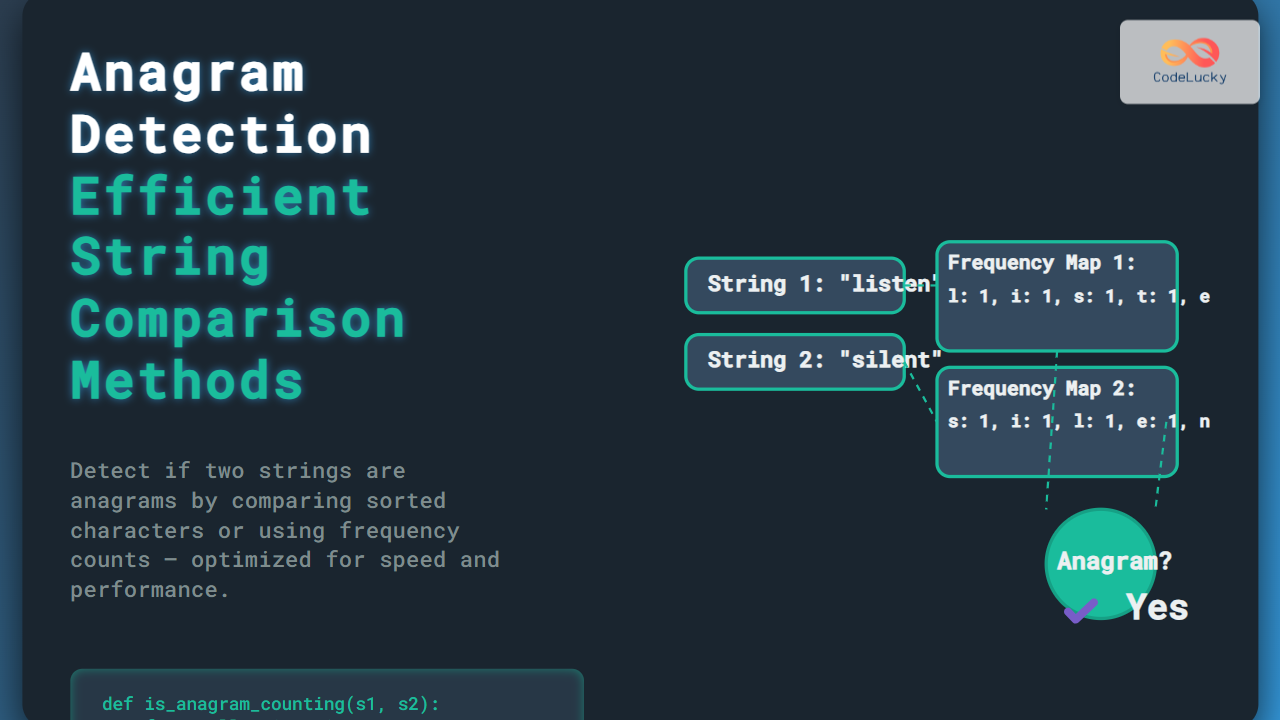
The algorithm is as follows:
- A quick preliminary check: if the strings have different lengths, they cannot be anagrams. Return
False. - Create a frequency map (e.g., a hash map or a 26-element array for lowercase English letters) for the first string,
s1. - Iterate through the second string,
s2, and for each character, decrement its count in the frequency map. - If at any point a character from
s2is not in the map, or its count is already zero, the strings are not anagrams. - After iterating through
s2, if all counts in the map are zero, the strings are anagrams.
This approach has a time complexity of because we iterate through the strings once. The space complexity is , where is the number of unique characters in the character set (e.g., 26 for lowercase English letters). Since the character set size is fixed, this is considered space.
The following NeetCode video and GeeksforGeeks article provide a comprehensive analysis of both methods.
Valid Anagram - Leetcode 242 - Python
This video covers the "Valid Anagram" problem, exploring both the hash map and sorting solutions and discussing their trade-offs.
First, review the definition of an anagram. Watch the explanation of the hash map approach. Notice how this builds on the frequency counting pattern we've used before. The video then shows a highly Pythonic shortcut using collections.Counter, which is great to know for practical coding but important to be able to explain from first principles in an interview: watch this part. Finally, understand the sorting solution and the discussion around its time and space complexity.
For a detailed textual breakdown of the algorithms and their complexities, the following reading is highly recommended. It systematically presents the different ways to implement the frequency counting method.
Check if two Strings are Anagrams of each other
This GeeksforGeeks article provides a clear, step-by-step guide to solving the anagram problem with detailed complexity analysis.
First, review the sorting approach. Pay close attention to the complexity analysis, especially the note about space complexity in Python due to string immutability. Next, read about the hash map approach. This is the most common and flexible frequency counting method. Finally, examine the frequency array approach. This is an optimization of the hash map method for when the character set is small and known (like 'a'-'z').
Articulating the Trade-offs
For an interview, simply providing a correct solution isn't enough. You need to articulate why you chose a particular solution and what its trade-offs are. For anagram detection:
| Method | Time Complexity | Space Complexity | When to Use |
|---|---|---|---|
| Sorting | in Python | Quick to code, simple logic. Good for a first pass, but be prepared to optimize. | |
| Frequency Count | (fixed charset) | The optimal solution. Demonstrates knowledge of hash maps and efficiency. |
In almost all scenarios, the frequency counting method is superior due to its linear time complexity. Bringing this up proactively in an interview shows that you are thinking not just about correctness, but also about performance.
Conclusion
In this lesson, we've tackled two fundamental string problems that are staples of coding interviews. You've seen how patterns from array manipulation carry over and how understanding data structures like hash maps leads to more optimal solutions.
Key Takeaways:
- Palindrome Check: The two-pointer technique provides an efficient, in-place solution with time and space, which is superior to methods requiring extra memory.
- Anagram Detection: This problem highlights a classic algorithmic trade-off. While sorting is simple, frequency counting with a hash map or array is more efficient, offering time complexity.
- Communicate Trade-offs: Being able to compare different approaches and justify your choice based on time and space complexity is a critical skill for technical interviews.
Today's lesson was a great practical example of choosing between different data structures and algorithms. In our next lesson, we will formalize this skill by dedicating the entire session to analyzing and articulating the trade-offs between using arrays and hash maps for a variety of problems, solidifying your ability to make optimal design choices.