Introduction
Hello! In the last lesson, we successfully implemented insertion and deletion methods for our LinkedList class. You might have noticed that some operations, like inserting at the beginning, were very simple, while others, like inserting at the end, required us to traverse the entire list.
Today, we'll formalize that intuition. Your goal is to analyze the time complexity of linked list operations versus list/array operations. This is a classic and essential topic in computer science and a very common question in technical interviews. We will compare the performance of our LinkedList against Python's built-in list type, and by the end, you'll be able to explain the performance trade-offs between them using Big O notation, which we covered in Module 4.
1. The Fundamental Difference: How Data Is Stored
The performance of any data structure is a direct result of how it organizes data in memory. This is the single most important concept to grasp when comparing arrays and linked lists.
-
An array (which is what Python's
listis based on) stores its elements in a single, contiguous block of memory. Think of it like a row of connected houses on a street, where each house has a unique address (its index). -
A linked list stores its elements (nodes) in separate, non-contiguous blocks of memory. The nodes can be scattered anywhere. Each node holds a piece of data and a pointer (the
nextattribute) that acts as a map to the next node. Think of it like a treasure hunt where each clue tells you where to find the next one.
To get a solid grasp of these core differences and how they impact performance, let's start with a reading.
Arrays vs Linked Lists – What You Actually Need to Know for ...
The article 'Arrays vs Linked Lists' from Design Gurus provides an excellent, interview-focused explanation. We'll start by reading the introductory section that defines these two structures.
Please read the section titled 'What Are Arrays and Linked Lists?'. Focus on the descriptions of 'contiguous memory' for arrays and 'nodes with pointers' for linked lists.
2. Performance Showdown: Analyzing Common Operations
Now that we understand the structural differences, let's analyze the time complexity of the most common operations. We'll use Big O notation to describe how the time taken for an operation scales with the number of elements, n.
Operation 1: Accessing an Element by Index
This refers to getting an element at a specific position, like my_list[5].
-
Python
list(Array): Access is (constant time).
Because elements are in a contiguous block, the computer can instantly calculate the memory address of any element using its index (memory_start_address + index * size_of_one_element). It doesn't matter if you're accessing the first or the last element; the time taken is the same. -
Linked List: Access is (linear time).
To get to the 5th element, you must start at thehead(the 0th element) and follow thenextpointers four times. In the worst case, to access the last element of a list withnelements, you have to visit allnnodes.
The following video provides a great explanation for this difference.
Data Structures: Arrays vs Linked Lists
The video 'Data Structures: Arrays vs Linked Lists' by mycodeschool clearly explains why array access is constant time and linked list access is linear.
Watch from 01:04 to 04:26. Pay close attention to the calculation used for array indexing versus the traversal required for linked lists.
Clear Winner: For random access by index, Python's list is far more efficient.
Operation 2: Insertion and Deletion
This is where the trade-offs become interesting. The cost depends heavily on where you insert or delete.
In an Array (Python list):
When you insert or delete an element from the beginning or middle of an array, all subsequent elements must be shifted to either make space or fill the gap.
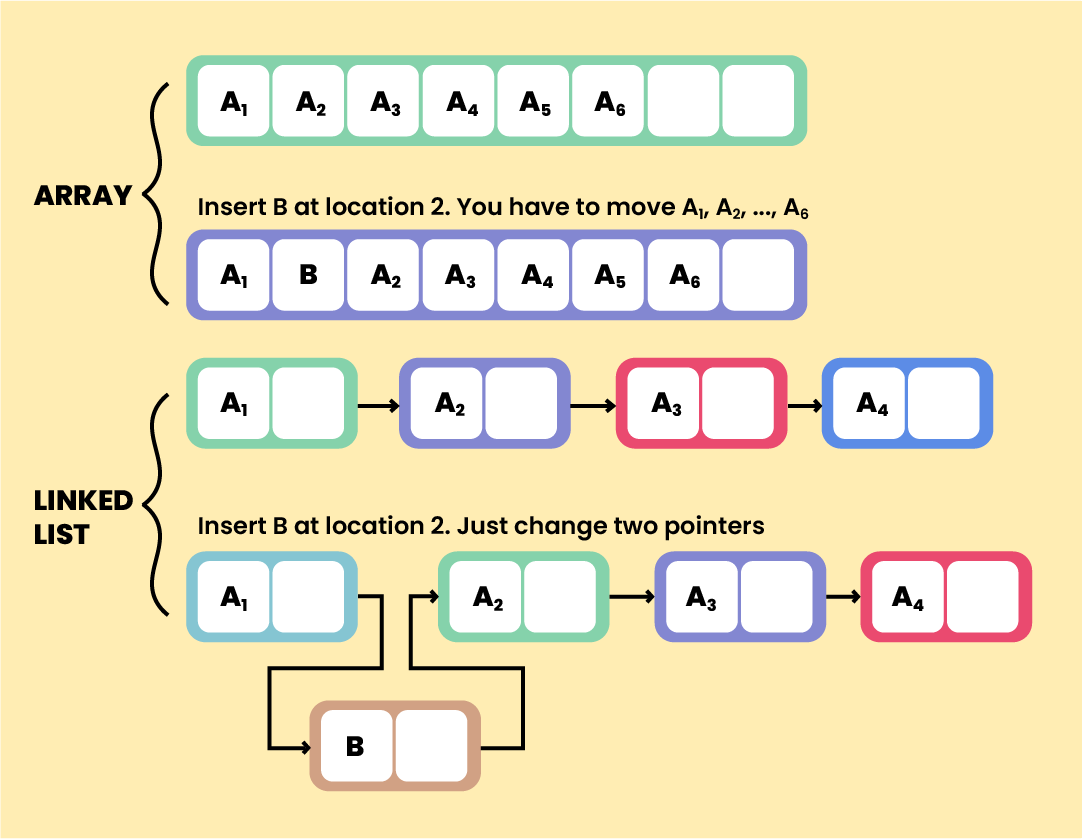
- Beginning or Middle: Shifting
nelements takes time. This is a slow operation for large lists. - End:
- Adding to the end (
append) is amortized . It's usually constant time because a Python list reserves extra space. Occasionally, when that space runs out, the list must be resized—a new, larger array is allocated, and all elements are copied over. This is an operation, but it happens so rarely that the average cost is considered . - Removing from the end (
popwith no index) is because no shifting is required.
- Adding to the end (
In a Linked List:
Insertion and deletion only require updating a few next pointers. The main cost comes from finding the correct position.
- Beginning: This is . As we saw in the last lesson, you just create a new node and update the
headpointer. No traversal is needed. - End or Middle: This is . Although the final pointer update is , you first have to traverse the list to find the insertion or deletion point. For our singly linked list, even deleting the last element requires traversing to the second-to-last element, which is an operation.
Let's watch another segment of the mycodeschool video that covers this.
Data Structures: Arrays vs Linked Lists
This next segment compares the cost of insertion for both data structures.
Watch from 08:25 to 11:16. The video explains the three cases for insertion: at the beginning, at the end, and in the middle.
The Verdict: Linked lists excel at fast insertions and deletions at the beginning. For operations at the end, dynamic arrays are typically faster. For middle operations, both are , but for different reasons (shifting vs. traversing).
3. Putting It All Together: A Comprehensive Review
You now have the tools to analyze the core trade-offs. The following reading ties everything together, including memory usage and practical considerations like CPU caching—a great point to bring up in an interview to show deeper knowledge.
Arrays vs Linked Lists – What You Actually Need to Know for ...
Let's return to the Design Gurus article. It provides a fantastic summary of all the performance differences and is great preparation for an interview.
Please read the following sections: 'Arrays vs Linked Lists: Key Differences in Performance and Usage' 'When to Use Which (and Why)' 'Know the Common Operations and Their Complexities' Focus on the 'Interview Takeaway' boxes and the final summary table of complexities. This reading directly reinforces everything we've discussed.
Summary Table of Time Complexities
Here is a summary table that you should aim to internalize. It's the kind of knowledge interviewers expect you to have at your fingertips.
| Operation | Python list (Dynamic Array) |
Singly Linked List | Key Reason |
|---|---|---|---|
Access by Index (list[i]) |
Contiguous memory vs. Traversal | ||
| Search by Value | Both require linear scan | ||
| Insert/Delete at Beginning | Shifting vs. Head pointer update | ||
Insert at End (append) |
Amortized | * | Direct access vs. Traversal |
Delete at End (pop) |
Direct access vs. Traversal | ||
| Insert/Delete in Middle | Shifting vs. Traversal |
*Note: A linked list's end-insertion can be made if we maintain a separate pointer to the tail node. Our current implementation does not do this.
Conclusion
Congratulations on completing this crucial lesson! You can now analyze and articulate the performance differences between two of the most fundamental data structures in computer science.
Key Takeaways:
- Arrays (Python lists) are great for fast, indexed access (). Their weakness is the cost of inserting or deleting elements anywhere other than the end, which requires shifting ().
- Linked Lists excel at insertion and deletion at the beginning (). Their weakness is slow indexed access () because they must be traversed sequentially.
- The choice between them is a classic engineering trade-off: it depends on the problem. If you need to access elements by index frequently, use an array. If you need to constantly add and remove from the front, a linked list is a better choice.
Preview of the Next Lesson:
So far, we have structures that give us fast indexing (arrays) and others that give us fast insertions/deletions at the head (linked lists). But what if we want fast lookups, insertions, and deletions all at the same time? In the next module, we will explore Hash Tables, the brilliant data structure that powers Python's dictionaries. You'll learn how they use a "hash function" to achieve average performance for all three operations, making them one of the most useful tools in a programmer's toolkit.