Hello! Welcome to the final lesson of the module, Active Trade and Risk Management.
In our last few lessons, we've built a solid foundation for managing risk on a trade-by-trade basis. You've learned to define your risk tolerance, set stop-loss orders to protect your capital, and calculate the precise position size for every trade. These are the skills that protect you from single, catastrophic losses.
Today, we're going to zoom out from the individual trade to look at the bigger picture: your entire portfolio. The goal of this lesson is to explain the concept of portfolio diversification to reduce overall risk. This is the classic wisdom of "not putting all your eggs in one basket," applied to the world of cryptocurrency.
By the end of this lesson, you'll understand why holding a mix of different crypto assets is a crucial risk management strategy and you'll know the core principles for building a diversified portfolio.
What is Portfolio Diversification?
At its core, diversification is the practice of spreading your investments across various assets. The aim is not to eliminate risk entirely—that's impossible in any market, especially crypto—but to manage it. If one of your investments performs poorly, a diversified portfolio ensures that the negative impact is cushioned by the performance of your other assets.
Given your interest in driving traffic to a business, you can think of it like this: a smart online business doesn't rely on a single source of traffic, like Google search alone. They diversify with social media, paid ads, and email marketing. If a Google algorithm update hurts their search rankings, the other channels can keep the business afloat. Portfolio diversification applies the same logic to your capital.
To get a formal introduction to this concept, let's watch a short video clip.
How to Diversify Your CRYPTO Portfolio - 5 Ways to Reduce Volatility in Altcoins and Profit MORE
The video 'How to Diversify Your CRYPTO Portfolio' offers a concise definition of diversification and explains its importance using the 2018 crypto market crash as a powerful example.
Watch the section from 00:42 to 01:40. Pay attention to how the speaker defines diversification and the core reason for doing it.
The Core Principles: Why Diversification Works
The video gave us the basic "what" and "why." Now, let's dig into the principles that make diversification an effective strategy.
How to Diversify Your Crypto Portfolio
The article 'How to Diversify Your Crypto Portfolio' from Zignaly provides an excellent breakdown of the foundational concepts behind diversification. It explains the 'why' in greater detail.
Read the first section of the article, under the heading 'Why Diversify Crypto Portfolio: Understanding the Core Concepts'. Focus on the three key terms: Smart Risk Management, Strategic Asset Allocation, and Low Correlation.
As the article highlights, the key is low correlation. If you own ten different cryptocurrencies, but they all rise and fall in perfect sync with Bitcoin, you aren't truly diversified. The goal is to find a mix of assets that react differently to market events, providing a buffer against volatility.
Practical Strategies for Crypto Diversification
So, how do you actually build a diversified crypto portfolio? It's more than just buying a random collection of coins. A good strategy involves diversifying across several layers.
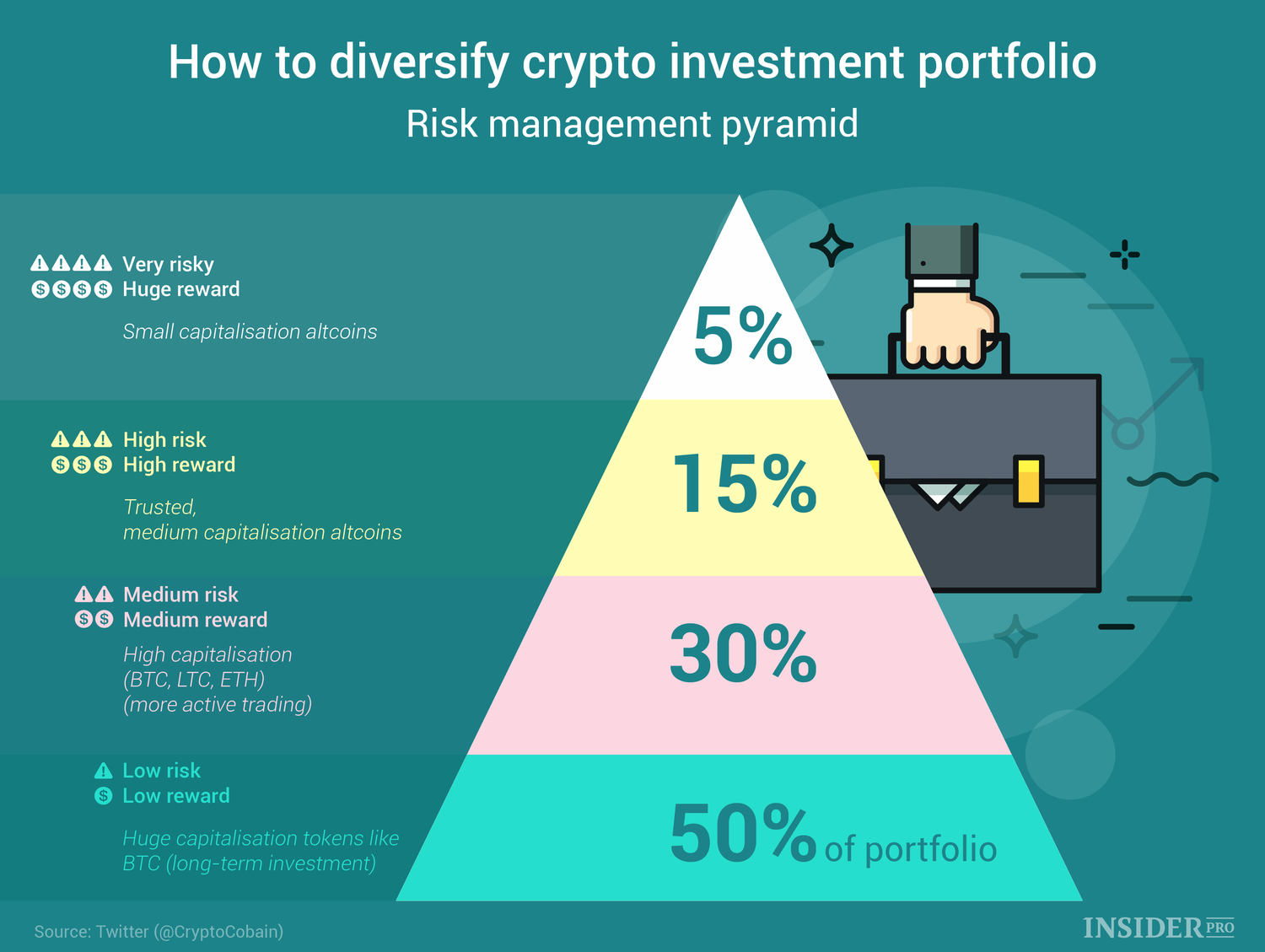
Strategy 1: Allocate Across Cryptocurrency Tiers
The most common starting point is to diversify by market capitalization (market cap). Think of it like building a team: you need reliable stars, solid role-players, and a few high-potential rookies.
- Large-Cap (The Stars): Bitcoin (BTC) and Ethereum (ETH). These are the most established, liquid, and relatively stable assets in the crypto market. They form the foundation of a portfolio.
- Mid-Cap (The Role-Players): Established projects with proven use cases but smaller market caps than BTC and ETH. They offer a balance of higher growth potential and credibility.
- Small-Cap (The Rookies): New, innovative, and often highly speculative projects. This is where you might find a 100x return, but it's also where the risk of losing your entire investment is highest.
This pyramid illustrates the concept perfectly, allocating a larger portion of your portfolio to lower-risk assets and a much smaller portion to the highest-risk ones.
Strategy 2: Diversify Across Sectors and Use Cases
Just as you wouldn't invest only in tech stocks, you shouldn't invest only in one type of crypto. Different cryptocurrencies are designed for different purposes. Spreading your investments across these sectors provides another layer of diversification. Key sectors include:
- Infrastructure: Layer 1 blockchains (e.g., Ethereum, Solana) and Layer 2 scaling solutions (e.g., Polygon, Arbitrum).
- Applications: Decentralized Finance (DeFi) platforms (e.g., Uniswap, Aave) and GameFi/Metaverse projects (e.g., The Sandbox).
- Stablecoins: A crucial, but often overlooked, category for managing risk.
Strategy 3: Include Stablecoins as a Defensive Anchor
This brings us to a vital component of a diversified portfolio: stablecoins (e.g., USDT, USDC). Their value is pegged to a stable asset like the US dollar.
Why hold something that doesn't go up in price? Because it also doesn't go down. Stablecoins act as your portfolio's defense. During a market crash, having a portion of your capital in stablecoins protects it from losses and gives you the "dry powder" to buy assets at a discount.
To see how these strategies come together, let's return to the Zignaly article.
How to Diversify Your Crypto Portfolio
This article explains these three core strategies in a very clear and practical way.
Read the sections titled 'Strategy 1: Allocate Across Cryptocurrency Tiers', 'Strategy 2: Diversify Across Digital Asset Categories', and 'Strategy 3: Include Stablecoins for Risk Management'. This will solidify your understanding of these practical steps.
Sample Portfolios: Putting Theory into Practice
To make this concrete, let's look at how these strategies can be combined to create portfolios for different risk tolerances.
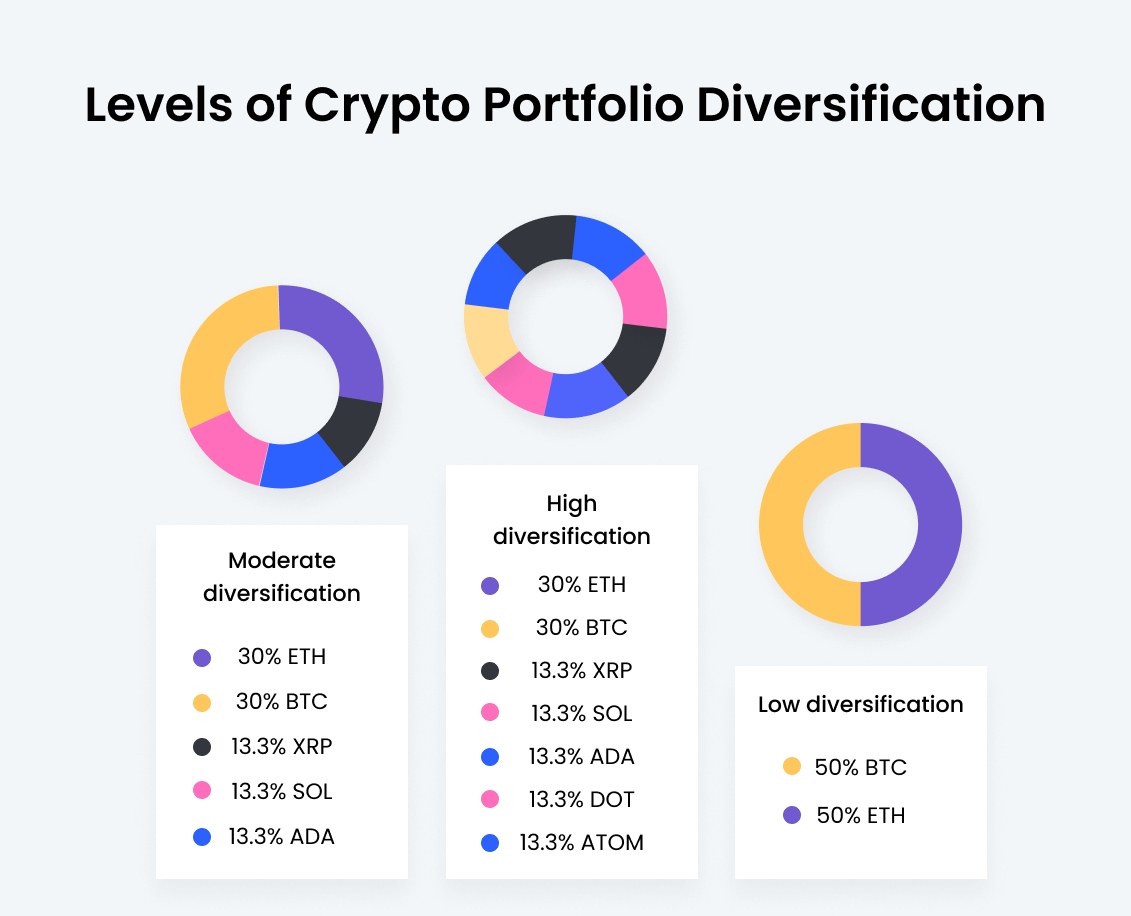
The article you've been reading provides excellent examples of what these allocations can look like in practice.
How to Diversify Your Crypto Portfolio
Let's review some sample portfolios. Seeing concrete percentage allocations makes the theory much easier to grasp.
Read the section 'Sample Diversified Portfolios - A Practical Look'. Notice how the allocation to BTC/ETH decreases and the allocation to Mid/Small-Caps increases as the portfolio becomes more 'Aggressive'.
Managing Your Portfolio: Common Mistakes to Avoid
Diversification isn't a one-time task. A portfolio needs to be managed. As the market moves, your initial allocations will drift. For example, a mid-cap coin might surge in price and grow to represent a much larger percentage of your portfolio than you originally intended, making you over-exposed to that single asset.
This is why active management is key. This involves rebalancing—periodically selling assets that have become overweight and buying assets that are underweight to return to your target allocation. It's a disciplined way to take profits and reinvest in cheaper assets.
Let's look at this and other common mistakes to avoid.
How to Diversify Your Crypto Portfolio
To wrap up, let's cover the most common pitfalls beginners face when trying to diversify.
Read the final two sections, 'How a Smart Investor Manages His Portfolio' and 'What are the Common Mistakes to Avoid When Diversifying Your Crypto Portfolio'. Pay close attention to the concepts of 'rebalancing' and 'diworsification'.
Conclusion
You have now completed the Active Trade and Risk Management module. You started by learning to manage risk on a single trade and have now expanded that knowledge to manage risk across your entire investment portfolio.
Key Takeaways:
- Portfolio diversification is about spreading investments across different assets to reduce the impact of any single asset performing poorly.
- The goal is to manage risk by holding assets with low correlation—assets that don't all move in the same direction at the same time.
- Effective diversification strategies include allocating across market-cap tiers (large, mid, small), different sectors (DeFi, GameFi), and including stablecoins for defense.
- Diversification is not a "set-and-forget" strategy. It requires periodic rebalancing to maintain your target allocations.
- Avoid "diworsification"—owning dozens of random, low-quality assets is riskier than owning a few well-researched ones.
What's Next?
So far, we've covered the theory of risk management and portfolio construction. In our next module, Managing Your Binance Portfolio, we will get practical. The very first lesson will be "Check your total portfolio balance and individual asset allocation." You'll learn how to navigate the Binance interface to see exactly how your capital is distributed, connecting the portfolio theory you learned today to the real-world tools on the platform.