Welcome to your first lesson in the Day Trading course! We're starting at the very beginning to build a solid foundation for your trading journey. This lesson will demystify the world of financial markets. We'll explore their fundamental purpose within the broader economy and identify the various actors who participate in them. Understanding this landscape—the "why" and the "who"—is the essential first step before you can learn the "how" of trading.
By the end of this lesson, you will be able to explain the role of financial markets in the economy and identify their key participants. This will give you the context needed to understand everything that follows, from how prices are formed to the function of the brokers and exchanges you will use.
The Purpose of Financial Markets: More Than Just Trading
At its core, a financial market isn't just a place to buy and sell assets. It's a complex and vital system for allocating capital efficiently. Think of it as a vast network that connects those with surplus funds who want to grow their money (lenders or investors) with those who need funds to create value (borrowers, such as businesses or governments). Your background in physics gives you an appreciation for complex systems, and financial markets are a fascinating example of a large-scale system driven by human behavior and economic principles.
To get a clear picture of this dynamic, let's start with a short video that provides an excellent high-level overview.
Money and Finance: Crash Course Economics #11
This video from CrashCourse's Economics series does a fantastic job of explaining the fundamental concept of the financial system by framing it as the meeting point for lenders and borrowers.
Please watch the segment from the beginning of the main explanation. Pay close attention to the distinction between the two main groups (lenders and borrowers) and the three primary ways they are connected: through banks, the bond market (debt), and the stock market (equity).
As the video explains, the financial system facilitates the flow of capital from savers to borrowers. This process is crucial for economic growth. Businesses can't expand, new products can't be invented, and infrastructure can't be built without access to capital. Financial markets provide the mechanisms for this to happen.
We can break down this broad economic role into several key functions, as illustrated in the infographic below.

Let's focus on a few of these functions that are most relevant to a trader:
- Capital Formation & Funds Mobilization: This is the core function we've been discussing. Markets gather savings from a wide pool of investors and channel them to companies that can use the money to grow, hire, and innovate.
- Liquidity: This refers to the ease with which an asset can be bought or sold without significantly affecting its price. High liquidity is essential for day traders, as it allows for quick entry and exit from positions. Markets provide a ready and willing pool of buyers and sellers, ensuring assets can be converted to cash when needed.
- Price Discovery: How much is a share of a particular company worth? Financial markets answer this question continuously. The price of an asset at any given moment is determined by the interaction of all its buyers and sellers. As a trader, your entire job will revolve around analyzing and predicting these price movements. We will dedicate our entire next lesson to this crucial topic.
- Risk Sharing: Markets allow risk to be distributed. An investor can spread their capital across many different assets (diversification) rather than betting it all on one venture. Corporations can also use markets to hedge against various business risks.
The Players in the Game: Market Participants
Now that we understand why financial markets exist, let's look at who participates in them. The market is an ecosystem of different entities, each with a specific role. A clear understanding of these players is crucial, as you will be interacting with or influenced by all of them.
This short video provides a simple, five-part framework for categorizing the participants.
Stock Market vs Stock Exchange - Saheb Academy
In this video, Saheb Academy breaks down the stock market ecosystem into five key groups. This gives us a useful structure for our discussion.
Watch the section from the main breakdown, which introduces the five major participants: the regulator, stock exchanges, companies, investors/traders, and market intermediaries.
Let's expand on that framework, adding detail from the perspective of an aspiring Indian trader.
1. The Regulator
Every organized system needs rules and a referee. In financial markets, this role is played by regulators. Their primary job is to ensure markets are fair, transparent, and stable. They protect investors from fraud and manipulation. Given your interest in Indian equities, the most important regulator for you to know is the Securities and Exchange Board of India (SEBI).
2. Companies (Issuers)
These are the entities that come to the market to raise capital. They do this by issuing securities. The two main types are:
- Stocks (Equities): When you buy a stock, you are buying a small piece of ownership in the company.
- Bonds (Debt): When you buy a bond, you are essentially lending money to the company in exchange for regular interest payments and the return of your principal at a later date.
As a day trader, you'll primarily be focused on trading stocks in the secondary market (i.e., trading shares that have already been issued).
3. Investors and Traders
This is the category you will fall into. While often used interchangeably, there's a key distinction:
- Investors typically buy assets with a long-term horizon, aiming to benefit from the company's growth over years.
- Traders (like day traders) seek to profit from short-term price fluctuations, often holding positions for only minutes or hours.
Both investors and traders can be further divided into two groups:
- Retail Participants: Individuals like you and me who are trading with our own capital.
- Institutional Participants: Large organizations that trade on a massive scale, such as mutual funds, pension funds, insurance companies, and Foreign Institutional Investors (FIIs). The actions of these large players can significantly influence market movements.
4. Market Intermediaries: The "Plumbing" of the Market
This is a broad category for the entities that facilitate the entire process of trading, making sure everything runs smoothly. They are the essential "plumbing" that connects all the other participants. For a trader in India, the most important intermediaries are the Stock Exchanges, Brokers, and Depositories.
The following reading from Zerodha Varsity, a highly-regarded Indian educational resource, provides an excellent breakdown of these entities.
Regulators and Market Participants in the Stock Market - Zerodha
This chapter from Zerodha's educational platform details the various participants in the Indian stock market, explaining the role of the regulator and the key intermediaries that make trading possible.
Start by reading the section Market Participants and the need to regulate them to understand why a referee is needed. Then, read about The Regulator to learn about SEBI's specific objectives. Finally, carefully study the table of market entities. As you read the table, focus specifically on the functions of Stock Brokers, Depositories, and Depository Participants (DPs), as these are the entities you will interact with directly when you open a trading account.
To help you visualize how these Indian market intermediaries connect, look at the following chart. It shows the flow of actions and information from the investor to the exchange and back.
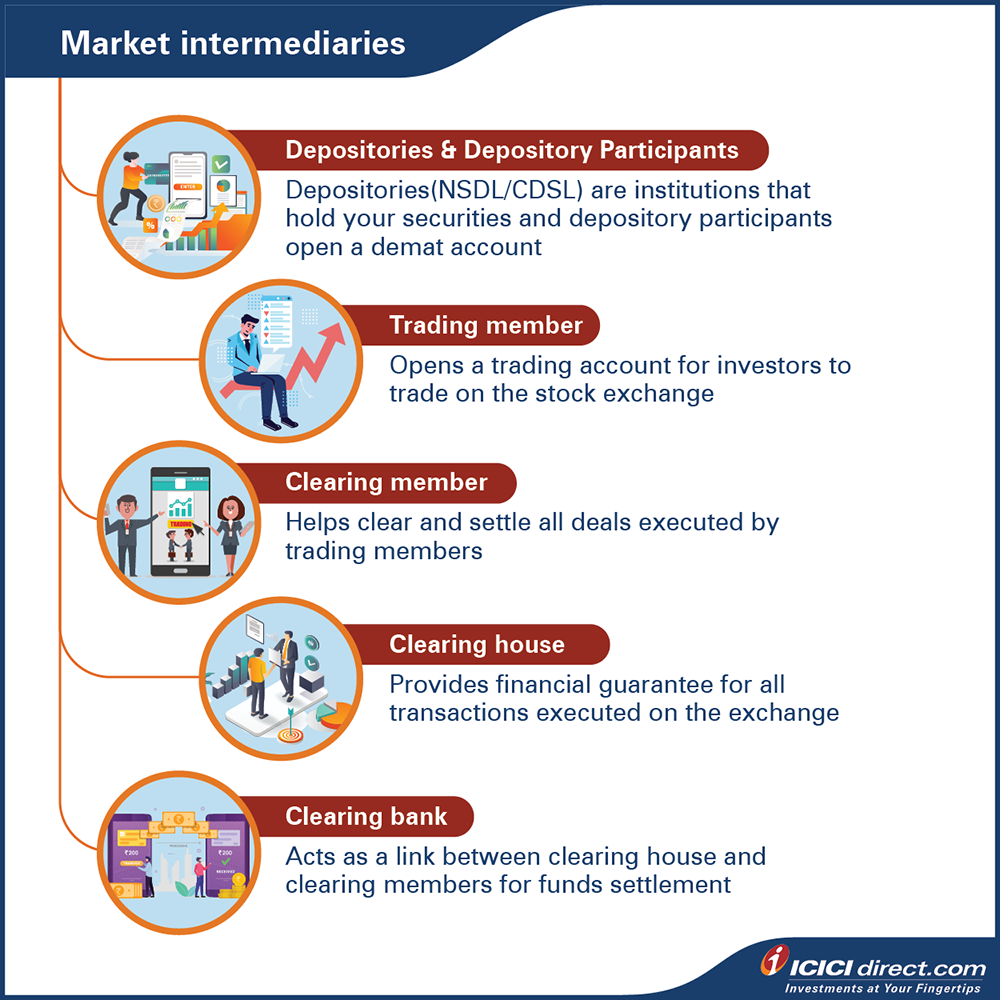
Here's a simple narrative to tie it all together:
- You, the trader, decide to buy shares of a company.
- You place your order through a Stock Broker (like Zerodha or ICICI Direct).
- The broker sends your order to the Stock Exchange (like the NSE or BSE), where it is matched with a seller's order.
- Once the trade is executed, the Clearing House guarantees the transaction, ensuring the seller gets their money and you get your shares.
- The shares are then electronically credited to your Demat account, which is held by a Depository (NSDL or CDSL) through your Depository Participant (DP).
- The whole process is overseen by the regulator, SEBI.
Finally, let's consolidate this knowledge with one more comprehensive reading from Investopedia. It will serve as a great review of all the concepts we've covered.
Financial Markets: Role in the Economy, Importance, Types ...
This article provides a broad summary of the role of financial markets and their participants, reinforcing the key ideas of this lesson.
First, read the section Understanding the Financial Markets to review the market's primary functions. Then, skip to the end and read the concluding section, which does an excellent job of summarizing the various types of participants and their motivations.
Conclusion
In this foundational lesson, we've established two critical points. First, financial markets are not merely abstract casinos; they are fundamental engines of economic growth that perform vital functions like capital formation, providing liquidity, and enabling risk sharing. Second, the market is a dynamic ecosystem composed of regulators who set the rules, companies who seek capital, investors and traders who provide it, and a host of intermediaries who ensure the system operates efficiently.
As a day trader, you are entering this ecosystem as an active participant. Your success will depend not just on reading charts, but on understanding the structure of the market you are trading in and the roles of the other players around you.
In our next lesson, we will dive into the core mechanism of Price Discovery. We'll explore how the fundamental economic forces of supply and demand interact to set the prices you see on your screen, which forms the very basis of technical analysis.