Welcome back. The previous lesson estimated how much water evaporates when a known share of a heat load is rejected through evaporation. That calculation describes one operating mode; a real cooling system may use different modes as outdoor conditions change. In about 40 minutes, you will use temperature, electricity-demand, and water-demand data to choose among dry, evaporative, and hybrid heat rejection for a specified site.
What the three options actually change
The choice here concerns how heat is rejected outdoors, not necessarily how heat is collected from servers. A facility can circulate water through indoor equipment and still reject heat outdoors without evaporating water. Conversely, a cooling tower can evaporate water even when the IT racks themselves are air-cooled.
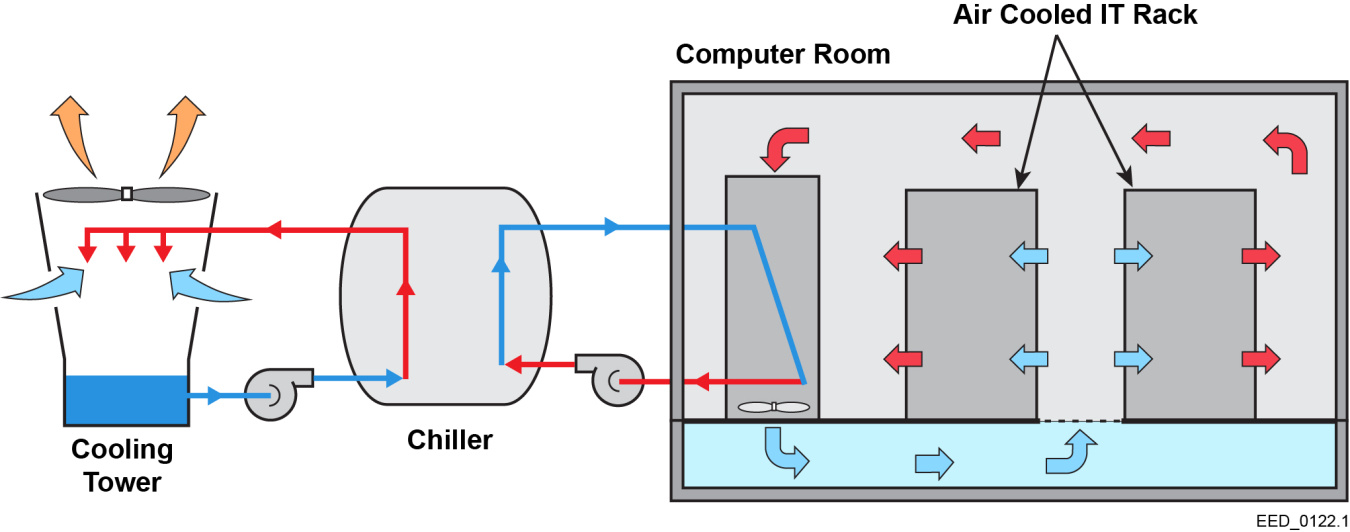
In a dry system, fans move outdoor air across a heat exchanger or condenser. The operating cooling system may use little or no water for heat rejection, but its electricity demand can rise when outdoor air is hot. If dry heat rejection alone cannot provide sufficiently cool fluid, a design may need compressor-assisted cooling.
An evaporative system uses water’s phase change to help reject heat. It may reduce electricity demand under suitable conditions, but it needs replacement water for evaporation and other tower losses. A hybrid system has both dry and evaporative capability: it can use dry rejection when outdoor conditions permit and bring in evaporative rejection when needed. Hybrid describes the outdoor operating options here; it does not mean that the IT equipment must be partly air-cooled and partly liquid-cooled.
Watch MEP Academy’s Air Cooled vs WaterCooled Data Centers for the basic comparison. Treat its efficiency statements as tendencies to test against site data, not guarantees.
Air Cooled vs WaterCooled Data Centers
MEP Academy’s comparison distinguishes outdoor air rejection from cooling-tower rejection and identifies the main water–electricity tradeoff.
Watch air cooling for how a system can contain chilled water indoors yet reject heat dry outdoors. Then watch selection factors for the climate tradeoff and the clarification that “air-cooled” does not mean air is the only fluid anywhere in the facility.
The Best Practices Guide for Energy-Efficient Data Center Design adds an important qualification: equipment selection must account for changing loads, and dry-cooler performance depends on outdoor temperature. Read the short comparison rather than assuming either design has one fixed electricity demand.
Best Practices Guide for Energy-Efficient Data Center Design
Read the U.S. Department of Energy guide’s comparison of air-cooled condensers, dry coolers, and cooling towers to see why the site and equipment configuration matter.
In Section 5, “Cooling Systems,” subsection 5.1, “Direct Expansion Systems” (around printed pp. 14–15), begin at the opening paragraph about considering initial, future, and part-load conditions. Read the comparison through the sentence introducing the cooling tower, just before the discussion of a larger open-loop tower and separate heat exchanger. Focus on what depends on ambient air temperature and what changes when evaporative rejection is added.
Temperature is a feasibility test, not just a climate label
A dry heat exchanger rejects heat to outdoor air, so outdoor dry-bulb temperature is a key constraint. Evaporative equipment is also affected by the air’s moisture content; outdoor wet-bulb temperature helps indicate its evaporative cooling potential. Neither temperature alone gives a complete equipment design. Heat-exchanger sizing, airflow, required coolant temperature, and any compressor assistance matter too.
Consider an illustrative site that needs coolant at no warmer than . For a first screening, suppose the proposed dry and evaporative outdoor units each deliver coolant approximately above their respective outdoor-air reference temperatures:
| Site condition | Hours per year | Dry-bulb | Wet-bulb | Screened dry outlet | Screened evaporative outlet |
|---|---|---|---|---|---|
| Mild | 6,000 | ||||
| Hot | 2,760 |
These are supplied screening assumptions, not universal performance rules. Both units pass the screen in mild hours. During hot hours, the dry unit alone does not; the proposed dry option would need the specified compressor assistance to meet the coolant requirement. The proposed evaporative unit passes the screening test in both periods. A hot and humid period with a higher wet-bulb temperature could change that result.
The Department of Energy describes a real hybrid arrangement that switches between air-cooled and tower-based rejection, or uses them together. Read its operating description for the principle, without treating that installation’s reported performance as a prediction for this illustrative site.
Cooling Water Efficiency Opportunities for Federal Data Centers | Department of Energy
Read the Department of Energy page’s account of hybrid heat rejection to see how a facility can change modes with outdoor conditions.
Near the end of the page, after “Low-Cost/No-Cost Water-Saving Opportunities at Existing Data Centers” and the discussion beginning “Direct liquid cooling systems,” find the paragraph beginning “These systems integrate direct liquid cooling.” Read the hybrid description through the following paragraph on control and maintenance, stopping before “Quick Links.” Focus on when the system uses its tower and why dependable switchover matters.
Make the site decision with matched operating data
Now suppose an engineering comparison supplies the following illustrative operating demands. All three designs meet the coolant requirement in both periods; the dry design uses compressor assistance during hot hours. Electricity is cooling-system electricity for fans, pumps, compressors, and associated controls, not total facility or IT electricity. Water is cooling-system makeup supplied onsite, including replacement for evaporation and any other tower losses.
| Outdoor rejection option | Mild hours: electricity | Mild hours: makeup | Hot hours: electricity | Hot hours: makeup |
|---|---|---|---|---|
| Dry, with hot-hour compressor assistance | ||||
| Evaporative throughout | ||||
| Hybrid: dry in mild hours, evaporative in hot hours |
A kilowatt is a demand at a time; kilowatt-hours measure energy over time. Likewise, liters per hour become a volume only after multiplication by operating hours. For the hybrid, annual cooling electricity is:
Its annual cooling makeup is:
Applying the same period-by-period calculation gives:
| Option | Annual cooling electricity | Annual cooling makeup |
|---|---|---|
| Dry with assistance | ||
| Evaporative throughout | ||
| Hybrid |
Suppose this site has two operating limits: no more than of annual cooling electricity and no more than of annual cooling makeup. On the supplied data, the hybrid is the only option meeting both. Dry meets the water limit but exceeds the electricity limit; continuous evaporative operation exceeds both.
That is a conditional selection, not a ranking of technologies everywhere. The hybrid avoids evaporation during the 6,000 mild hours and avoids the dry design’s high hot-hour compressor demand. If the site required zero operational makeup water, the dry option would be the water-compliant one, but its electricity use would require a changed budget or redesigned system. If a hybrid’s switching equipment were unavailable or unreliable, its calculated advantage would not establish that it meets the site’s cooling requirement in practice.
Finally, keep the water label intact: the table reports makeup supplied, not necessarily water consumed. Some makeup replaces evaporated water; some may replace blowdown that is discharged. A consumption claim needs the discharge and return boundary established separately. Nor does zero cooling makeup mean zero water associated with the facility or with generating its electricity.
Key takeaways
Select a cooling option in three passes: verify that it can meet the required temperature in each outdoor condition; multiply its electricity and water rates by the hours in those conditions; then compare the resulting totals with the site’s constraints. Dry, evaporative, and hybrid designs trade water demand, electricity demand, and operational complexity differently as conditions change. Site-specific numbers—not a generic claim that one type is always more efficient—determine the defensible choice.
This completes the cooling-design module. The next module makes the accounting boundary explicit, so that onsite cooling water and water associated with electricity can be compared without mixing withdrawals, consumption, or reporting periods.