Hello! Welcome to our next lesson on kinematic constraints.
In our previous session, we developed systematic methods to handle constraints imposed by inextensible strings in pulley systems. We saw that the core idea was to translate a physical principle—the constant length of a string—into a mathematical equation that could be differentiated to find relationships between velocities and accelerations.
Today, we shift our focus to a different but equally fundamental type of constraint: rolling without slipping. This phenomenon is central to the motion of wheels, gears, and any object rolling on a surface. Our learning outcome is to derive the kinematic constraint relation for rolling without slipping using the concept of relative velocity at the point of contact. This derivation is a beautiful application of vector kinematics and forms a crucial link between translational and rotational motion.
1. Decomposing Rolling Motion
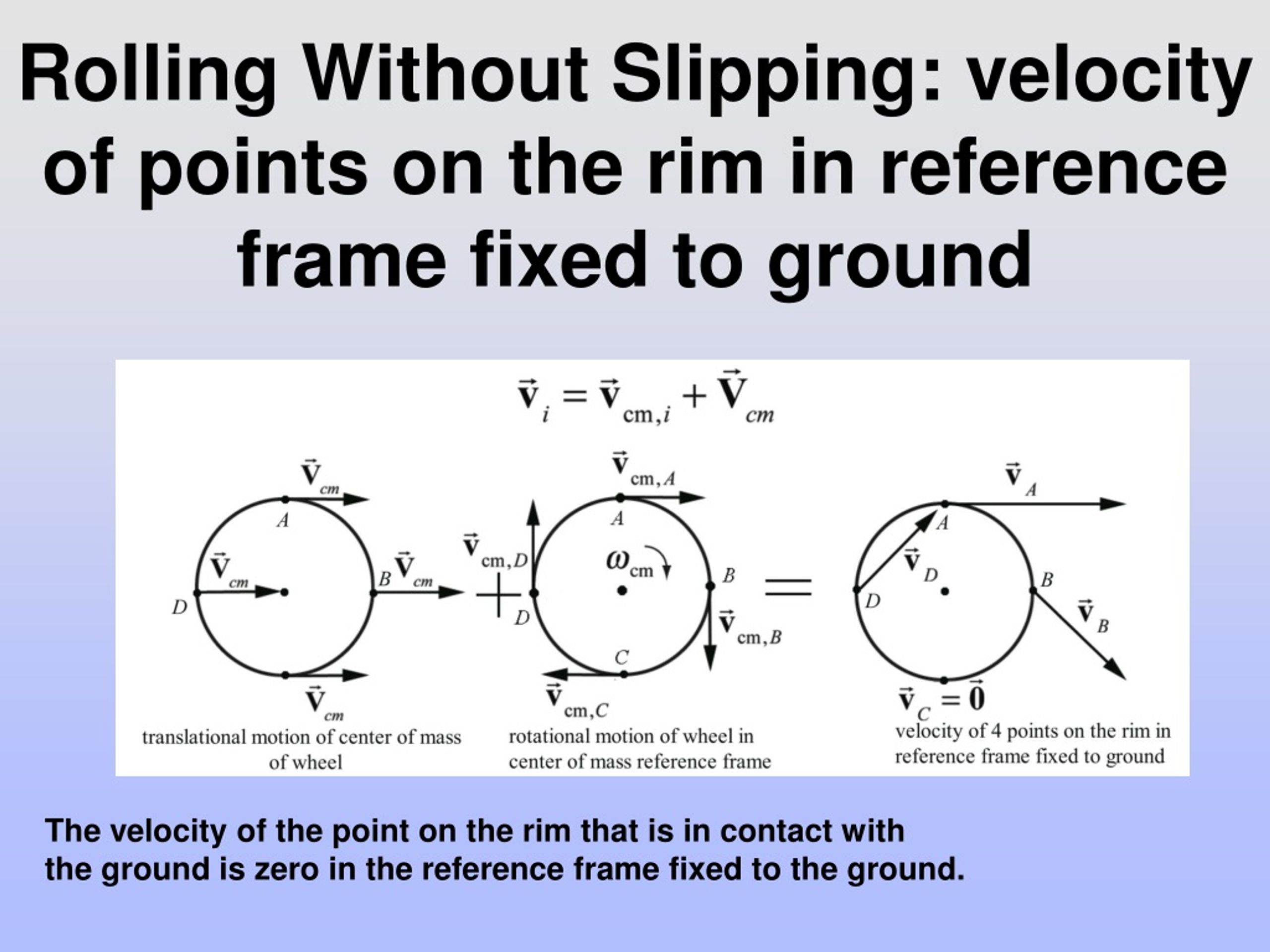
At its core, rolling motion is a superposition of two simpler motions: the translation of the body's center of mass and the rotation of the body about its center of mass.
To understand this combination, let's first watch a short video that clearly illustrates this principle.
Class 11 Physics | Rigid Body Dynamics | #31 Pure Rolling of a body on Inclined Plane | JEE & NEET
The video 'Class 11 Physics | Rigid Body Dynamics | #31 Pure Rolling' by Physics Galaxy provides an excellent conceptual breakdown. It visually separates rolling into its translational and rotational components and then combines them to find the velocity of various points on the rolling object.
Please watch the first 4 minutes and 23 seconds. Pay close attention to how the velocity of any point on the rolling body is the vector sum of the translational velocity of the center (v_c) and the tangential velocity due to rotation (r*omega_c).
As the video explained, if a body's center of mass (CM) moves with velocity and the body rotates with angular velocity about the CM, the velocity of any point P on the body is given by the vector sum:
Here, is the velocity of point P relative to the center of mass. For a rigid body, this is purely rotational. If is the position vector from the CM to point P, this relative velocity is given by the cross product:
Therefore, the general equation for the velocity of any point on a rolling body is:
This equation is our fundamental tool for the derivation to come.
2. The Condition of "Rolling Without Slipping"
The phrase "rolling without slipping" is a precise physical statement about the nature of the contact between the rolling body and the surface.
- Slipping occurs when the body's contact point slides along the surface. This means there is relative motion between the body and the surface at the point of contact.
- No Slipping means that at the instant of contact, the point on the body touching the surface has the exact same velocity as the point on the surface it is touching.
Let's call the contact point on the body and the contact point on the surface . The no-slip condition is mathematically stated as:
The most common case, which we will analyze first, is rolling on a stationary surface. In this case, , and the no-slip condition simplifies to:
This is a profound statement: for a body rolling without slipping on the ground, the very bottom point of the body is instantaneously at rest.
3. Deriving the Kinematic Constraint
Now, we will use this no-slip condition to derive the relationship between the linear velocity of the center of mass, , and the angular velocity, . The following resource provides a rigorous vector-based derivation.
The webpage 'Rolling motion' from the University of Illinois provides a concise and mathematically rigorous derivation of the rolling without slipping constraints. We will focus on the derivation for a flat surface.
Please read the introduction and the section 'Rolling on a 2D flat surface'. Focus on the vector derivation under the heading 'Center velocity and acceleration while rolling on a flat surface' which starts with the condition that the contact point has zero velocity.
Let's walk through the derivation together, formalizing the steps.
Consider a wheel of radius rolling on a flat, stationary horizontal surface. We'll set up a coordinate system where the x-axis is the ground, the y-axis is vertical, and the wheel rolls in the positive x-direction.
- Translational Velocity:
- Angular Velocity: For the wheel to roll forward, it must rotate clockwise. By the right-hand rule, this corresponds to an angular velocity vector pointing into the page, along the negative z-axis. So, .
- Position of Contact Point (P) relative to CM: The contact point P is directly below the CM. So, .
Now, we calculate the velocity of the contact point P using our general formula:
Substituting our vectors:
Recalling the cyclic property of cross products ():
Now, we apply the no-slip condition for a stationary surface, :
This gives us the fundamental scalar relationship for rolling without slipping:
The Acceleration Constraint
To find the relationship between the linear acceleration of the center of mass, , and the angular acceleration, , we can simply differentiate the velocity constraint with respect to time (assuming rolling on a flat surface where R is constant):
Which gives us the acceleration constraint:
Note: This simple differentiation works for a flat surface. For a body rolling on a curved surface, the relationship is more complex as the direction of the normal vector changes.
4. A Deeper Dive: Acceleration of the Contact Point
A common misconception is that if the contact point's velocity is zero, its acceleration must also be zero. This is incorrect. Let's calculate the acceleration of point P, , to see why. The general formula for acceleration of a point on a rigid body is:
The last term is the centripetal acceleration of P about the CM. Let's compute each term:
- is the centripetal part. We already found . So:
Summing the terms:
The acceleration of the contact point is not zero. It is directed vertically upwards towards the center of the wheel with magnitude (or ). This makes sense: the point comes to rest, and then immediately accelerates upwards to rejoin the rest of the wheel. The resource Rolling motion also shows this derivation in its section "Contact point P velocity and acceleration while rolling on a flat surface".
5. Alternative Viewpoint: The Instantaneous Axis of Rotation (IAOR)
Your preference for deep, mathematical understanding makes this next concept particularly relevant. Since the point of contact P is instantaneously at rest, the entire motion of the body at that instant can be described as a pure rotation about P. This point P is called the Instantaneous Axis of Rotation (IAOR).
This provides a more elegant way to see the relationship.
The handout 'Mechanics V: 2D Rotation' from the Physics Olympiad materials by Kevin Zhou formalizes this dual perspective. It's a high-level resource that you should find stimulating.
Read 'Example 1' on the second page. It explicitly shows how the velocity field of a rolling disc can be described either as translation + rotation about the CM, or as pure rotation about the origin (the contact point).
From the IAOR perspective, the velocity of the center of mass is simply its rotational velocity about the point P.
- The vector from the IAOR (P) to the CM is .
- The velocity of the CM is .
- .
The magnitude is . This derivation is faster and provides a powerful conceptual shortcut for analyzing rolling motion.
Test your understanding!
Consider the system shown in the diagram below. A cylinder of radius rolls without slipping between a block A, which moves to the right with a constant velocity , and the stationary ground.
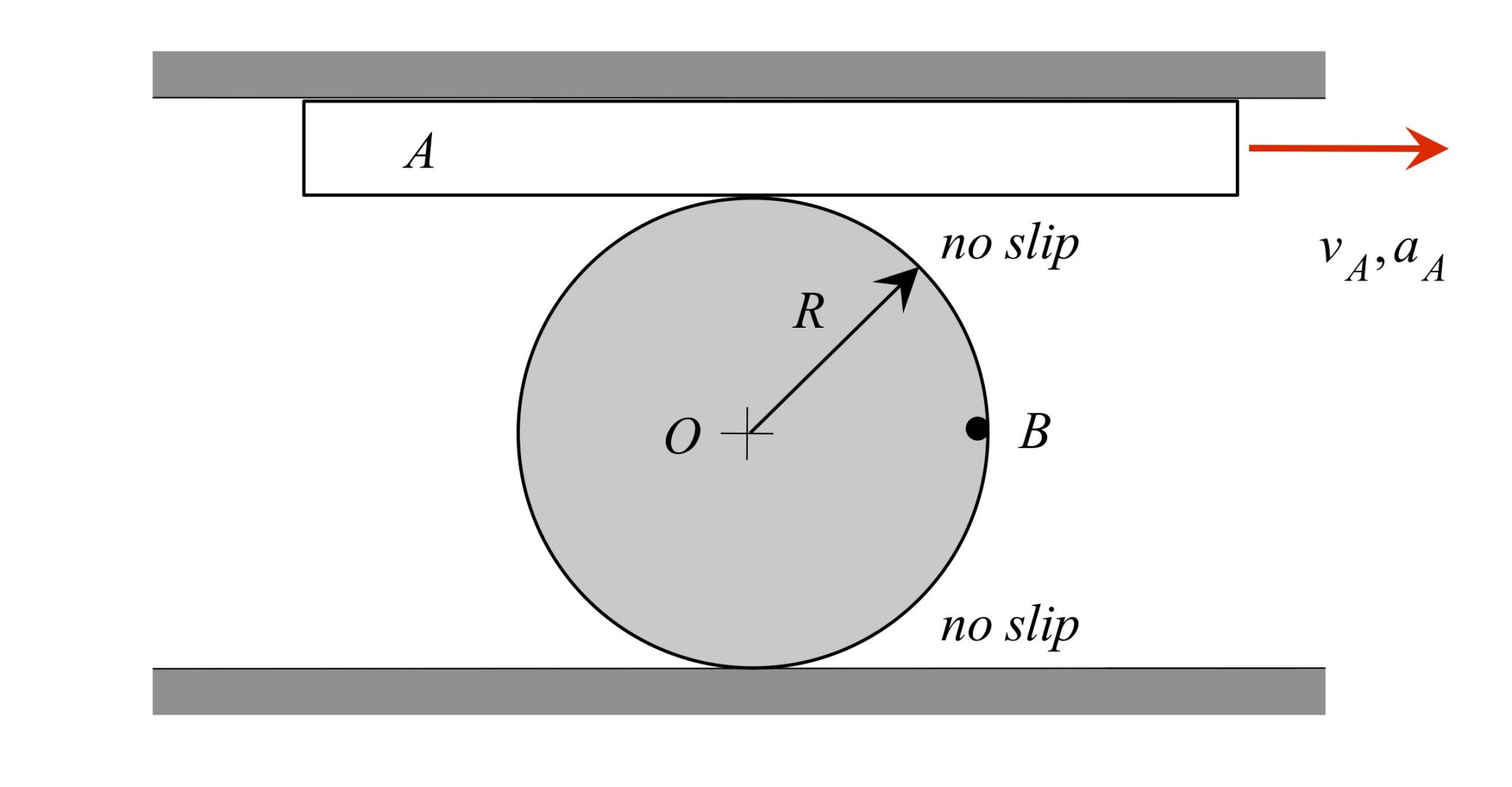
Using the principle of relative velocity at the points of contact, derive expressions for the velocity of the cylinder's center, , and its angular velocity, , in terms of and .
Show answer
Let's denote the velocity of the cylinder's center as (assumed to be to the right) and its angular velocity as (assumed to be clockwise, which is consistent with rolling to the right). In vector form, and .
We have two points of contact, so we must apply the no-slip condition at both.
-
Bottom Contact Point () with the stationary ground:
The velocity of the ground is 0. So, the velocity of must be 0.
Here, .
This gives our first equation: . -
Top Contact Point () with the moving block A:
The velocity of the block is . So, the velocity of must be equal to .
Here, .
Setting this equal to :
This gives our second equation: .
Now we solve the system of two equations:
(1)
(2)
Substitute (1) into (2):
Now find using (1):
The center of the cylinder moves at half the speed of the top block.
Conclusion
In this lesson, we have rigorously derived one of the most important kinematic constraints in mechanics.
Key Takeaways:
- Rolling motion can be decomposed into pure translation of the CM and pure rotation about the CM.
- The "no-slip" condition means the relative velocity between the contacting surfaces is zero. For a stationary surface, the contact point on the rolling body is instantaneously at rest.
- Applying this condition with vector kinematics yields the scalar constraints for rolling on a flat surface: and .
- The acceleration of the contact point is not zero; it is a centripetal acceleration directed toward the center of the rolling body ().
- The motion can be elegantly viewed as an instantaneous pure rotation about the contact point (the IAOR).
Preview of the Next Lesson:
Today, we focused solely on the kinematics—the description of motion. We derived the constraint rule. In the next lesson, we will apply this rolling-without-slipping constraint to solve problems involving bodies rolling on stationary or moving surfaces. This will involve dynamics, where we use Newton's laws and energy principles in conjunction with the kinematic rules we've established today to predict the motion that results from applied forces.