Hello! Welcome to the next lesson in our exploration of circular motion.
In our previous session, we established the fundamental language for describing rotation: angular position (), velocity (), and acceleration (). We rigorously derived the velocity vector for a particle in circular motion, , by differentiating the position vector in polar coordinates. This process highlighted a crucial subtlety: the polar unit vectors, and , are not constant and their time derivatives are non-zero.
Today, we take the logical next step: finding the acceleration vector, . You might intuitively think that if an object moves at a constant speed in a circle, its acceleration should be zero. However, acceleration is the rate of change of the velocity vector. Since the direction of velocity is constantly changing, there must be an acceleration. Our goal for this lesson is to prove the formula for this acceleration, known as centripetal acceleration (), using both rigorous vector calculus and an elegant geometric argument. This dual approach will give you both the formal mathematical command and the intuitive physical insight that you seek.
1. Proof via Vector Calculus: The Fundamental Derivation
This method is the most powerful as it flows directly from the first principles we've already established. It not only proves the formula for centripetal acceleration but also reveals another component of acceleration present in non-uniform circular motion.
We begin with the expression for velocity in circular motion of radius :
To find the acceleration , we differentiate with respect to time. Since both (the angular velocity) and (the tangential unit vector) can change with time, we must use the product rule:
Since is constant for circular motion:
Let's analyze the two terms in the parenthesis:
-
The first term: We recognize as the angular acceleration, . So, the first term is . This component of acceleration is directed along the tangent and is called the tangential acceleration, . It is responsible for changing the speed of the particle.
-
The second term: This term contains . We need to evaluate this derivative. Recall the definition of in terms of the constant Cartesian unit vectors:
Applying the chain rule for differentiation:
Factoring out :
We recognize the expression in the parenthesis as the radial unit vector, . Therefore, we have the critical result:
Now, substituting these pieces back into our expression for acceleration:
This is the complete acceleration vector for a particle in circular motion. The second term, , is the centripetal acceleration. The negative sign confirms that it is always directed radially inward, towards the center of the circle (opposite to ).
The magnitude of the centripetal acceleration is:
To get the formula in terms of linear speed , we use the relationship , which implies . Substituting this in:
This completes the formal proof.
The following video provides a complete derivation of velocity and acceleration in the more general polar coordinates. The derivation for circular motion is a special case of this.
Velocity, Acceleration in Polar Coordinates
The video 'Velocity, Acceleration in Polar Coordinates' by For the Love of Physics offers a rigorous derivation that aligns perfectly with your preference for deep, mathematical proofs. It derives the full acceleration vector for any motion in a 2D plane using polar coordinates.
Watch the segment from 17:05 to 21:30. The presenter derives the general acceleration vector in polar coordinates. Pay close attention to the final expression. To see how it proves our result, simply set the radius 'r' to be constant. This means its time derivatives, 'r dot' and 'r double dot', are zero. You will see the general formula collapse into the two components we just derived: the radial (centripetal) and tangential accelerations.
This vector calculus method is powerful because it is general. It doesn't assume uniform motion and naturally separates the acceleration into its two orthogonal components, each with a distinct physical role.
Test your understanding!
A particle moves in a circle of radius m. Its angular position is given by . What is the total acceleration vector at s?
Show answer
First, we find the angular velocity and acceleration by differentiation:
- . At s, rad/s.
- . At s, rad/s².
Now, we find the magnitudes of the centripetal and tangential acceleration components:
- Centripetal acceleration: m/s².
- Tangential acceleration: m/s².
The total acceleration vector is the sum of these components:
The minus sign on the centripetal component indicates it points towards the center. The total magnitude is m/s².
2. Proof via Geometry and Limits
While the calculus proof is exhaustive, a geometric proof provides a different, highly intuitive way to understand the origin of centripetal acceleration. This method is typically shown for uniform circular motion (UCM), where the speed is constant.
The following video walks through this elegant proof. I will summarize the key steps below it.
Two Simple Derivations of Centripetal Acceleration
The video 'Two Simple Derivations of Centripetal Acceleration' by Physics Ninja presents the classic geometric proof with excellent clarity. It leverages the concept of similar triangles to connect the geometry of the particle's path to the geometry of its changing velocity vector.
Please watch from 0:32 to 13:24. The first part (up to 9:38) details the derivation of the magnitude using similar triangles. The second part (from 9:38 onwards) rigorously proves the direction of the acceleration vector in the limit of small time intervals. Focus on why the two triangles (one for position, one for velocity) are similar.
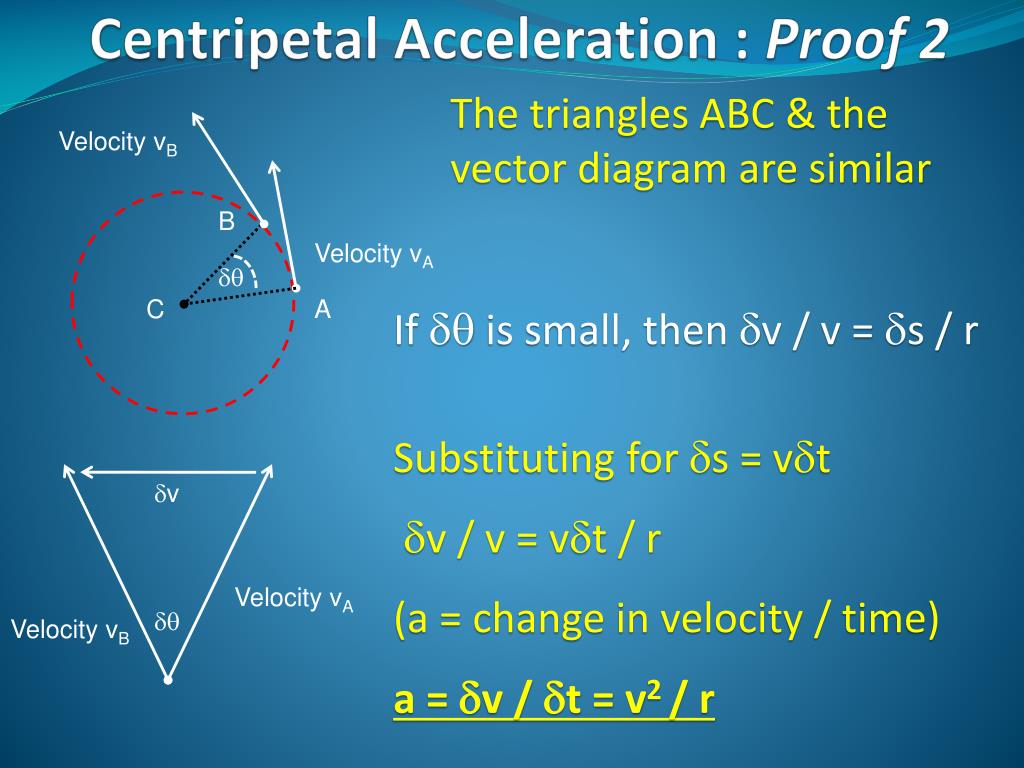
Here is a summary of the geometric argument:
-
Position Triangle: Consider an object moving from point P to point Q in a small time , sweeping an angle . The position vectors and form an isosceles triangle with the chord . The two equal sides have length .
-
Velocity Triangle: The velocity vectors and are tangent to the circle at P and Q. Since the motion is uniform, they have the same magnitude, . If we place these two vectors tail-to-tail, they also form an isosceles triangle with the change-in-velocity vector . The angle between and is also .
-
Similar Triangles: We now have two similar isosceles triangles. The ratio of the length of the base to the length of a side must be the same for both:
-
Introducing Time and Limits: We know acceleration is . Rearranging the similarity relation gives . Substituting this into the definition of acceleration:
In the limit as , the length of the chord becomes equal to the arc length, which is . Therefore, the limit becomes: -
Final Result: Substituting this back gives the magnitude of the acceleration:
The proof in the video also shows that as , the direction of becomes perpendicular to , which means it points radially inward.
Conclusion
Today, we have rigorously proven one of the most important formulas in kinematics from multiple perspectives. This fulfills the learning outcome and deepens your understanding of why motion in a circle implies acceleration.
Key Takeaways:
- An object moving in a circle is always accelerating, even at a constant speed, because its velocity vector is changing direction.
- This acceleration, called centripetal acceleration, is directed towards the center of the circle.
- We proved its magnitude, , using two powerful methods:
- Vector Calculus: By differentiating the velocity vector in polar coordinates. This method is more general and also revealed the tangential component of acceleration, .
- Geometry and Limits: By using the properties of similar triangles formed by the position and velocity vectors in the limit of an infinitesimally small time step.
Preview of the Next Lesson:
Our vector calculus derivation naturally yielded two components of acceleration: tangential () and centripetal (). In the next lesson, we will focus on non-uniform circular motion, where speed is not constant. We will formally derive these two components from first principles (which will be a focused review of today's calculus proof) and explore their distinct physical roles in changing the velocity vector's magnitude and direction, respectively.