Hello! In our previous lesson, we explored how calculus provides a powerful and systematic framework for solving optimization problems in kinematics. We learned to find maxima and minima by setting up a function and finding where its derivative is zero. This is a universal tool of great power.
Today, we delve into a different, often more elegant and insightful, problem-solving paradigm: symmetry. Your goal for this lesson is to learn to apply symmetry arguments to simplify complex kinematics problems and identify equivalent physical scenarios. While calculus can grind through complex equations, a well-chosen symmetry argument can bypass them entirely, revealing the solution with stunning simplicity. This approach aligns perfectly with your preference for understanding the fundamental "why" behind physical phenomena, as symmetry principles are among the deepest in all of physics.
In physics, a symmetry is a feature of a system that remains unchanged under some transformation. This could be a geometric transformation like a rotation or reflection, or a more abstract one like shifting our perspective to a different reference frame. Identifying and exploiting these invariances is a hallmark of an expert physicist.
1. Exploiting Geometric Symmetry
The most straightforward type of symmetry to spot is geometric. When a problem's initial setup involves a regular shape (like an equilateral triangle, a square, or a circle), it's a strong hint that symmetry will be the key to the solution.
Consider a classic problem: three bodies start at the vertices of an equilateral triangle and move towards each other. A direct attempt to write equations for their spiraling paths would involve complex, coupled differential equations. However, by focusing on the symmetry of the system, the problem becomes much simpler.
Challenging physics problem | 2D motion
The video 'Challenging physics problem | 2D motion' from the FloatHeadPhysics channel masterfully demonstrates how a change in perspective can solve a seemingly intractable problem. It visualizes the complex motion and then reveals the simple, underlying symmetric behavior.
Please watch the video from the beginning to 8:30. 0:00 - 3:28: Observe the setup and the visualization of the complex spiral paths. This illustrates why a brute-force calculation is difficult. 3:28 - 8:30: This is the core of the lesson. Focus on the conceptual shift from tracking individual paths to analyzing the rate at which the distance between any two bodies changes. The video refers to this as their 'relative approach speed'.
The crucial insight is that the symmetry of the system is preserved over time. The three bodies will always form an equilateral triangle that shrinks and rotates. Instead of analyzing the full 2D motion, we can simplify the problem to a 1D question: At what rate does the side length of the triangle decrease?
Let's formalize the calculation of the "relative approach speed" with mathematical rigor. Consider two adjacent vertices, A and B. We want to find the rate of change of the distance between them, . Let and be their position vectors.
The rate of change of the vector separating them is .
The rate of change of the distance, , is the projection of this relative velocity vector onto the unit vector pointing from A to B, .
From the problem setup:
- has magnitude and points directly along . So, .
- has magnitude and points towards vertex C. The angle between the vector and the vector is the exterior angle of the equilateral triangle, which is 120° or radians. So, .
Substituting these into our equation:
The negative sign confirms that the distance is decreasing. The speed of approach is therefore constant and equal to . The time taken for the initial distance to shrink to zero is simply:
This powerful method can be generalized to any regular n-gon. The key is always to calculate the relative speed of approach between adjacent vertices. The handout below presents this generalization.
The handout 'Kinematics - Mechanics I' by Kevin Zhou, a resource for Physics Olympiad training, contains a similar problem but for a hexagon.
Please read Problem 18 on page 14 of the PDF. This problem analyzes six bugs on a regular hexagon. Notice how the solution again relies on the system's symmetry to find the rate of change of distance between adjacent bugs. The handout provides two elegant methods to arrive at the solution.
Test your understanding!
Consider four bugs at the vertices of a square of side length . Each bug starts moving with a constant speed towards the next bug in a counter-clockwise direction. At what time do they collide?
Show answer
Let's use the rigorous method. Consider two adjacent bugs, A and B, on the square. A moves towards B, and B moves towards the next vertex, C.
The rate of change of distance is .
- .
- The angle between and is the exterior angle of the square, which is 90°.
- .
So, . The speed of approach is simply .
The time to collide is .
Notice a beautiful simplification: Bug B's motion is entirely perpendicular to the line connecting A and B, so it has no component of velocity towards or away from A. The entire rate of approach is due to bug A's motion alone.
2. Creating Symmetry: The Power of Reference Frames
Sometimes a problem appears complex and asymmetric in the standard "lab" frame. The art of physics often lies in finding a different reference frame where the problem becomes simple and symmetric. This is the essence of identifying "equivalent physical scenarios".
The Freely Falling Frame
For any problem involving multiple objects moving under uniform gravity , a transformative trick is to switch to a reference frame that is itself accelerating downwards at .
Let's return to the Kevin Zhou handout and examine a problem that becomes trivial in the right reference frame.
Please read Problem 9 and its solution on page 10. Two cannons fire at each other.
In the lab frame, this is a problem of two intersecting parabolic trajectories. In the freely falling frame, gravity effectively vanishes. The cannonballs no longer follow parabolas; they travel in straight lines at their initial velocities. The complex projectile motion problem is transformed into a simple question: do two objects moving at constant velocity collide? This equivalence is a profound simplification.
The Tilted Frame
When a problem involves a constant force that isn't vertical, such as wind or motion on an incline, you can create a symmetric scenario by tilting your coordinate system.
The Kevin Zhou handout again provides a perfect example of this technique.
Read Example 5 on page 16, which discusses projectile motion with a constant horizontal wind force.
The key idea is to define an "effective gravity" vector, . This new vector points downwards and sideways. If you align your coordinate system's y-axis with , the problem becomes kinematically identical to standard projectile motion. To return to the thrower in this "tilted world," you must launch the projectile straight "up" against the effective gravity. This elegant symmetry argument gives the answer directly, without writing out and differentiating trajectory equations.
3. Trajectory and Temporal Symmetry
Symmetry can also be found within the motion itself. Standard projectile motion is a prime example.
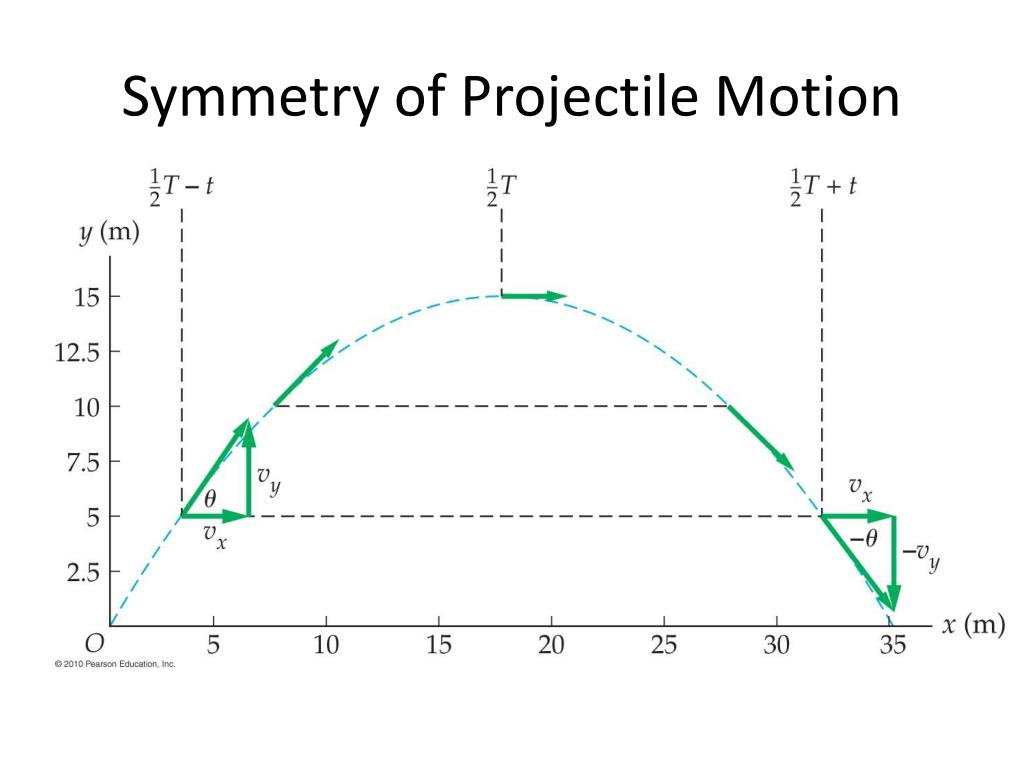
This simple symmetry can be surprisingly useful. For example, knowing the velocity at a certain height on the way up immediately tells you the velocity at that same height on the way down.
This concept extends to more advanced geometric properties. As we touched on in the previous lesson about optimization, the parabolic trajectory has a deep geometric symmetry related to its focus and directrix. This symmetry can be used to solve complex optimization problems geometrically, as seen in Problem 34(c) from the Kevin Zhou handout (page 25), providing an alternative to the calculus methods we studied.
Conclusion
Today, we've explored the power of symmetry as a tool for physical reasoning. Instead of relying on brute-force calculation, you've learned to look for invariances and transformations that simplify a problem's core structure. This is a significant step in your development from a student who solves problems to a physicist who understands them.
Key Takeaways:
- Geometric Symmetry: In problems with regular geometric setups, the symmetry is often preserved. Analyzing the motion of the overall shape (e.g., a shrinking polygon) is simpler than tracking individual curved paths. The key is often to calculate the relative speed of approach between adjacent components.
- Symmetry via Reference Frames: A problem that appears asymmetric can often be made symmetric by choosing a clever reference frame. The freely falling frame eliminates gravity, and the tilted frame can align the coordinates with an "effective" gravity, both transforming complex trajectories into simpler, equivalent scenarios.
- Inherent Symmetry: Trajectories themselves can possess temporal or geometric symmetries that provide powerful shortcuts and deeper insight into the motion.
Preview of the Next Lesson:
We have now studied two powerful techniques for tackling complex problems: systematic optimization with calculus, and elegant simplification with symmetry. In our next lesson, we will address situations where an exact solution is either impossible or impractical. We will learn to use limiting processes and approximations to analyze the behavior of kinematic systems in special cases. This skill is essential for developing physical intuition and making sense of highly complex models.