Welcome to the final lesson of our first module, "Foundations of Data Analytics." In our previous lesson, we mapped out the data analytics lifecycle, the step-by-step process that takes us from a business question to a deployed solution. Today, we'll zoom in on the heart of that lifecycle—the analysis stage—and explore the different kinds of questions we can answer with data.
The goal for this lesson is to learn how to distinguish between descriptive, diagnostic, predictive, and prescriptive analytics. These four types represent a spectrum of analytical capability, moving from understanding the past to actively shaping the future. Knowing the difference is fundamental for a data analyst, as it allows you to match the right analytical approach to the right business problem, ensuring your work is not just accurate, but also impactful.
1. The Spectrum of Analytics
Imagine you're solving a puzzle. First, you look at the pieces you have (what happened). Then you try to figure out why some pieces don't fit (why it happened). Next, you might guess what the final picture will look like (what will happen). Finally, you decide the best order to place the remaining pieces to finish the puzzle (what should we do?).
Data analytics follows a similar progression. The four types build on one another, increasing in both complexity and business value. This progression is often visualized as a journey from hindsight to foresight.
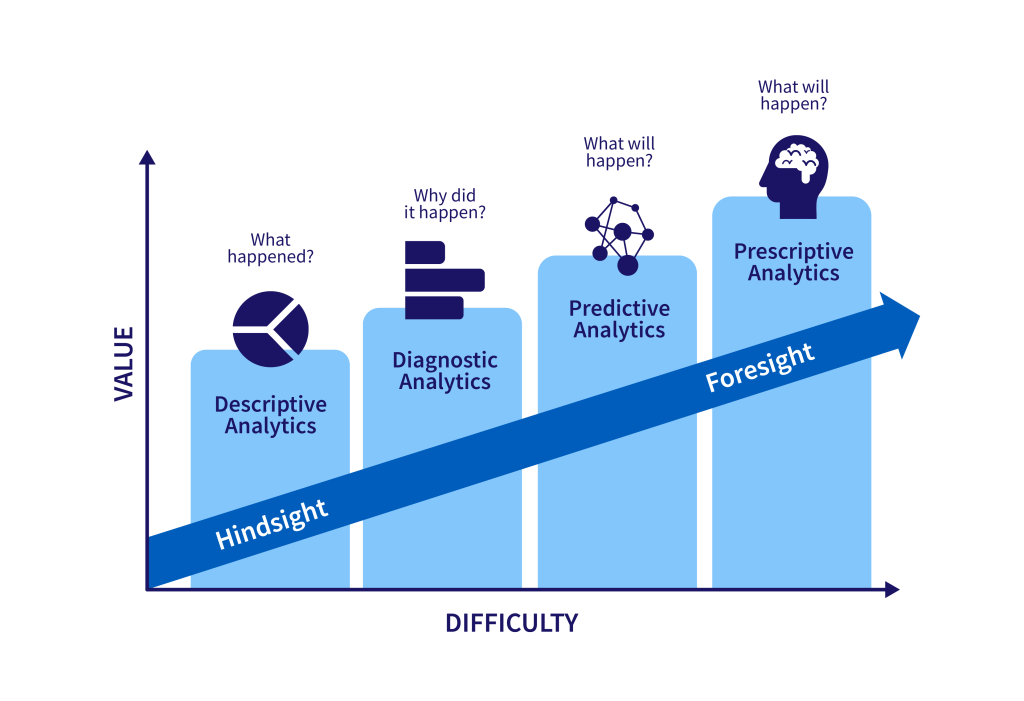
Let's start with a short video that uses an excellent analogy—a visit to the doctor—to make these concepts tangible. Given your background in pharmacy and healthcare, this should provide a very intuitive starting point.
Descriptive vs Diagnostic vs Predictive vs Prescriptive Analytics: What's the Difference?
This video from Maven Analytics clearly defines the four types of analytics and uses a practical, healthcare-related example to illustrate the key differences.
Please watch from the beginning until the end of the doctor's visit example. Pay close attention to how the doctor's statements evolve from simply stating a fact (descriptive) to recommending a treatment plan (prescriptive). Also, note the important point that these types are often used together, not as a strict linear path.
As the video explained, these four types work in tandem to provide a comprehensive understanding of a business problem. Let's now explore each one in detail.
2. A Deeper Look at the Four Types
We will now work through each of the four types of analytics. The article "The 4 Types of Data Analytics Explained" from Domo will be our main guide. It provides clear definitions and great business examples. We'll supplement these with specific applications in healthcare and HR to align with your career goals.

A. Descriptive Analytics: What Happened?
This is the most common and fundamental type of analytics. It involves summarizing historical data to provide a clear, concise picture of past events. Think of it as creating the headlines for your data story.
- Question: What happened?
- Goal: To track Key Performance Indicators (KPIs) and understand business performance at a glance.
- Outputs: Dashboards, reports, summary statistics (mean, median, counts).
The 4 Types of Data Analytics Explained + Examples
This section of the Domo article provides a thorough explanation of descriptive analytics.
Please read the section on descriptive analytics. Focus on how it organizes data into a clear view and the examples provided.
As you read, consider these examples from your fields of interest:
- Healthcare: A hospital manager uses a dashboard to view the average patient length of stay, the number of admissions per day, and bed occupancy rates for the past month.
- Human Resources: An HR analyst creates a quarterly report showing employee headcount, turnover rate by department, and the average time-to-hire for new roles.
In both cases, you are simply describing what has already occurred. This is the foundation upon which all other types of analysis are built.
B. Diagnostic Analytics: Why Did It Happen?
Once you know what happened, the natural next question is why. Diagnostic analytics is the investigative, "data detective" work. It involves drilling down into the data to find the root causes, dependencies, and patterns behind the outcomes identified in descriptive analytics.
- Question: Why did it happen?
- Goal: To understand the drivers behind trends, anomalies, or specific performance metrics.
- Outputs: Drill-down reports, correlation analysis, segmentation.
The 4 Types of Data Analytics Explained + Examples
Now, let's explore the next level of analysis in the same article.
Read the section on diagnostic analytics. Note the emphasis on techniques like filtering and segmentation to isolate variables.
Let's apply this to our previous examples:
- Healthcare: The hospital manager sees that the average length of stay (descriptive) has increased. They use diagnostic analytics to discover this increase is isolated to patients from a specific surgical unit, correlating with the introduction of a new post-operative procedure.
- Human Resources: The HR analyst sees that the company's overall turnover rate (descriptive) is high. Through diagnostic analysis, they find that the turnover is disproportionately high among employees in the first year of employment within a single department, pointing towards a potential issue with onboarding or management in that specific team.
C. Predictive Analytics: What Will Happen?
This is where analytics shifts from looking at the past to forecasting the future. Predictive analytics uses historical data, statistical algorithms, and machine learning techniques to identify the likelihood of future outcomes.
- Question: What is likely to happen?
- Goal: To make informed forecasts and proactively plan for future events.
- Outputs: Forecasts, probability scores, risk assessments.
The 4 Types of Data Analytics Explained + Examples
Continuing with the Domo article, we now move from hindsight to foresight.
Please read the section on predictive analytics. Pay attention to the idea that this is about probability, not certainty.
Predictive analytics is incredibly powerful in healthcare and HR:
- Healthcare: As mentioned in the HBS article "3 Applications of Data Analytics in Health Care," the CDC uses historical data to forecast the potential severity and spread of the seasonal flu. This allows hospitals and public health officials to prepare resources in advance. Another powerful example is using patient data to predict which individuals are at high risk for a specific condition, like sepsis in newborns, enabling early intervention.
- Human Resources: An organization can build a model that uses data on employee tenure, role, performance reviews, and engagement scores to predict which high-performing employees are at risk of leaving the company in the next six months.
D. Prescriptive Analytics: What Should We Do?
This is the most advanced form of analytics. It goes beyond predicting a future outcome to recommending specific actions to take to either achieve a goal or mitigate a risk. It essentially provides data-driven advice.
- Question: What should we do to make X happen?
- Goal: To optimize decision-making by suggesting the best course of action among various choices.
- Outputs: Recommended actions, optimized plans, decision-support systems.
The 4 Types of Data Analytics Explained + Examples
Finally, let's look at the most action-oriented type of analytics.
Read the section on prescriptive analytics in the Domo article. The key takeaway here is the combination of prediction with decision logic and constraints.
Here's how this plays out:
- Healthcare: A predictive model might identify a patient as having a high risk of developing diabetes. A prescriptive analytics system would go a step further. As the HBS article mentions, it could assess the patient’s full profile and recommend a specific, optimized preventative plan, perhaps combining diet, exercise, and medication to achieve the best outcome.
- Human Resources: After the predictive model identifies employees at risk of leaving, a prescriptive system could suggest a "next-best-action" for their manager. For one employee, it might recommend a conversation about career growth; for another, it might suggest a bonus or a new project assignment, based on what has worked for similar employees in the past.
3. Analytics Maturity
Most organizations don't jump straight to prescriptive analytics. They build their capabilities over time, typically starting with descriptive reporting and gradually moving towards more advanced types. This journey is often called the "analytics maturity model." Understanding this progression is helpful as you begin your career, as most entry-level analyst roles are heavily focused on descriptive and diagnostic analytics.
The Domo article you've been reading provides a great summary of this journey.
The 4 Types of Data Analytics Explained + Examples
This final reading provides context on how organizations evolve their analytical capabilities.
Read the short section titled Analytics maturity. This will help you understand where the skills you're learning fit into a company's broader data strategy.
Conclusion
In this lesson, we have demystified the four main types of data analytics. This framework is essential for any aspiring analyst, as it helps you clarify business questions and choose the right tools for the job.
Here are the key takeaways:
- Descriptive Analytics asks "What happened?" by summarizing past data.
- Diagnostic Analytics asks "Why did it happen?" by investigating the root causes of trends.
- Predictive Analytics asks "What will happen?" by forecasting future outcomes based on historical patterns.
- Prescriptive Analytics asks "What should we do?" by recommending actions to optimize for a future goal.
- These types represent a maturity curve, moving from simple hindsight to complex foresight, with each step adding more business value.
This lesson concludes our "Foundations of Data Analytics" module. You now have a solid conceptual understanding of what data is, how it's structured, the lifecycle of an analysis project, and the types of questions you can answer.
In our next lesson, we will begin Module 2: Data Analysis with Advanced Excel. We will move from theory to practice and start building the technical skills needed to perform descriptive and diagnostic analysis yourself, beginning with logical and conditional functions to segment and summarize data.