Introduction
In our previous lesson, we defined Macaulay Duration as a bond's "effective maturity"—a weighted-average measure of the time until cash flows are received. While this provides a powerful temporal intuition, its true utility in finance comes from its direct relationship with price risk.
Today, we will make that connection explicit. Our goal is to derive Modified Duration directly from first principles of calculus. You will see how it emerges as the first derivative of the bond's price-yield function, formally establishing it as the primary measure of a bond's sensitivity to interest rate changes. This lesson forms the theoretical bedrock for quantifying and managing interest rate risk.
From a Curve to a Tangent Line: The Calculus of Price Sensitivity
Recall the fundamental inverse relationship between a bond's price and its yield to maturity (YTM). This relationship is not linear; it's a convex curve.
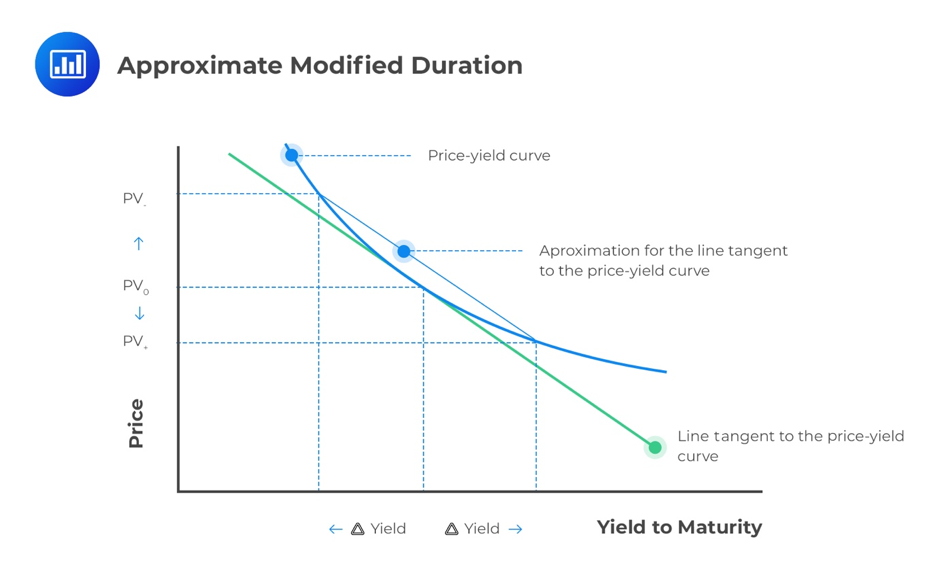
As the image illustrates, for any given point (a specific price and yield), the steepness of the curve determines how much the price will move for a small change in yield. In calculus, the "steepness" or instantaneous rate of change at a point is given by the derivative. Our first step, therefore, is to find the derivative of the price function with respect to yield, .
Deriving the Price-Yield Derivative
Let's start with the standard bond pricing formula, assuming for now annual compounding for simplicity, where is the price, is the cash flow at time , is the maturity, and is the yield to maturity.
To differentiate this, it's easier to rewrite it using a negative exponent:
Now, we can differentiate with respect to . Since the derivative is a linear operator, we can move it inside the summation and differentiate term by term. Applying the power rule and the chain rule to each term gives:
Since , this simplifies to:
This expression represents the absolute change in the bond's price (in dollar terms) for an infinitesimal change in the yield. The following video walks through this exact derivation.
Derivation of a Bond's Duration
Watch this segment from a video by Matt Brigida for a clear, step-by-step derivation of the first derivative of the bond's value with respect to its yield.
Pay close attention to the application of the power rule and how the final expression for the derivative is formulated from the bond pricing formula.
Defining Modified Duration
The derivative gives us the absolute price change, but a more universal measure is the percentage price change. This allows us to compare the interest rate sensitivity of bonds with different prices.
We define Modified Duration () as the negative of the percentage change in price for an infinitesimal change in yield. The negative sign is a convention to make duration a positive number, since price and yield move in opposite directions ( is negative).
This is the formal definition of Modified Duration. It is, by definition, the semi-elasticity of the bond's price with respect to its yield.
The Link to Macaulay Duration
Now, let's connect this calculus-based definition to the time-based measure we learned in the last lesson, Macaulay Duration. We can substitute our derived expression for into the definition of Modified Duration:
This expression looks very similar to the formula for Macaulay Duration. Let's perform a simple algebraic manipulation by factoring out :
Look closely at the term in the parentheses. It is:
This is precisely the formula for Macaulay Duration ()!
This leads us to the fundamental relationship between Modified and Macaulay Duration:
For a bond with compounding periods per year, the relationship is generalized to:
This elegant result bridges the two concepts: the sensitivity measure derived from calculus is directly proportional to the time-based measure of a bond's cash flows.
The following resources provide excellent, concise derivations showing this crucial link.
Deriving the Modified Duration and Its Link to Macaulay Duration
This video by Fabian Moa, CFA, FRM, CTP, FMVA provides another excellent derivation, this time explicitly connecting the derivative back to the Macaulay Duration formula.
Watch the segment from the initial differentiation to the final algebraic link. Focus on how the term (1+y) is factored out to reveal the Macaulay Duration expression.
For a rigorous, text-based alternative, the Wikipedia article provides a very clean formal derivation.
Duration (finance) - Formal derivation
Read the "Formal derivation" section of the Wikipedia article on Duration.
This section concisely presents the same mathematical steps we've just discussed, from the price function to the final relationship between Modified and Macaulay duration. It's a great summary to consolidate your understanding.
Conclusion
In this lesson, we have formally derived Modified Duration and established its role as the key measure of interest rate sensitivity. By applying calculus to the bond pricing formula, we have moved from the intuitive concept of a weighted-average timeline (Macaulay Duration) to a precise, actionable risk metric.
Key Takeaways:
- Modified Duration is formally defined as the negative of the semi-elasticity of a bond's price with respect to its yield: .
- It is derived by taking the first derivative of the price-yield function, which represents the slope of the tangent to the price-yield curve.
- The derivative of the price function is .
- Modified and Macaulay Duration are linked by the simple formula: . This provides the crucial bridge between a time-based measure and a price-sensitivity measure.
Now that we have rigorously derived Modified Duration, our next lesson will focus on its practical application. We will see how to use it to approximate the percentage price change of a bond for a small change in yield and begin its implementation in Python.