Introduction
In the previous module, we completed our journey from basic bond pricing to the construction and macroeconomic interpretation of entire yield curves. You learned to derive spot, forward, and par curves and to interpret their shapes as powerful signals of economic conditions.
Now, we will leverage this sophisticated term structure framework to analyze more complex fixed-income securities. This module begins our exploration of such instruments with the Floating Rate Note (FRN), or "floater". Today's lesson focuses squarely on the first step: understanding and modeling the cash flow structure of an FRN. We will define its components, formalize its payment stream mathematically, and establish the fundamental intuition that will underpin its pricing in subsequent lessons.
1. What is a Floating Rate Note?
Unlike the fixed-coupon bonds we have studied so far, a Floating Rate Note has coupon payments that are not known in advance. Instead, they are periodically reset based on a benchmark or reference interest rate.
The key components that define an FRN are:
- Reference Index: A variable, market-based interest rate that determines the coupon. Common examples include SOFR (Secured Overnight Financing Rate) or the historical LIBOR (London Inter-bank Offered Rate).
- Quoted Margin (or Spread): A fixed number of basis points added to (or subtracted from) the reference index to determine the total coupon rate. This margin is constant over the life of the bond and reflects the issuer's creditworthiness relative to the reference index's risk.
- Reset Dates: The dates on which the coupon rate for the next period is determined by "fixing" the value of the reference index.
- Payment Dates: The dates on which the coupon payments are made to the bondholder, typically at the end of each coupon period.
- Day-Count Convention: As with fixed-rate bonds, this determines how interest accrues over a specific period.
The coupon rate for a given period is typically set at the beginning of that period and paid at the end. For example, for a semi-annual FRN, the rate for the next six months is set today based on the current 6-month reference rate, and the corresponding coupon is paid in six months' time.
This structure is visualized well in the following timeline for a 5-year FRN linked to 6-month LIBOR.

The core challenge and the key feature of an FRN is that its future cash flows are uncertain. How can we model—and eventually price—an instrument whose payments are not fixed?
2. Formalizing the Cash Flow Model
To move from intuition to a rigorous model, let's formalize the cash flow structure. Your background in data science and engineering emphasizes the importance of precise definitions, which is exactly what we need here.
The document "Credit Risk Modeling" provides a clear, formal definition of a prototypical FRN.
This section from a textbook on credit risk modeling provides a concise mathematical definition of an FRN's payment stream.
Please read the paragraph that begins "In an analogous contract, c_n is not deterministic...". It's about halfway down the first page of Section 2.3.1. Focus on how the coupon payments c_n and the final payment c_N are defined in terms of the notional value N and the floating rate L.
Let's synthesize this into our own notation. Consider an FRN with a notional (principal) of and a set of coupon dates , where is the maturity date. Let's define as the issue or start date.
- The -th coupon period runs from to .
- The length of this period, according to the relevant day-count convention, is .
- The reference rate for this period is , which is the simply-compounded market rate for the term as observed at time .
- The quoted margin is a constant spread, .
The coupon rate for the -th period, , is set at and is given by:
The cash flow (coupon payment) received by the investor at time is:
This applies for . At maturity , the final cash flow also includes the repayment of the principal:
Forecasting the Cash Flows
A critical question arises: if we are at time , we only know the rate for the first period, . How do we determine the expected values for , , etc.?
This is precisely where our work on the term structure pays off. The forward rate curve provides the market's implied forecast for future spot rates. Therefore, to forecast the cash flows of an FRN, we set the unknown reference rate equal to the forward rate that we can derive from the current spot yield curve.
3. Decomposing the FRN: A Mathematical Insight
Now let's analyze the structure of the FRN's value. This involves a particularly elegant result that is foundational to fixed income analysis. We will start by considering a "standard" or "vanilla" floater where the quoted margin .
Let's find the present value of a single coupon payment, , assuming . The coupon is . Its present value at time 0 is:
where is the discount factor for time .
If we assume the market is rational and we use the forward rates from our yield curve to forecast the coupons (i.e., ), we can substitute the definition of the simply compounded forward rate:
Substituting this into the present value formula for the coupon gives:
The terms cancel out, and simplifying gives:
This remarkable result shows that the present value of a single floating-rate coupon is equal to the notional amount times the difference in value of two zero-coupon bonds.
The total present value of all coupons is the sum of these individual values. This creates a telescoping sum:
All intermediate terms cancel out, leaving:
Since is today, the discount factor . So, the present value of all the floating coupons is .
The present value of the principal repayment at maturity is simply .
Therefore, the total price of this standard () floater is:
This proves a cornerstone of fixed income theory: a standard floater, whose coupon is the market reference rate and is discounted on the same basis, is always valued at its par value () on each reset date.
4. The Role of the Spread and Model Structure
What happens when the quoted margin, , is not zero? We can decompose the FRN's cash flows into two parts:
- A standard floating-rate coupon stream:
- A fixed spread (annuity) stream:
The total price of the FRN is the sum of the values of these two streams:
From our derivation above, we know the price of the standard floater part is just its notional, . The second part is simply a fixed-annuity—a series of known cash flows —which we can price by discounting each payment with the appropriate spot rate from our yield curve.
This powerful decomposition allows us to see that the price of an FRN deviates from par only by the present value of its spread payments. An FRN with a positive spread will trade above par, and one with a negative spread will trade below par (assuming the forecasting and discounting curves are the same).
This exact line of reasoning is explored in the following Stack Exchange post, which nicely frames why FRNs can be more complex than they first appear.
FRN are more complex than we think
This post on the Quantitative Finance Stack Exchange explores the pricing of an FRN with a spread.
Read only the initial question posed by the user. Notice how their derivation leads to the same conclusion we just reached: the value of the FRN is the "notional + a fixed rate bond" (where the fixed-rate bond corresponds to the annuity of spread payments).
Given your background, it's useful to think about how you would model this for implementation. Professional financial libraries use an object-oriented approach. A FloatingRateNote would be an object composed of a list of Coupon objects and a final CashFlow for the principal.
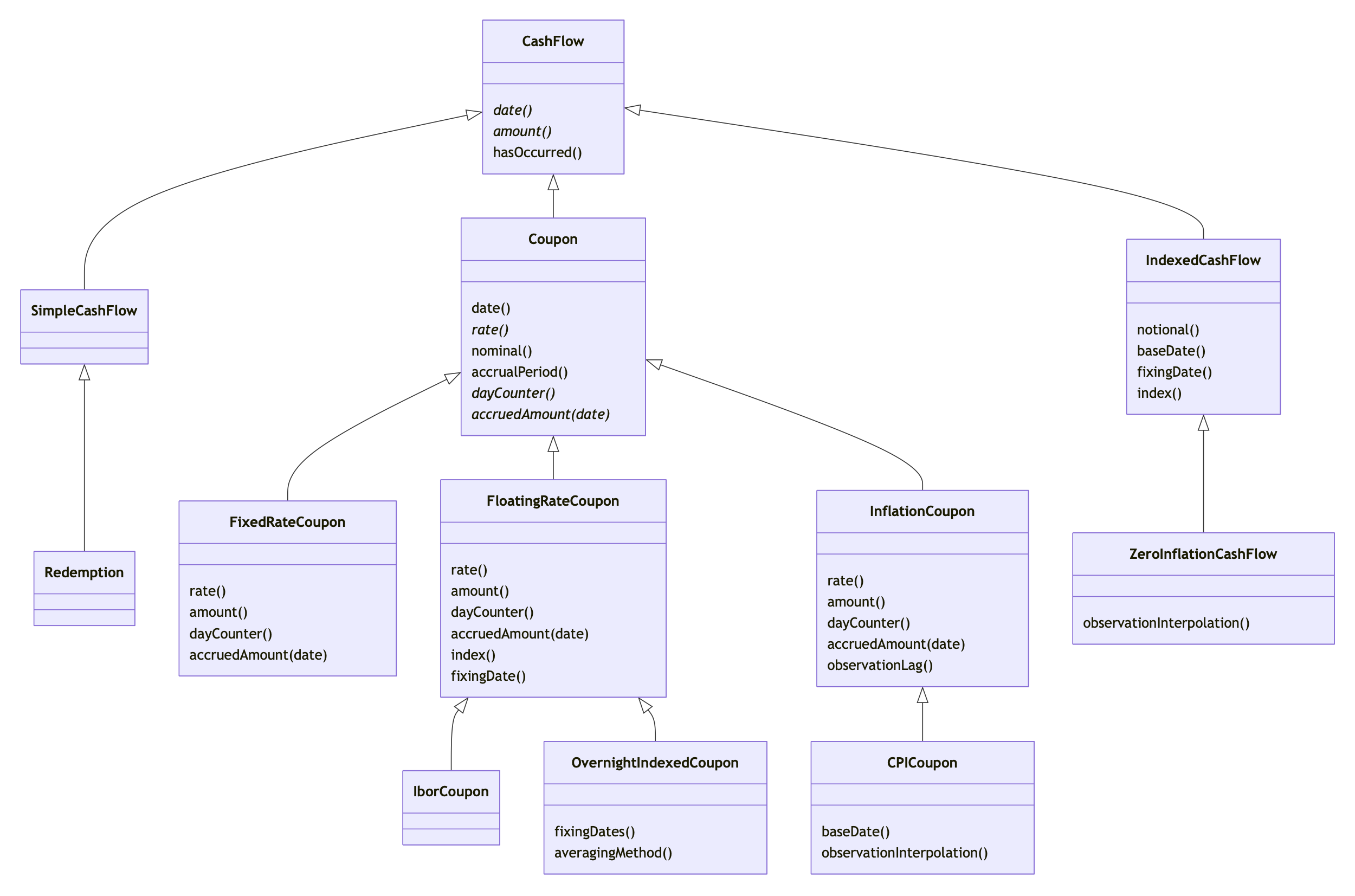
As you can see, a FloatingRateCoupon is an object with specific properties like its fixing date, its reference index, and the applicable day counter. Building an FRN model in code would involve creating a series of such objects, each capable of calculating its future cash flow based on a provided forward rate curve.
Conclusion
In this lesson, we have laid the essential groundwork for understanding Floating Rate Notes. We moved from a conceptual overview to a precise mathematical model of their cash flow structure, a process that should feel familiar and robust given your technical background.
Key Takeaways:
- An FRN's cash flows consist of periodic coupons tied to a reference index plus a quoted margin, and a final principal repayment.
- The future (unknown) coupon payments are forecasted using the forward rate curve derived from the current term structure.
- A "standard" floater (with zero spread, and where the coupon index and discount basis are the same) has a theoretical value equal to its par value on every reset date.
- The value of an FRN can be decomposed into two parts: a standard floater worth par, and a fixed annuity representing the present value of the spread payments.
- This structure can be modeled efficiently using an object-oriented approach, where the bond is a container for coupon and cash flow objects.
In the next lesson, we will build directly on today's findings. We will formalize the pricing of a standard floater, mathematically proving why it is valued at par on its reset dates, and then proceed to pricing floaters between these reset dates.