Introduction
In our previous lessons, we established that pricing a bond using a zero-coupon yield curve (ZCYC) provides a more accurate valuation than using a single yield-to-maturity. We even built a Python function to perform this pricing by discounting each cash flow with its corresponding spot rate.
Today, we'll delve deeper into the information embedded within the ZCYC. Beyond just discounting present cash flows, the spot curve implies a set of expectations about future interest rates. These are known as forward rates. This lesson will define what forward rates are and, crucially, derive the mathematical relationship they share with spot rates. We will achieve this using a cornerstone of financial theory: the no-arbitrage argument.
1. Defining Spot vs. Forward Rates
Let's begin by solidifying the distinction between a spot rate and a forward rate.
- A spot rate () is the annualized rate of return on a zero-coupon bond that starts today (time 0) and matures at a future time . It's the rate for an investment made "on the spot."
- A forward rate () is an interest rate that is agreed upon today (time 0) for a loan that will be made at a future time and will mature at an even later time .
Think of it this way: a spot rate is for a loan that starts now, while a forward rate is for a loan that starts later. The terms of the forward rate are locked in today.
To get a clearer picture of the different types of rates and their standard notations, please watch the following video.
Spot Rates & Forward Rates | Exam FM | Financial Mathematics Lesson 30 - JK Math
In this video from JK Math, you will be introduced to the term structure of interest rates, spot rates, and finally, forward rates.
First, watch the initial segment to understand the concept of a term structure of interest rates (first part). Next, focus on how spot rates are defined and used as accumulation factors (next segment). Finally, pay close attention to the definition of forward rates and the various notations used to represent them (last part). The notation f_{t,T} (or similar variants) denotes the forward rate for a period starting at time t and ending at time T.
2. The No-Arbitrage Derivation
The relationship between spot and forward rates is governed by the principle of no arbitrage. This principle states that in an efficient market, there should be no opportunity to make a risk-free profit without any initial investment. If two different investment strategies yield the same certain outcome in the future, they must have the same cost today.
Let's use this principle to find the link between spot and forward rates. Consider two risk-free investment strategies for investing $1 for two years:
Strategy A: Invest for two years at the 2-year spot rate.
- Invest $1 today at the 2-year spot rate, .
- At the end of two years, the future value will be: .
Strategy B: Invest for one year, then reinvest at the 1-year forward rate.
- Invest $1 today at the 1-year spot rate, . At the end of year one, this grows to .
- Simultaneously, at time 0, enter into a forward agreement to invest the proceeds from year one for another year at the 1-year forward rate, starting one year from now. This rate is denoted as .
- At the end of two years, the future value will be: .
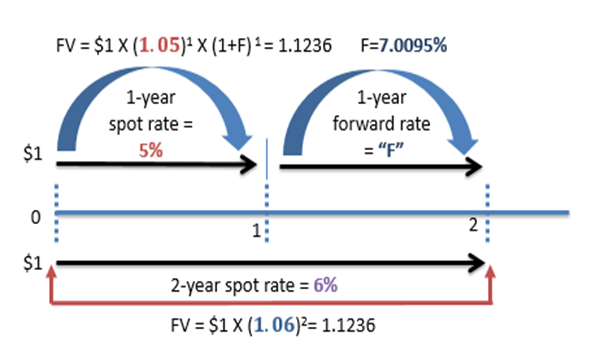
Since both strategies are risk-free and produce a guaranteed amount at the end of two years, their future values must be equal:
This simple but powerful equation forms the basis of the relationship between spot and forward rates. It shows that the forward rate is not an independent variable but is implicitly determined by the 1-year and 2-year spot rates.
The following video walks through this derivation with clear numerical examples, showing how to calculate specific forward rates from a given set of spot rates.
Spot Rates & Forward Rates | Exam FM | Financial Mathematics Lesson 30 - JK Math
This segment from the JK Math video provides a step-by-step application of the no-arbitrage logic.
Watch the derivation of the one-year forward rate starting in year one, F_{1,2}. Then, follow the similar calculation for the one-year forward rate starting in year two, F_{2,3}.
3. Generalizing the Forward Rate Formula
We can generalize the no-arbitrage equation for any two time periods. Let be the spot rate for a period of years and be the spot rate for a period of years, where . The forward rate from time to time is denoted .
The two equivalent strategies are:
- Lend Long: Invest for years at . Future Value: .
- Lend Short, Roll into Forward: Invest for years at , and reinvest the proceeds from to at the forward rate . Future Value: .
Equating them gives the general relationship:
By rearranging this equation, we can solve for the implied forward rate :
This is the general formula for calculating an annualized forward rate between any two points in time, given the spot rates for those maturities.
The JK Math video also covers this generalization for both single-period and multi-period forward rates.
Spot Rates & Forward Rates | Exam FM | Financial Mathematics Lesson 30 - JK Math
Let's return to the JK Math video to see the generalized formulas.
First, review the general formula for a one-year forward rate, often denoted f_{n-1,n}. Next, observe how the setup is generalized for a multi-year forward rate, denoted f_{K,N}.
4. A Formal View: Forward Rates and Forward Pricing
Your background in quantitative fields will appreciate a more formal connection between these rates and financial contracts. A forward rate is, in essence, the yield implied by a forward contract on a zero-coupon bond.
Let's explore this with a reading from a graduate-level course.
Forward Contracts and Forward Rates
These slides from an NYU Stern course formalize the no-arbitrage argument we've just discussed, explicitly framing it in the context of riskless lending strategies.
Read through slides 8, 9, and 10, starting from the section titled "Forward Contract on a Zero as a Forward Loan" and ending before "Summary: One No Arbitrage Equation...". Focus on these key points: Slide 8: How a forward purchase of a zero-coupon bond is equivalent to a forward loan, defining the forward rate f_{t,T}. Slide 9: This is the crucial part. It lays out the arbitrage argument by comparing two riskless lending possibilities: lending long at the spot rate r_T versus lending short at r_t and rolling into a forward contract. Slide 10: This presents the resulting no-arbitrage equation and connects it back to the forward price of the underlying zero-coupon bond. Note that the formulas here use semi-annual compounding (dividing rates by 2 and multiplying exponents by 2), but the underlying logic is identical to our annual compounding example.
The key insight is that the relationship is not just a mathematical curiosity. It's the mechanism that ensures the spot curve and the forward curve are internally consistent, preventing arbitrageurs from generating free money by packaging spot and forward loans in different ways.
Conclusion
In this lesson, we have formally defined forward rates and derived their fundamental relationship with spot rates. You now understand that the term structure of interest rates is not just a collection of spot rates for different maturities, but also contains a complete set of implied forward rates that reflect the market's expectations for the path of future interest rates.
Key Takeaways:
- A forward rate () is a rate agreed upon today for a loan that starts at a future time and ends at time .
- The no-arbitrage principle dictates that two risk-free strategies with the same future payoff must have the same initial cost.
- This principle leads to the core relationship between spot and forward rates: .
- From this, we can derive a general formula to calculate any implied forward rate from the spot curve.
We have derived the theory behind forward rates. In the next lesson, you will put this theory into practice by implementing a Python function to compute a forward rate curve from a given spot rate curve, creating another essential tool for our bond analytics toolkit.