Welcome to your first lesson in digital marketing! We're kicking off your journey to successfully market your new fitness equipment dropshipping store. This initial lesson is all about building a solid foundation. We'll define what digital marketing is in the context of an online business and explore why it's the most powerful tool you have for turning your new store into a successful venture. By the end of this lesson, you'll have a clear understanding of the core purpose of digital marketing and how it applies directly to your goal of selling fitness gear online.
What is E-commerce and Digital Marketing?
To begin, it's important to understand the two key terms that define your business landscape: e-commerce and digital marketing. Think of it this way: e-commerce is your store, and digital marketing is how you bring customers to it.
E-commerce (or electronic commerce) is simply the buying and selling of goods or services using the internet. When a customer buys a set of dumbbells from your online store, that transaction is e-commerce.
Digital marketing, on the other hand, is the practice of using online channels and promotional strategies to reach potential customers, build interest in your products, and ultimately drive them to your store to make a purchase.
To get a clear overview of these concepts and how they work together, please watch the first part of this introductory video from the Google Career Certificates channel.
Intro to Digital Marketing & E-commerce | Google Digital Marketing & E-commerce Certificate
This video provides a straightforward definition of e-commerce and digital marketing, explaining how the latter helps e-commerce businesses succeed.
Please watch from the beginning until the explanation of how digital marketing helps businesses.
As the video explained, digital marketing isn't just about placing ads; it's the entire process of attracting and engaging customers online. To reinforce this distinction, let's turn to a resource from Shopify, a leading e-commerce platform.
26 Need-to-Know Ecommerce Marketing Tactics (2025) - Shopify
This short FAQ section directly answers the question of how e-commerce and digital marketing differ.
Please read the first question in the FAQ, "What’s the difference...", to solidify your understanding of how these two concepts are related but distinct.
In essence, your dropshipping website is the e-commerce part of your business. Everything you do to make people aware of it and persuade them to buy your fitness equipment falls under the umbrella of digital marketing.
Why Digital Marketing is Crucial for Your Store
Now that we've defined our terms, let's focus on the why. For a new dropshipping business, digital marketing isn't just an option; it's essential for survival and growth. Unlike traditional marketing (think billboards, TV commercials, or newspaper ads), digital marketing offers several key advantages that level the playing field for new entrepreneurs.
To understand these benefits, let's continue with the Google video.
Intro to Digital Marketing & E-commerce | Google Digital Marketing & E-commerce Certificate
This next segment details the specific advantages of digital marketing, such as cost-effectiveness and the ability to build customer relationships.
Watch the section that covers the advantages of digital marketing. Pay close attention to how these benefits apply to a new online store with a limited budget.
The video you just watched highlighted a few key benefits. Another expert, Adam Erhart, provides a great summary of why digital channels are so powerful compared to their traditional counterparts.
Digital Marketing 101 (A Beginner’s Guide To Marketing)
This video offers a clear contrast between digital and traditional marketing, emphasizing the advantages of precise targeting, cost-effectiveness, and measurability.
Watch the segment from the beginning which breaks down the significant advantages of using digital channels.
Let's summarize these advantages and apply them directly to your fitness equipment store:
- Cost-Effectiveness & Precise Targeting: You don't need a Super Bowl-sized budget. You can spend a small amount on a Meta ad and show it only to people in their 30s who have expressed an interest in "home fitness" and "weightlifting." This precision means your marketing dollars go much further.
- Measurability & Immediate Feedback: If you run a Facebook ad, you will know exactly how many people saw it, how many clicked it, and how many ended up buying a product. If an ad isn't working, you can stop or change it within hours, not months. This allows you to quickly learn what resonates with your customers.
- Wider Reach: Your store isn't limited to a single physical location. With digital marketing, you can reach potential customers interested in fitness equipment across the entire country, or even globally.
- Building Relationships: Through channels like email and social media, you can communicate directly with your customers, answer their questions, share workout tips, and build a loyal community around your brand. This turns one-time buyers into repeat customers.
The Main Activities of E-commerce Marketing
So, what does e-commerce marketing actually involve? It's a combination of different activities, or channels, used to achieve your business goals. The most successful strategies use a mix of these channels.
This infographic provides a high-level overview of the key channels you'll be learning about in this course.
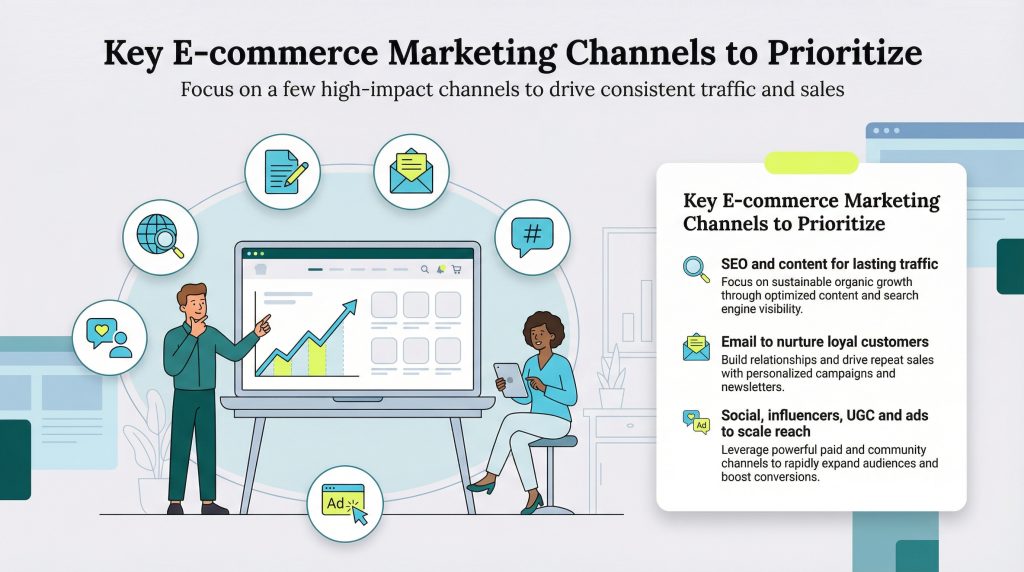
These channels—SEO, email, social media, and paid ads—are the fundamental tools you'll use. To see how they fit into a broader strategy, it's helpful to think about the goals of e-commerce marketing.
26 Need-to-Know Ecommerce Marketing Tactics (2025) - Shopify
This article from Shopify clearly defines the core purpose of e-commerce marketing.
Read the section "What is ecommerce marketing?". Focus on the three main goals mentioned: driving traffic, converting traffic into customers, and retaining those customers.
This "traffic, conversion, retention" model is a simple but powerful way to think about your marketing efforts. A more detailed framework breaks this down into four pillars: Acquisition, Conversion, Retention, and Analysis.
What Is Ecommerce Marketing? A Complete Beginner's Guide
This guide from Martech.org introduces a strategic framework for thinking about e-commerce growth.
Start by reading the section "What is ecommerce marketing?". Then, continue to the next section, "Pillars of modern ecommerce marketing", which introduces the four-pillar flywheel model.
Let's quickly break down what these pillars mean for your store:
- Acquisition: This is how you attract new visitors. It's about getting your brand in front of people who are looking for fitness equipment. This might happen through a Google search (SEO), a Facebook ad, or a post on Instagram.
- Conversion: Once a visitor is on your product page for a new adjustable kettlebell, how do you convince them to click "Add to Cart" and complete the purchase? This involves optimizing your website, writing great product descriptions, and building trust.
- Retention: After someone buys from you, the journey isn't over. This pillar is about encouraging them to come back and buy again. You might do this through a follow-up email with a discount on their next purchase or by sharing useful content like workout routines.
- Analysis: This is the process of looking at your data to see what's working and what isn't. Are your ads profitable? Which channel is bringing in the most customers? Analysis informs and improves all the other pillars.
Throughout this course, we will explore practical ways to execute strategies across these pillars using the key channels of digital marketing.
Conclusion
In this lesson, we established the foundational concepts of your marketing journey. You've learned that e-commerce is the act of selling online, while digital marketing is the engine that drives customers to your store.
Here are the key takeaways:
- Digital marketing is the process of using online channels to attract, convert, and retain customers for an e-commerce business.
- For a new dropshipping store, digital marketing is essential because it is cost-effective, highly targeted, measurable, and provides a global reach.
- The core activities of e-commerce marketing can be understood through the framework of Acquisition, Conversion, and Retention, using channels like SEO, paid ads, social media, and email.
You now have a solid mental model for what digital marketing is and why it matters. In our next lesson, we will dive deeper into the main digital marketing channels, giving you a clearer picture of each one's role in your overall strategy.