Welcome to the second lesson in our module on Spring Framework Fundamentals. In our previous lesson, we established a crucial foundation by learning how to manage a Java project using Maven. You now know how to define a project's structure, handle its dependencies through pom.xml, and use the build lifecycle. This frees us from the manual, error-prone tasks of library management and project compilation.
With that groundwork laid, we can now explore the core philosophy that makes the Spring Framework so powerful and popular for enterprise development. This lesson will introduce you to two fundamental principles: Inversion of Control (IoC) and Dependency Injection (DI). Understanding these concepts is essential, as they represent a significant shift in how you think about structuring an application. We'll explore what these principles mean, why they are beneficial, and how they relate to each other.
1. The Problem: Tightly Coupled Code
Before we dive into what IoC and DI are, let's first understand the problem they solve. In traditional object-oriented programming, when one object needs another to do its job, it often creates that object itself.
For example, imagine a UserService that needs a DatabaseService to fetch user data. A straightforward implementation would look like this:
public class DatabaseService {
    public String getUserData(int userId) {
        // Code to connect to a database and get data...
        return "User data for ID: " + userId;
    }
}

public class UserService {
    private DatabaseService databaseService;

    public UserService() {
        // UserService is responsible for creating its own dependency.
        this.databaseService = new DatabaseService();
    }

    public void displayUser(int userId) {
        String data = databaseService.getUserData(userId);
        System.out.println(data);
    }
}
This approach works, but it has a major drawback: the UserService is tightly coupled to the DatabaseService. What if you wanted to test UserService without connecting to a real database? Or what if you decided to switch from a SQL database to a NoSQL one, requiring a NoSQLDatabaseService? You would have to change the UserService code itself. This makes the code rigid, difficult to test in isolation, and hard to maintain.
The following video uses a great analogy of a chef and different food types to illustrate this problem of "hard dependencies."
Dependency Injection Made Simple with Java Examples | Clean Code and Best Practices | Geekific
This video, "Dependency Injection Made Simple" from the Geekific channel, provides a clear, non-framework-specific explanation of the problem.
First, watch the section that introduces the problem with a Chef and Burger example from the beginning. This demonstrates how inflexible tightly coupled code can be. Then, continue watching as the video introduces the solution from this point. It defines Dependency Injection and explains how it decouples the Chef from its dependencies, making it more flexible.
2. Dependency Injection (DI): The Pattern for Decoupling
As the video explained, the solution to tight coupling is to provide an object with its dependencies from an external source, rather than having the object create them itself. This pattern is called Dependency Injection (DI).
Let's refactor our earlier example to use DI. Instead of UserService creating DatabaseService, we will "inject" it through the constructor.
public class UserService {
    private final DatabaseService databaseService; // Dependency

    // The dependency is "injected" via the constructor.
    public UserService(DatabaseService databaseService) {
        this.databaseService = databaseService;
    }

    public void displayUser(int userId) {
        String data = databaseService.getUserData(userId);
        System.out.println(data);
    }
}

// In the main part of our application:
public class Main {
    public static void main(String[] args) {
        // The dependency is created outside and passed in.
        DatabaseService dbService = new DatabaseService();
        UserService userService = new UserService(dbService);

        userService.displayUser(101);
    }
}
Notice the difference: UserService no longer knows or cares how the DatabaseService is created. It just receives an object that fulfills its needs. This makes UserService highly flexible. We can easily give it a MockDatabaseService for testing or a different implementation entirely without changing UserService at all.
This brings us to the different ways dependencies can be injected.
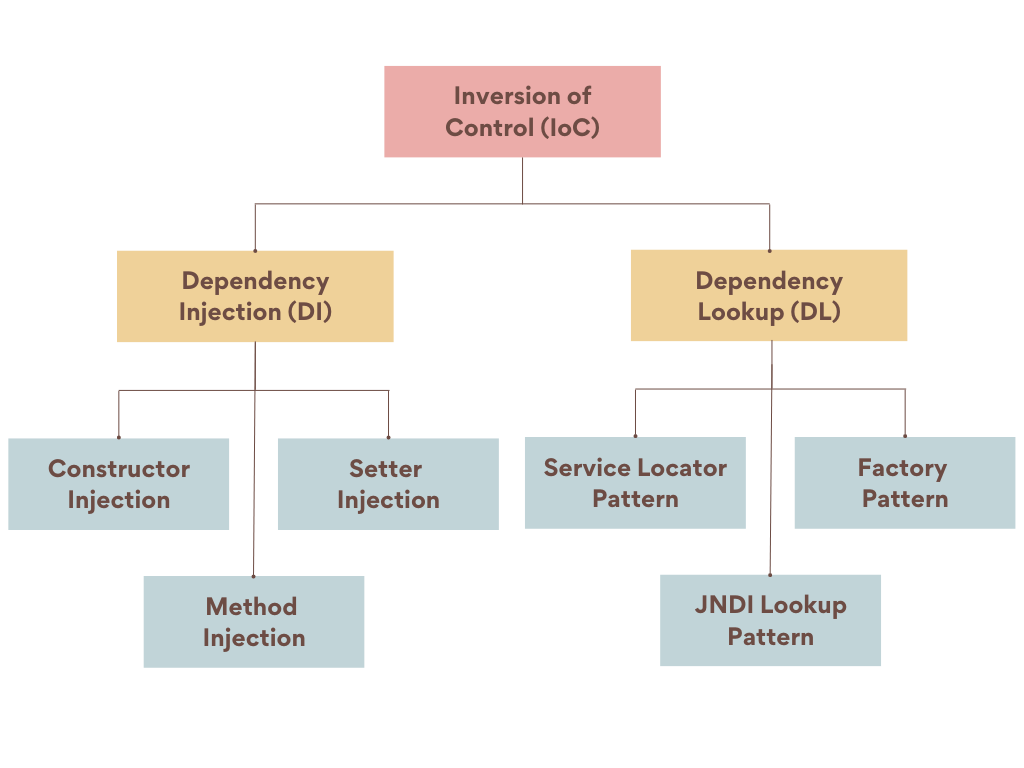
There are three primary types of Dependency Injection:
- Constructor Injection: Dependencies are provided as parameters to the constructor. This is the most recommended approach. It ensures that an object is created with all its required dependencies, so it's always in a valid state.
- Setter Injection: Dependencies are provided through public setter methods. This is useful for optional dependencies that are not essential for the object's initial state.
- Field Injection: Dependencies are injected directly into the fields (member variables), often using an annotation like
@Autowired. While this can look cleaner, it's generally discouraged because it hides dependencies, makes testing harder, and can violate the principle of immutability.
The following resource provides an excellent breakdown of these types.
Inversion of Control and Dependency Injection with Spring
This article from Baeldung is a classic reference for Spring concepts. It clearly explains the different forms of DI with code examples.
Start by reading the section on Constructor-Based DI. Then, read the section on Setter-Based DI, paying attention to the recommendation of using it for optional dependencies. Finally, review the section on Field-Based DI and note the reasons why it is often discouraged.
3. Inversion of Control (IoC): The Overarching Principle
Now a critical question arises: if UserService isn't creating DatabaseService, who is? In our simple Main method example, we were. But in a large application with hundreds of objects and complex dependency chains, managing this manually would be a nightmare.
This is where Inversion of Control (IoC) comes in. IoC is a design principle where you delegate the control of object creation and dependency management to an external container or framework. Instead of your code actively creating and linking objects, the framework does it for you based on some configuration.
This is often called the "Hollywood Principle": "Don't call us, we'll call you."
- Traditional Control: Your code calls a library. (
new DatabaseService()). - Inverted Control: The framework calls your code by creating objects and providing them where needed.
In the context of Spring, this framework is the Spring IoC Container.
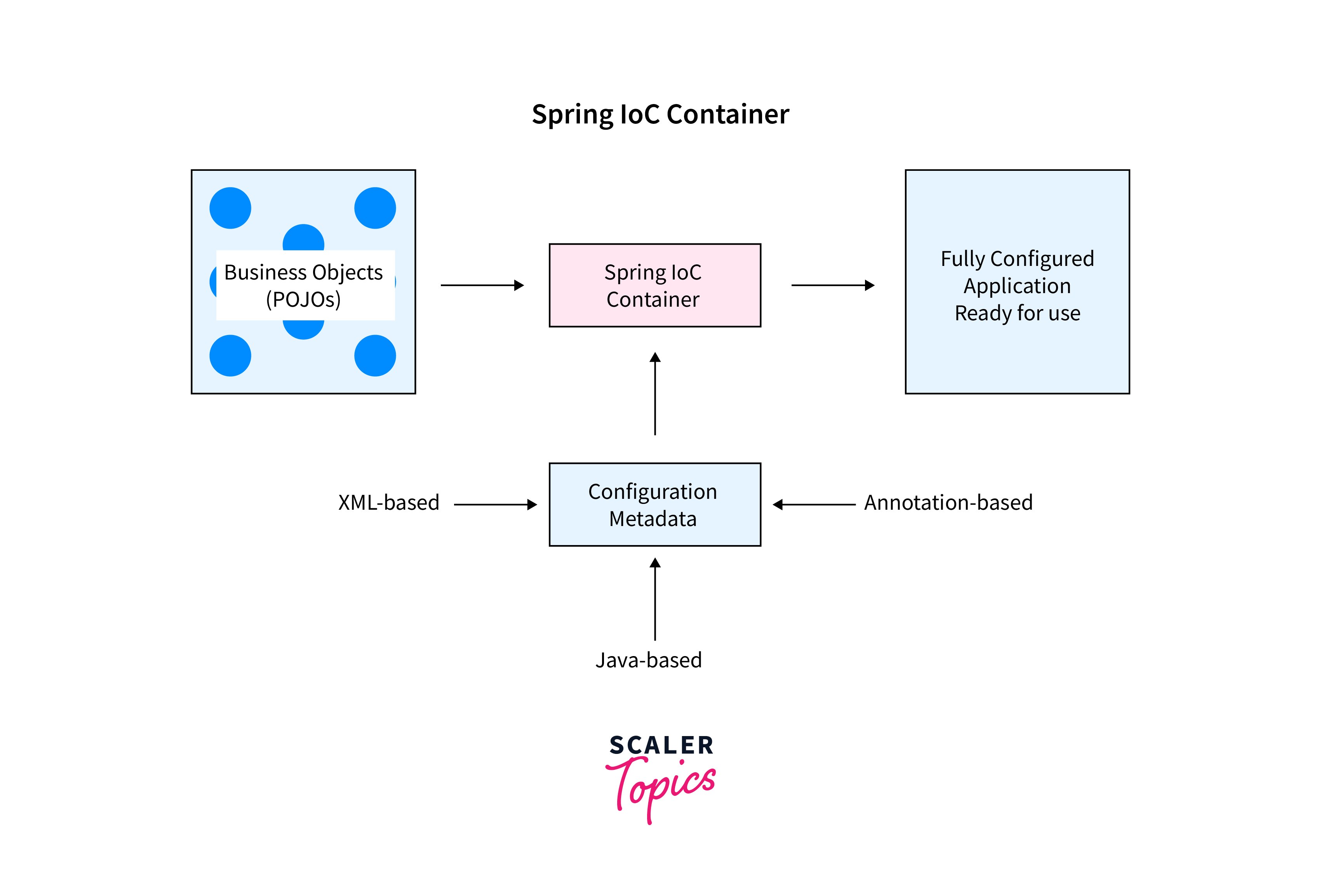
The relationship is simple: DI is the pattern that implements the IoC principle. Spring's IoC container uses Dependency Injection to wire together all the components (which Spring calls beans) of your application.
4. How Spring Puts It All Together
Let's see a practical demonstration of how Spring automates this process, freeing you from writing new everywhere. The following video walks through building a simple application first without Spring, and then with Spring, to highlight the difference.
Spring Boot : IOC & Dependency Injection | Code your 1st Spring Boot project | Spring core
This video from the Selenium Express channel provides a hands-on, step-by-step comparison that makes the benefits of Spring's IoC container very clear.
First, watch the "before" state from this segment. The presenter demonstrates the manual process of creating a Computer object and then manually creating and injecting its Keyboard dependency. This shows the tight coupling and boilerplate code that IoC and DI eliminate. Next, see how Spring is introduced to solve this. Watch from this part, where the presenter adds the Spring dependency and uses the @Component and @Autowired annotations. This is your first glimpse of how you tell the Spring container to take control. Finally, to understand how the container itself is managed in a modern Spring Boot application, watch the segment from this section. It shows how SpringApplication.run() and the @SpringBootApplication annotation bootstrap the entire IoC container, making the process almost transparent to the developer.
As the video demonstrates, Spring completely handles the object lifecycle. You simply declare your classes as components and specify their dependencies. The IoC container then:
- Scans your application to find these components.
- Creates instances of them (these instances are called "beans").
- Injects the required dependencies into each bean.
- Makes the fully-configured beans available for you to use.
Conclusion
In this lesson, we've unpacked the foundational principles of the Spring Framework. You've moved from simply managing a project with Maven to understanding the core philosophy that governs how a Spring application is built.
Key Takeaways:
- Tight Coupling is a design problem where objects are directly responsible for creating their own dependencies, making the code rigid and difficult to test.
- Dependency Injection (DI) is a design pattern that solves this by providing dependencies to an object from an external source. The main types are Constructor (recommended), Setter, and Field injection.
- Inversion of Control (IoC) is a broader principle where a framework or container takes over control of the application flow, including object creation and lifecycle management.
- The Spring IoC Container (
ApplicationContext) is Spring's implementation of this principle. It uses DI to automatically create and wire together the objects (beans) in your application.
You now have the conceptual framework to understand why Spring works the way it does. In our next lesson, we will get hands-on with this concept by learning how to formally define our classes as Spring beans using stereotype annotations like @Component, @Service, and @Repository. This is how you provide the "configuration metadata" that the IoC container needs to do its job.