Hello! Welcome to the first lesson in our course on the Databricks Data Engineer Associate certification.
This course is designed to take you from your current experience in data analytics and build the specific skills you need to become a certified Databricks Data Engineer. Given your interest in data engineering, this is a great first step.
Today, we'll start with the most fundamental concept underpinning the entire Databricks platform. Our goal is to differentiate between data lakes, data warehouses, and the lakehouse paradigm. Understanding these core architectural patterns is crucial because it explains why platforms like Databricks exist and what problems they solve. This conceptual foundation will serve you well throughout the course and in your future data engineering work.
Let's begin by exploring the two traditional approaches to storing and analyzing large amounts of data.
The Two Poles: Data Warehouses and Data Lakes
Historically, organizations faced a choice between two distinct types of data systems: data warehouses and data lakes. Each was designed for different purposes and handled data in fundamentally different ways.
To get a clear overview of these two systems, let's start with a video from IBM Technology that explains them well.
Data Lake vs. Data Warehouse vs. Data Lakehouse: Which One to Choose?
This video provides a concise explanation of data warehouses and data lakes. Please watch the first part, which introduces these two concepts.
Watch from the beginning until timestamp 02:25. Focus on how each system handles data types, the process for loading data (ETL vs. ELT), and their primary use cases.
As you saw in the video, these two architectures represent opposite ends of a spectrum. Let's summarize the key distinctions.
Data Warehouse
A data warehouse is a highly structured and optimized system, primarily built for business intelligence (BI) and reporting.
- Data Type: It stores structured data (like tables from a relational database) that has been cleaned, validated, and transformed.
- Schema: It uses a "schema-on-write" approach. This means the schema (the structure of the data) must be defined before the data is loaded into the warehouse. This ensures data quality and consistency but makes the system rigid.
- Process: The process is ETL (Extract, Transform, Load). Data is extracted from source systems, transformed into the desired format, and then loaded into the warehouse.
- Use Case: Ideal for generating predictable reports and dashboards where speed and reliability are paramount.
Data Lake
A data lake is a flexible, large-scale storage repository designed to hold vast quantities of raw data.
- Data Type: It can store data of any type: structured, semi-structured (like JSON or XML), and unstructured (like text, images, or audio).
- Schema: It uses a "schema-on-read" approach. Raw data is loaded as-is, and a schema is applied only when the data is read for analysis. This provides immense flexibility.
- Process: The process is ELT (Extract, Load, Transform). Data is extracted and loaded directly into the lake in its raw format. Transformation happens later, as needed for a specific analysis.
- Use Case: Perfect for exploratory data analysis, data science, and machine learning, where data scientists need access to raw, unaltered data to build and train models.
To give an analogy from your physics background, a data warehouse is like a published table of experimental results in a scientific paper—perfectly structured, validated, and ready for others to cite. A data lake is like the complete, raw output from the particle detector—all event files, log data, and sensor readings in their original formats. It's not immediately ready for a summary report, but it contains all the information needed for a physicist to perform a novel analysis.
To reinforce these differences, please review the following summary from a Databricks blog post.
Data Lakes vs Data Warehouses Explained | Databricks Blog
This article, 'Data Lakes vs Data Warehouses Explained', contains a concise table that summarizes the key differences. It's a great quick reference.
Please read the section titled 'Key Differences: A Quick Recap' and pay close attention to the comparison table.
The Problem with Two Systems
The challenge for many organizations was that they needed both BI reporting and advanced analytics. This often led to a complex and expensive two-tier architecture:
- A data lake for storing all raw data and for ML workloads.
- A data warehouse for BI and reporting, fed by ETL pipelines from the data lake.
This setup created data silos, increased storage costs due to data duplication, and introduced governance challenges in keeping the two systems synchronized. This is the problem the "lakehouse" was designed to solve.
The Synthesis: The Data Lakehouse
The data lakehouse is a modern architecture that combines the benefits of both data lakes and data warehouses into a single, unified platform.
Let's return to the IBM video to see how the lakehouse achieves this and how it compares to the other two systems.
Data Lake vs. Data Warehouse vs. Data Lakehouse: Which One to Choose?
Now, let's watch the remainder of the video, which introduces the data lakehouse and provides a detailed comparison across six key dimensions.
Watch from timestamp 02:25 to the end. Focus on how the lakehouse merges features from both warehouses and lakes, particularly regarding data types, cost, performance, and flexibility.
The core idea of the lakehouse is to implement data warehouse-like features (such as data management and transactions) directly on top of the low-cost, flexible storage used for data lakes (like Amazon S3, Azure Blob Storage, or Google Cloud Storage).
This is visually represented in the diagram below.
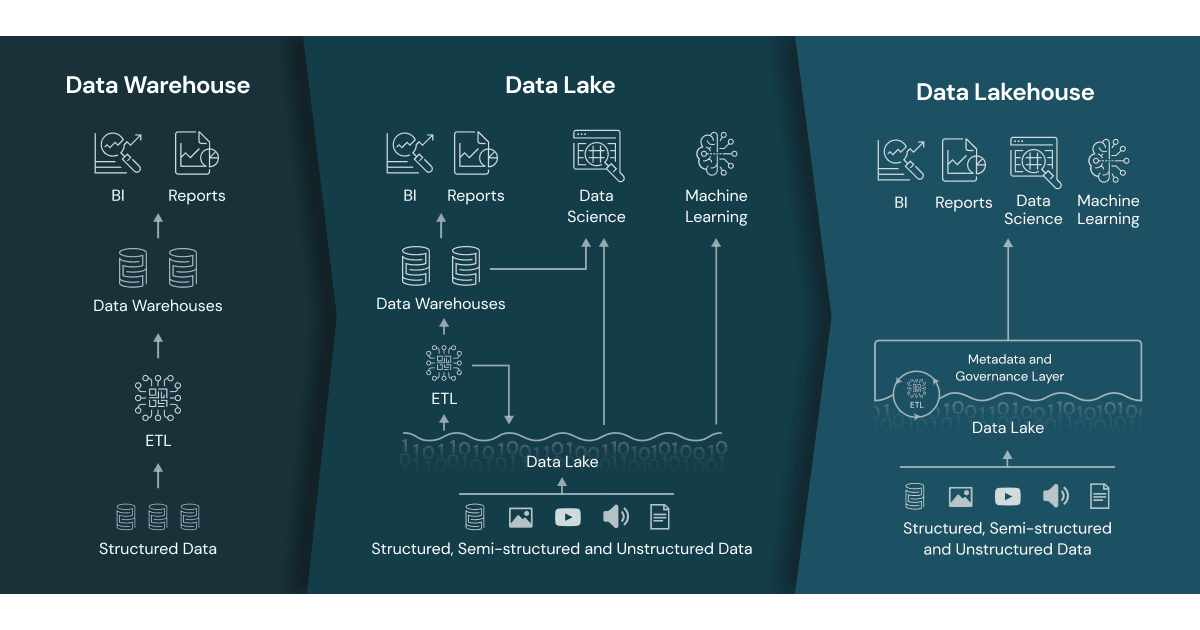
The technology that makes this possible in the Databricks ecosystem is Delta Lake, an open-source storage layer. We will dive deep into Delta Lake in Module 3, but for now, just know that it brings reliability (through ACID transactions) and performance to data lakes, effectively turning them into lakehouses.
The following article from Microsoft's documentation provides another excellent summary of these concepts.
What is a data lakehouse? - Azure Databricks
This document from Microsoft Azure provides another clear breakdown of the three architectures.
Please read the section titled 'Lakehouse vs Data Lake vs Data Warehouse'. It effectively summarizes the evolution and the combined benefits offered by the lakehouse.
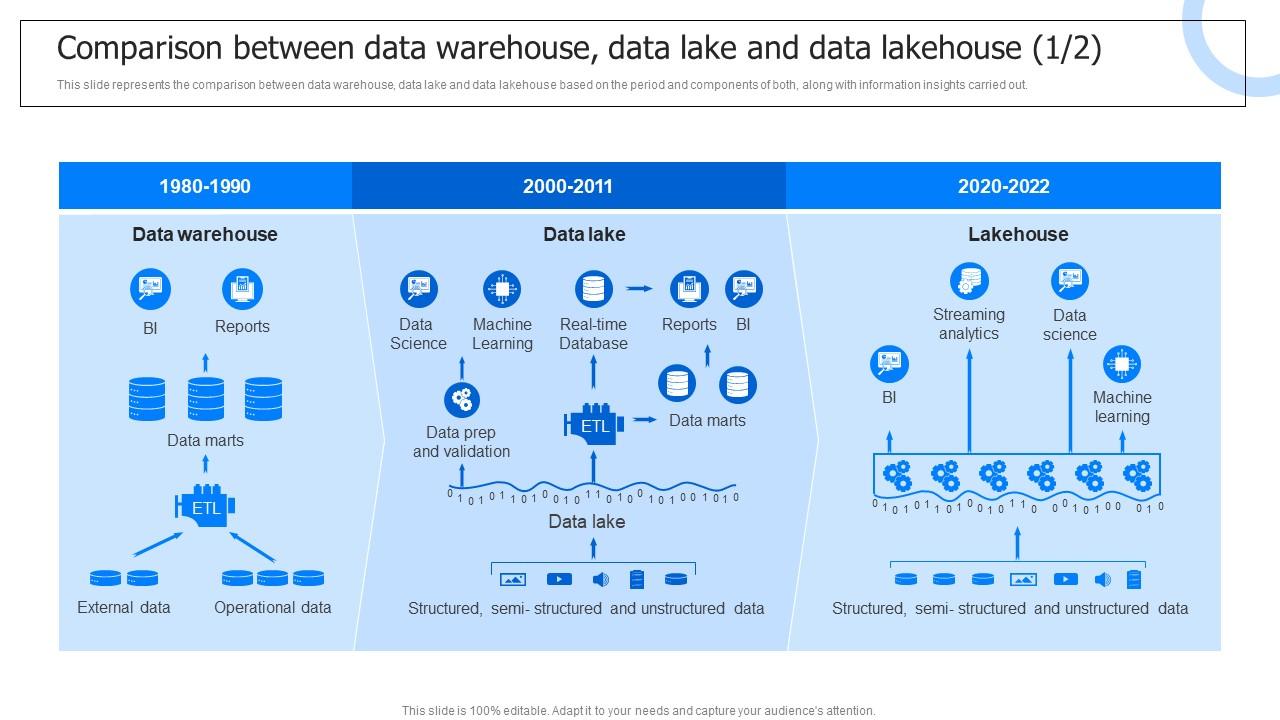
Putting It All Together: An Evolutionary View
It's helpful to see these architectures as an evolution over time, with each new paradigm building on the last to meet new demands.
To solidify your understanding, consider these scenarios:
-
Scenario A: Your finance team needs highly reliable, daily reports on company revenue, drawing from a structured sales database. The queries must be fast and the data must be perfectly consistent. Which architecture was traditionally designed for this?
Answer
A Data Warehouse is the classic choice here, due to its optimization for BI workloads, high performance, and strong data consistency guarantees (schema-on-write). -
Scenario B: A data science team is tasked with developing a fraud detection model. They need to analyze raw, unstructured server logs, semi-structured user activity data (JSON), and structured transaction records. They need the flexibility to explore and experiment with all the raw data. Which architecture would they use to store this data?
Answer
A Data Lake is ideal for this scenario. It can store all the different data types in their raw format, providing the flexibility needed for data exploration and model development (schema-on-read). -
Scenario C: An organization wants both the finance reports from Scenario A and the fraud model from Scenario B. They want to avoid data duplication and ensure both teams are working from a single source of truth. Which architecture would achieve this?
Answer
The Data Lakehouse is the solution. It provides a single platform where raw data can be stored for ML, while also offering the structure, governance, and performance needed for the finance team's BI reports, all on the same copy of the data.
Key Takeaways
You've successfully covered the first foundational concept for your certification. Let's summarize:
- Data Warehouse: Optimized for BI and reporting. It uses structured data, a rigid schema-on-write model, and an ETL process.
- Data Lake: Built for scalability and flexibility, ideal for data science and ML. It handles all data types, uses a flexible schema-on-read model, and an ELT process.
- Data Lakehouse: A unified architecture that combines the low-cost storage of a data lake with the reliability, performance, and data management features of a data warehouse. It serves as a single source of truth for both BI and AI use cases.
Next Steps
In our next lesson, we will move from theory to practice. You will learn to describe the architecture and key components of the Databricks Lakehouse Platform. We will see how Databricks has built a platform that fully realizes the lakehouse vision.