Welcome to the final lesson in our "Foundations of Global Payroll" module. In our previous lesson, we established the critical logic for prorating pay, ensuring that an employee's earned salary accurately reflects their time worked. We now have a solid model for calculating what the employee earns. This lesson takes the next logical step by asking: what does the employee cost?
Today, we will identify the specific data components required to calculate the full picture of employer liabilities and the total cost of employment. This moves our focus from the employee's payslip to the company's balance sheet. Understanding these components is fundamental for your goal of building a payroll module. Your system must not only calculate net pay but also track, accrue, and report on all the associated costs the company bears, from mandatory social security contributions to provisions for future benefits.
From Earned Salary to Cost to Company (CTC)
In the business world, especially in India, the total cost of employing someone is often referred to as "Cost to Company" or CTC. This figure represents the entire expense a company incurs for an employee, which is significantly more than just their take-home salary. To begin, let's explore this distinction.
The following video provides a concise overview of CTC versus in-hand salary, breaking down a typical salary structure in India.
CTC VS In Hand Salary - Understanding Salary Structure
This video from Wealth Cafe Financial clearly explains the concept of CTC and introduces the various components that contribute to it but may not appear in an employee's monthly bank transfer.
Please watch from the beginning until the main breakdown. As you watch, note down the components that are part of the CTC but are not direct monthly payments, such as insurance premiums and contributions to retirement funds.
As the video explained, the CTC is the sum of all direct payments, indirect benefits, and savings contributions made on behalf of an employee. This leads to a crucial formula for your system's logic: CTC > Gross Salary > Net Salary.

This image shows a detailed CTC structure for an employee in India. Notice how it's divided into "Payslip Components," a "Flexible Benefit Plan," and "Benefits." The first two sections largely constitute the employee's gross pay, while the "Benefits" section, containing items like the employer's PF contribution and Gratuity, represents direct employer liabilities that are part of the total cost but not part of the monthly pay.
Employer Liabilities: The Core Components
The difference between CTC and an employee's gross salary is primarily composed of employer liabilities. These are costs the employer is obligated to pay on top of the salary. For your payroll module, these liabilities must be calculated and accounted for with every pay run.
Let's refine our understanding of two key components that are part of CTC but are not paid out monthly: Gratuity and the employer's contribution to the Provident Fund (PF).
What is the difference between CTC and Net Salary? | CA Rachana Ranade
In this segment, CA Rachana Ranade explains precisely why Gratuity and the employer's PF contribution are excluded from the gross salary calculation, even though they are a significant part of the employee's total compensation package and the employer's total cost.
Please watch the section from this explanation. Pay close attention to the logic: Gratuity is a future liability contingent on service length, and the employer's PF contribution is a direct payment to a government fund, not to the employee.
Based on this, we can start to categorize the data components your system will need to track for total employment cost:
- Direct Remuneration: This is the employee's gross pay, comprising Basic Salary, various allowances (like HRA), and any bonuses paid out.
- Statutory Contributions (Employer's Share): These are mandatory, government-mandated payments based on the employee's salary.
- Provident Fund (PF) / Social Security: The employer's matching contribution (e.g., 12% in India for EPF, 6.2% in the US for Social Security).
- Social & Health Insurance: Contributions to state-run insurance schemes (e.g., ESI in India, German statutory health insurance).
- Unemployment Insurance: Taxes to fund unemployment benefits (e.g., SUI in the US).
- Professional Tax: A state-level tax in India, levied on the employee but facilitated by the employer.
- Provisions & Accruals: These are funds set aside to meet future obligations.
- Gratuity (India): A liability that accrues over the employee's tenure and is paid upon leaving after a certain period.
- Leave Encashment: The cost of unused vacation days that the company may have to pay out.
- Benefits & Perquisites: The cost of non-cash benefits provided to the employee.
- Insurance Premiums: Health, life, or disability insurance paid by the employer.
- Reimbursements: Allowances for expenses like phone bills, internet, or travel (LTA in India).
The Global Context: "Employer Burden"
This structure is not unique to India. Globally, the sum of mandatory employer-side costs is often called the "employer burden." This burden varies dramatically between countries and is a critical data point for any MNC.
The following resource provides an excellent high-level overview of how to calculate this total cost and how the employer burden differs across your target geographies.
EOR Cost 2026: 31-Provider Pricing Comparison & Hidden Fees
This article, while framed around Employer of Record (EOR) services, provides a clear, finance-oriented breakdown of total employment costs.
Please read the following sections: Start with the formula for calculating the true cost. This is the core logic you'll need to model. Next, review the table under "EOR cost breakdown". Compare the "Employer burden %" for the US, Germany, and India. This highlights the jurisdictional variance you must account for. Finally, examine the larger table under "EOR pricing by country". Focus on the "Notes" column for the US, Germany, India, and Brazil to see what these burdens typically include (e.g., "EPF + ESI + gratuity provision" for India).
A Deeper Look at Cost Components
The articles you've reviewed highlight that base salary is just the beginning. Let's use another resource to solidify our understanding of the specific components that make up the total cost, particularly in your target countries.
Employee Cost Calculator 2026 — True Employer Cost by Country
This resource breaks down the "true cost of an employee" into its constituent parts and provides specific details for several countries.
Please read the following sections: Why base salary is just the start, noting the examples for the US, Germany, and Brazil. The key cost components, which categorizes the main employer liabilities. Under the FAQ, read the answer to "Which country has the highest total employer cost?" for specific details on Brazil's high employer burden (INSS, FGTS, 13th month salary). Also under the FAQ, read the answer to "What are the employer costs for hiring in India?" to reinforce your understanding of EPF and ESI.
Synthesizing for Your Payroll Module
To build your payroll software, you must translate these concepts into a data model. Your system will need to store and process a wide range of data points to correctly calculate both net pay and total employer cost.
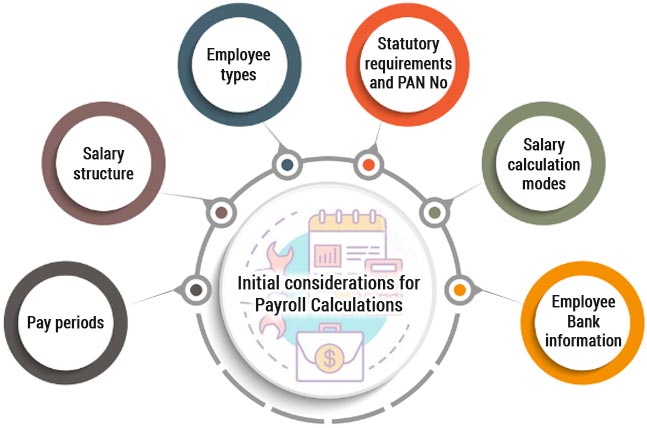
This mind map illustrates the key data categories required for payroll. Our focus on employer liabilities expands on "Salary structure" and "Statutory requirements."
Based on today's lesson, here is a list of essential data components your system must handle to calculate employer liabilities:
Employee-Specific Data:
- Gross salary components (Basic, allowances, etc.)
- Eligibility flags for specific contributions (e.g., Is the employee's salary below the ESI threshold in India? Are they an exempt or non-exempt employee in the US?)
- Voluntary deduction choices (e.g., additional NPS contribution).
Company Policy Data:
- Employer's share of benefit premiums (e.g., 80% of health insurance cost).
- Company-specific benefits or allowances (e.g., internet reimbursement limits).
- Accrual policies (e.g., rules for leave encashment).
Jurisdictional Data (Configurable by Country/State):
- Contribution Rates:
- Employer EPF rate (India)
- Employer ESI rate (India)
- FICA tax rates (US)
- SUI tax rate (varies by US state)
- Social security rates for health, pension, unemployment (Germany)
- INSS and FGTS rates (Brazil)
- Wage Ceilings:
- Salary cap for EPF wage calculation (India)
- Social Security wage base limit (US)
- Tax Slabs:
- Professional Tax slabs (varies by Indian state)
- Mandatory Provisions:
- Gratuity calculation rules (India)
- Rules for mandatory 13th-month salary (Brazil)
Your payroll module will need to pull data from all three categories to accurately compute the total cost for each employee in each pay cycle.
Conclusion
In this lesson, we have moved beyond the employee's net pay to map out the full landscape of the total cost of employment. You can now identify the critical data components that constitute an employer's financial liability for each employee.
Key Takeaways:
- Total Cost of Employment (or CTC) is the sum of an employee's gross salary, the employer's statutory contributions, and the cost of any additional benefits or provisions.
- The primary components of employer liability are statutory contributions (like social security, insurance), provisions for future payments (like gratuity), and the cost of benefits (like health insurance).
- These costs, often termed the "employer burden," are highly dependent on the legal and fiscal framework of each country, making them a critical variable in a global payroll system.
- Your payroll module must be architected to handle these distinct data categories—employee, policy, and jurisdiction—to ensure accurate and compliant calculations.
Preview of the Next Module:
We have now completed our foundational overview of global payroll concepts. We've defined pay components, understood proration, and identified total employer costs. With this solid foundation, we are ready to dive deep into the specific calculation logic for our primary jurisdiction: India.
In the next lesson, we will begin Module 2 by tackling the very core of the Indian salary structure: calculating the Basic Salary and applying the complex but crucial exemption logic for House Rent Allowance (HRA).