In our last few lessons, we've carefully mapped out the landscape of employee compensation, defining gross pay, its components, and the various statutory and voluntary deductions that lead to net pay. We now have a clear model of what gets paid and what gets deducted in a typical pay cycle. However, a crucial piece of logic is still missing: what happens when an employee doesn't work for the full pay period?
This lesson addresses that exact question by focusing on the business logic for calculating prorated pay. We will explore how to adjust earnings and deductions for mid-cycle events like new hires, employee departures, and periods of unpaid leave. For your goal of building a robust payroll module, mastering proration logic is essential. It's a fundamental calculation that ensures fairness and accuracy, forming the very foundation of the payroll run for any employee who hasn't worked the complete cycle.
What is Proration?
Proration is the process of proportionally adjusting an employee's salary and other compensation components to reflect the actual number of days they worked within a given pay period. Your payroll system must trigger proration logic in several common scenarios:
- Mid-cycle Joiners: An employee is hired after the first day of the pay period.
- Mid-cycle Leavers: An employee's last day of work is before the end of the pay period.
- Unpaid Leave: An employee takes one or more days of leave that are not covered by their paid leave balance. This is often called Loss of Pay (LOP) or Leave Without Pay (LWP).
- Mid-cycle Salary Changes: An employee receives a raise or a change in their compensation structure partway through a pay period.
The image below shows a real-world example of how proration is applied when an employee's salary changes during a bonus period.
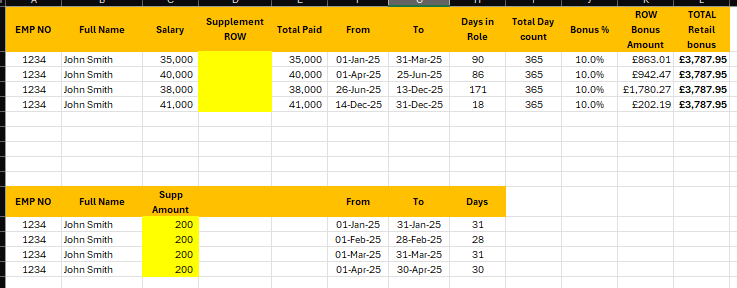
As you can see, the system must break the year into distinct periods based on salary changes and calculate the bonus for each segment proportionally. The same principle applies to regular salary calculations within a single month.
The Core Logic: Two Methods for Proration
When building the logic for your payroll engine, you'll find there are two primary methods for prorating pay. The choice between them is typically a matter of company policy or, in some jurisdictions, local regulations.
Let's explore these methods using the documentation from Oracle's HR system, which provides a clear and professional breakdown.
How Prorated Earnings and Deductions are Calculated
This document outlines the standard industry approaches to proration. It provides concrete formulas and examples that you can translate directly into business logic.
Please focus on the two main examples provided: First, read the section based on calendar days. Pay close attention to how the formula uses the total days in the period as the denominator. Next, read the section based on a work schedule. Notice how the denominator changes to reflect scheduled workdays or hours, not just calendar days.
Let's unpack the logic from that reading.
Method 1: Calendar Day Proration
This is often the simplest method to implement. The employee's pay is based on the number of calendar days they were employed or "active" during the pay period.
The general formula is:
Where "Days Payable" are the number of calendar days the employee was on the payroll during that month.
For example, an employee joins on April 16th with a monthly salary of ₹60,000. April has 30 days.
- Days Payable: 15 (April 16 to April 30 inclusive)
- Calculation:
This method is straightforward but can lead to slight variations in daily pay rates between months (e.g., the daily rate in February is higher than in March).
Method 2: Working Day Proration
This method is often considered more precise as it accounts for the actual work schedule, including weekends and public holidays. It requires your system to have access to the company's work calendar and the employee's specific schedule.
The general formula is:
Let's use the same scenario: an employee joins on April 16th with a salary of ₹60,000. Assume there are 22 working days in April, and from April 16th to 30th, there are 11 working days.
- Days Worked: 11
- Calculation:
In this specific example, the result is the same, but it wouldn't be if the start date was different. For instance, if the employee started on April 15th (a Friday), the Calendar Day method would add 1 day of pay, while the Working Day method would also add 1 day of pay. But if they started on April 18th (a Monday), the Calendar Day method would pay for 13 days, while the Working Day method might only count 10 working days if the weekends are unpaid. The choice of method is a crucial policy decision for any organization.
Unpaid Leave: Loss of Pay (LOP)
One of the most frequent triggers for proration is when an employee takes unpaid leave. In India and many other regions, this is commonly referred to as Loss of Pay (LOP) or Leave Without Pay (LWP). Your system must be able to deduct pay for these absences.
The following resource from Zoho Payroll provides an excellent overview of LOP, its rules, and its calculation, with a specific focus on the Indian context.
What is loss of pay (LOP) in salary & how is it calculated?
This article details the business logic for handling unpaid leave in India. It's a practical guide that aligns perfectly with your goal of building a payroll module.
Please read the following sections: First, understand the definition of LOP and when it applies. Next, review the general rules and policy considerations. Finally, focus on the calculation logic and formula.
The key takeaway from the reading is the formula for calculating the LOP deduction amount:
LOP Deduction = (Employee's monthly salary / Number of working days in the month) X Number of LOP days
As you can see, this is a direct application of the "Working Day Proration" method we discussed earlier. The system calculates a daily rate based on working days and multiplies it by the number of unpaid leave days to determine the amount to be deducted from the gross salary. The article notes that some companies use calendar days, reinforcing that the proration method is a configurable policy in any robust payroll system.
Downstream Impact of LOP
This is a critical point for you as a developer. A change in earned salary due to LOP is not an isolated event. It has a cascading effect on other payroll components, particularly statutory contributions that are calculated as a percentage of salary.
The Zoho article you just reviewed explains this well. Let's formalize that logic.
What is loss of pay (LOP) in salary & how is it calculated?
This section connects the concept of LOP back to the statutory benefits we've previously discussed.
Please read the section on benefit impacts. Note how EPF, Gratuity, and ESI are all affected by a reduction in monthly salary.
Here is the business logic you need to implement:
- Calculate Gross Salary: Determine the full gross salary for the month.
- Calculate LOP Deduction: Based on the number of unpaid leave days and the company's chosen proration method (working days or calendar days), calculate the total LOP deduction.
- Calculate Earned Salary:
Earned Salary = Gross Salary - LOP Deduction. - Calculate Statutory Contributions: This is the key step. All statutory deductions that are based on salary must now be calculated using the Earned Salary, not the original Gross Salary.
- EPF: The 12% employee contribution is calculated on the earned Basic + DA for the month.
- ESI: The 0.75% employee contribution is calculated on the earned Gross Pay for the month.
Your system's processing flow must follow this exact sequence to ensure compliance. First prorate, then calculate contributions.
Finally, a payroll system must also handle corrections. Sometimes LOP is deducted incorrectly, or an unapproved leave is later approved. Your system needs a function for LOP Reversal, which credits the wrongly deducted amount back to the employee, typically in the next pay run. The Zoho article briefly covers this in the section What is LOP reversal and how is it done?, which is a good concept to keep in mind for your design.
Conclusion
In this lesson, we've established the core business logic for prorating pay, a non-negotiable function for any payroll system. You are now equipped to design a module that can accurately handle pay calculations for employees who work partial periods.
Key Takeaways:
- Proration is the proportional adjustment of salary for mid-cycle joiners, leavers, and employees on unpaid leave.
- The two main calculation methods are Calendar Day Proration and Working Day Proration. The method used is a key policy setting in the system.
- Loss of Pay (LOP) is the specific term for proration due to unpaid leave and is a common scenario, especially in India.
- Proration has a downstream impact: the adjusted "earned salary" must be used as the basis for calculating statutory contributions like EPF and ESI.
Preview of the Next Lesson:
Now that we have a solid grasp of how to calculate an employee's gross pay, even in complex partial-period scenarios, we are ready to look beyond the employee's payslip. The next lesson will focus on employer liabilities—the additional costs an employer incurs on top of salary, such as their share of provident fund and social insurance contributions. This will give us the complete picture of the true total cost of employment.