Introduction
Welcome to the first lesson in our module on counterfactual reasoning. In the previous modules, we established a solid foundation for designing your triadic experiment and identifying causal effects, culminating in an understanding of subtle biases like Berkson's paradox. We have focused on the crucial question of whether a causal effect is identifiable from data. Now, we shift our focus from identification to reasoning. We will move up the Ladder of Causation from intervention to the realm of "what if" questions.
This lesson addresses the fundamental task of formulating counterfactual queries. For a system as interconnected as your vee triad, where one person's actions affect everyone's outcomes, simple questions are insufficient. You will learn how to use the formal language of potential outcomes to construct precise, unambiguous counterfactual questions that account for these simultaneous, system-wide effects. This is the essential first step before we can attempt to compute the answers to these questions in subsequent lessons.
1. From Factual to Counterfactual
At its heart, a counterfactual question asks what would have happened under circumstances different from what actually occurred. In causal inference, we distinguish between the factual world, which we observe, and the counterfactual world, which is a hypothetical reality we can only imagine. The "fundamental problem of causal inference," which you know well, is that for any single individual or system at a single point in time, we can only observe one of these worlds.
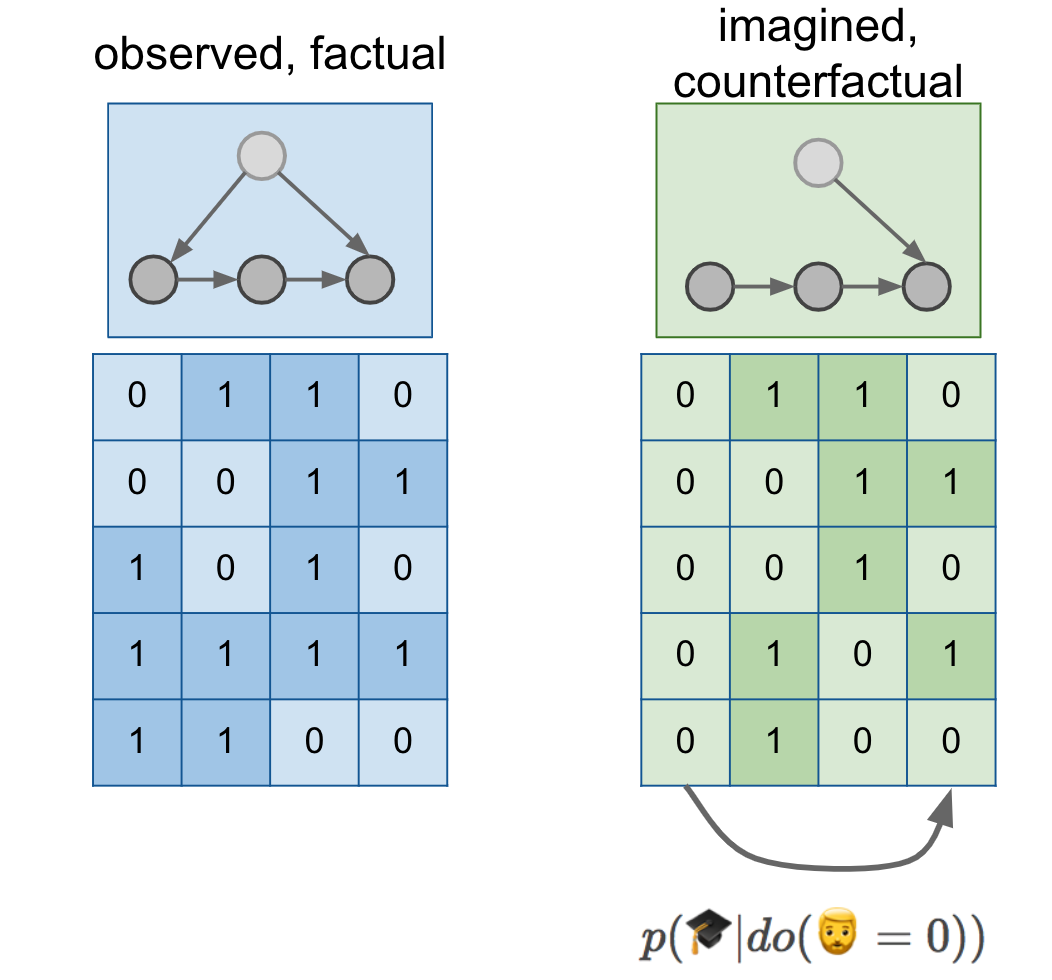
The do-calculus we've worked with allows us to answer interventional questions, like "What would the average satisfaction be if we forced all triads to adopt a certain living arrangement?" This is a question about the distribution of outcomes in a population under a hypothetical intervention. A counterfactual query is more specific and personal. It takes the form: "Given that we observed a specific outcome for this particular triad under this specific arrangement, what would their outcome have been under a different arrangement?"
The following short video provides a crisp review of this distinction and the core idea of counterfactuals.
14 - Counterfactuals and Mediation
This video from Brady Neal's "Causal Inference" series serves as an excellent refresher on the fundamental problem of causal inference and how structural causal models (SCMs) allow us to formally approach counterfactuals.
Please watch these two segments: The first part, "The Fundamental Problem", revisits why we cannot simultaneously observe both factual and counterfactual outcomes for a single unit. The next section, "Computing Counterfactuals", introduces the notation for counterfactuals and lays out the conceptual roadmap for how SCMs help us overcome this fundamental problem. Pay close attention to the distinction between an interventional do(t) expression and a counterfactual expression.
2. Formalizing Queries in an Interconnected System
In a simple experiment, a unit i's potential outcome depends only on its own treatment, t_i, which we write as Y_i(t_i). Your vee triad, however, is a network. The satisfaction of one member depends on the actions and treatments of the others—a classic case of interference.
To handle this, we must expand our notation. The potential outcome for any individual i in the triad must be a function of the entire treatment vector t that specifies the treatment for every relevant member of the system. We write this as Y_i(t).
Let's denote the members of your vee triad as A (the pivot), B (partner 1), and C (partner 2). Let the treatment vector be t = (t_B, t_C), where t_B and t_C are actions taken by partners B and C, respectively. A's satisfaction, Y_A, is a function of what both B and C do. Thus, A's potential outcome is written as Y_A(t_B, t_C). Similarly, B's satisfaction depends on their own action and C's action, so we have Y_B(t_B, t_C).
The DAG below illustrates this interdependence for two units, i and j (which you can think of as partners B and C). The action of unit i, A_i^{(T)}, and the action of unit j, A_j^{(T)}, both influence the outcomes of i and j (Y_i and Y_j).

This formal notation is the bedrock of modern causal inference on networks. The following paper provides the precise definitions we will use. Given your background in causal analysis, you will find its formal structure for handling interference highly relevant.
Estimating Heterogeneous Causal Effect on Networks via ... - arXiv
This paper develops a method for estimating causal effects on networks, and its initial sections provide a clear and formal setup for our problem.
Please read the following: Section 3, "Notations": Focus on how potential outcomes are defined. The key is the notation Yi(t), which explicitly makes an individual's outcome dependent on the full treatment vector. This is the formal representation of interference. Section 4, "Orthogonal heterogeneous interference structure": Read the first two paragraphs, from the start down to the end of Assumption 2. This section defines key estimands—Individual Total, Direct, and Spillover Effects (ITE, IDE, ISE)—as contrasts between different potential outcomes. This provides the building blocks for our counterfactual queries. Also, note Assumption 1 (local interference); in our triad, this is the reasonable assumption that a member's satisfaction is only affected by the other two members, not people outside the triad.
3. Constructing Counterfactual Queries for the Vee Triad
Armed with this formal notation, we can now move from vague "what if" questions to precise, answerable queries. Let's consider the living arrangement experiment from our course plan.
- Units: Pivot
A, PartnerB, PartnerC. - Treatment: A single, triad-level variable
Tdescribing the living arrangement. - Treatment Levels:
t_1= All three members live together.t_2= PivotAlives with PartnerB;Clives separately.t_3= PivotAlives with PartnerC;Blives separately.
The potential satisfaction for any person i \in \{A, B, C\} is Y_i(t_k).
Now, let's formulate some queries.
Factual Scenario: In one phase of your N-of-1 crossover trial, the triad adopts arrangement t_2. You measure Partner B's satisfaction and find it to be 85. This is a factual observation: Y_B(t_2) = 85.
Counterfactual Query 1: A Question of Total Effect
- In English: "Given that B's satisfaction was 85 when living with A alone, what would B's satisfaction have been if all three had lived together?"
- Formal Query: We are asking for the value of
Y_B(t_1)conditional on the evidenceT=t_2andY_B(t_2)=85.
Counterfactual Query 2: Decomposing Effects
To isolate direct and spillover effects, we need a treatment that is assigned at the individual level. Let's define a new treatment for partners B and C: participation in a weekly structured communication session with A.
- Treatment vector:
t = (t_B, t_C), wheret_i=1if partneriparticipates,t_i=0if not.
Factual Scenario: Both partners participate, t=(1,1), and you observe C's satisfaction, Y_C(1,1).
-
Query for Direct Effect on C (in English): "What would be the change in C's satisfaction from participating versus not, assuming B does not participate in either scenario?"
-
Formal Query: This corresponds to the Individual Direct Effect (IDE) for C. We are asking for the value of
E[Y_C(t_B=0, t_C=1) - Y_C(t_B=0, t_C=0)]. -
Query for Spillover Effect on C (in English): "What effect does B's participation have on C's satisfaction, assuming C themselves does not participate?"
-
Formal Query: This corresponds to the Individual Spillover Effect (ISE) of B on C. We are asking for the value of
E[Y_C(t_B=1, t_C=0) - Y_C(t_B=0, t_C=0)].
This process of breaking down a complex question into contrasts between formally defined potential outcomes is the essence of formulating counterfactual queries in an interconnected system.
4. A Preview of Computation
Formulating the question is the first step. Answering it—computing the value of the counterfactual—requires a model of the world. Specifically, it requires a Structural Causal Model (SCM). While the details are the subject of our next lesson, it's useful to understand the general process now.
Judea Pearl outlines a three-step algorithm for computing unit-level counterfactuals:
- Abduction: Use the factual evidence (e.g.,
Y_B(t_2) = 85) to update our belief about the unobserved, latent characteristics (U) of the specific unit or system. In our case,Urepresents the unique, stable psychological dynamics of this particular triad. The observation that B was happy in arrangementt_2tells us something about their underlying nature. - Action (or Modification): Modify the SCM to represent the counterfactual world. This is done by using the
do-operator to set the treatment variable to its counterfactual value (e.g.,do(T=t_1)). - Prediction (or Computation): Use the modified model and the inferred information about
Ufrom step 1 to compute the outcome in the counterfactual world.
The following video walks through this three-step process with a simple, clear example.
14.2 - Computing Counterfactuals
This video, also from Brady Neal, provides the mechanics of computing counterfactuals once you have a parametric SCM.
Watch the segment from "a very simple example" to see a complete walk-through of the three-step process for a deterministic case. The next short section, "general steps", explicitly names the three steps: Abduction, Action, and Prediction. Finally, watch the section on non-invertible examples. This is crucial, as it explains what happens when the evidence doesn't point to a single value of U. In this more realistic case, we don't get a single number for our counterfactual, but rather a probability distribution over possible outcomes.
This process gives us a powerful conceptual framework. By observing how our triad behaves under one arrangement, we can infer their underlying relational "physics" and use that to predict how they might have behaved under another.
Conclusion
In this lesson, we have laid the groundwork for counterfactual reasoning within your complex triadic system. You have learned how to move beyond simple "what if" notions to construct precise, formally-stated queries that rigorously account for interference.
Key Takeaways:
- A counterfactual query asks what would have happened to a specific unit under a hypothetical condition, given a factual observation about that unit.
- In systems with interference, potential outcomes must be defined over the entire treatment vector:
Y_i(t). - Counterfactual queries about direct and spillover effects can be formulated as contrasts between potential outcomes under different treatment vectors (e.g.,
Y_i(t_A=1, t_B=0)vs.Y_i(t_A=0, t_B=0)). - Computing the answer to a unit-level counterfactual query requires a structural model and follows a three-step process: abduction, action, and prediction.
We have focused today on formulating the right questions. In our next lesson, "Compute counterfactual outcomes for each member under alternative arrangements," we will take the next logical step: building a structural causal model for the vee triad and using it to actually compute the answers to these queries.