Introduction
In our previous lesson, we surveyed methods for identifying causal effects in the presence of unmeasured confounding, culminating in the powerful Double Negative Controls (DNC) technique. These methods address threats to internal validity that arise from common causes. However, another subtle but potent threat can emerge not from confounding, but from the very process of selecting our sample for analysis. This is known as selection bias.
This lesson focuses on a particularly deceptive form of selection bias called Berkson's paradox. You will learn how this bias arises from conditioning on a "collider"—a variable that is a common effect of two other variables. We will explore how this can create spurious associations where none exist and, crucially, how this paradox can manifest in your triadic experiment simply by analyzing the data from participants who choose to complete the study. This will complete our tour of key identification challenges before we move on to estimating and reasoning with causal effects.
1. The Perils of Conditioning on a Collider
Your work in causal analysis has centered on identifying and blocking non-causal "backdoor" paths to isolate the effect of interest. Typically, this involves conditioning on confounders. However, what happens if we condition on a variable that isn't a confounder? Specifically, what happens when we condition on a variable that is a common effect of two other variables?
Such a variable is known as a collider. On a path in a DAG, a collider is any node where two arrowheads meet (e.g., ). A crucial rule in DAGs is that a path containing a collider is naturally blocked at that collider. However, if we condition on the collider (or a descendant of it), we unblock that path, creating a statistical association between its parents, and , even if they were previously independent.
The following video provides an excellent technical explanation of this mechanism, showing how conditioning on a collider does the opposite of conditioning on a confounder: it opens a non-causal path instead of closing one.
This video from "Econometrics, Causality, and Coding with Dr. HK" clearly explains the graphical structure of a collider and the bias it induces.
Please watch the first two segments: The first part defines a collider on a causal path and explains how, unlike a confounder, conditioning on it opens a previously closed backdoor path. The second part illustrates this with a modern, intuitive example: the apparent negative correlation between programming skills and social skills among employees at a tech company. Pay close attention to how "being hired" acts as the collider.
This phenomenon, often called collider-stratification bias, is the engine behind Berkson's paradox. For a more formal treatment, we can turn to the literature on selection bias in epidemiology.
Understanding and Addressing Selection Bias
This review paper by Louisa H. Smith uses DAGs to provide a unified theory of selection bias.
Please read the following sections: Start with the Introduction. Read from the beginning to the end of the paragraph on progress to see how collider bias is a central concept for understanding various named biases. Next, read the section "Conditioning on a Collider". This passage formally states the rule: conditioning on a collider induces a non-causal association between its causes, potentially creating bias.
2. Berkson's Paradox: Intuitive Examples
Berkson's paradox occurs when the selection process itself acts as a collider, leading to distorted findings within the selected sample. The examples are often counterintuitive and highlight how easily this bias can creep into everyday observations and formal studies.
The Dating Pool Paradox
A classic example asks why attractive people sometimes seem to have less desirable personalities. Let's assume that, in the general population, attractiveness and personality are independent traits. However, when you consider your "potential dating pool," you are implicitly selecting on a collider. You are more likely to consider dating someone if they are attractive or have a great personality. You are unlikely to consider someone who is neither attractive nor nice.
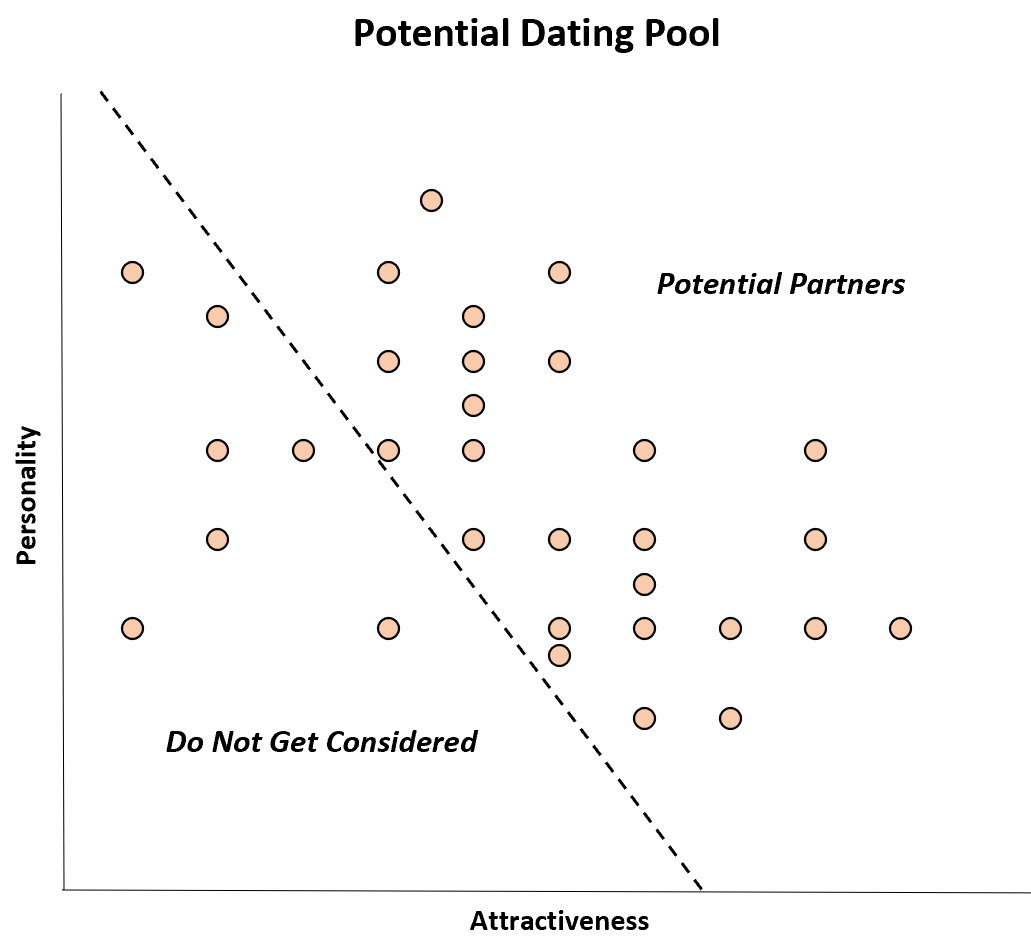
The video below explains this and other examples with clear visuals.
Collider Bias (Berkson’s paradox): how ‘censored’ data leads to flawed conclusions
This video from Norman Fenton's channel gives several clear and simple examples of Berkson's paradox.
Watch the introduction for a quick overview of the flawed conclusions that can result. Then, focus on the example of attractiveness and personality. This segment walks through exactly how conditioning on the "dating pool" creates the illusion of a trade-off between looks and personality.
The Hospital-Based Study Paradox
The paradox gets its name from Joseph Berkson's original 1946 paper, which described a bias he observed in hospital-based case-control studies. Imagine a study investigating a potential link between two unrelated diseases, say Disease A and Disease B. If the study sample is drawn exclusively from hospitalized patients, a spurious association between the two diseases can appear.
Why? Because a patient is admitted to the hospital if they have Disease A, or Disease B, or both. The presence of either disease increases the probability of hospitalization. Therefore, hospitalization is a collider:
Disease A Hospitalization Disease B
If we look only at hospitalized patients, we are conditioning on this collider. Among these patients, the presence of Disease A becomes evidence against the presence of Disease B. If a patient is hospitalized, and we know they don't have Disease A, it increases the likelihood that they are in the hospital because they have Disease B. This creates a spurious negative association between the two diseases in the hospital sample, even if they are independent in the general population.
The following DAG illustrates a similar medical scenario.
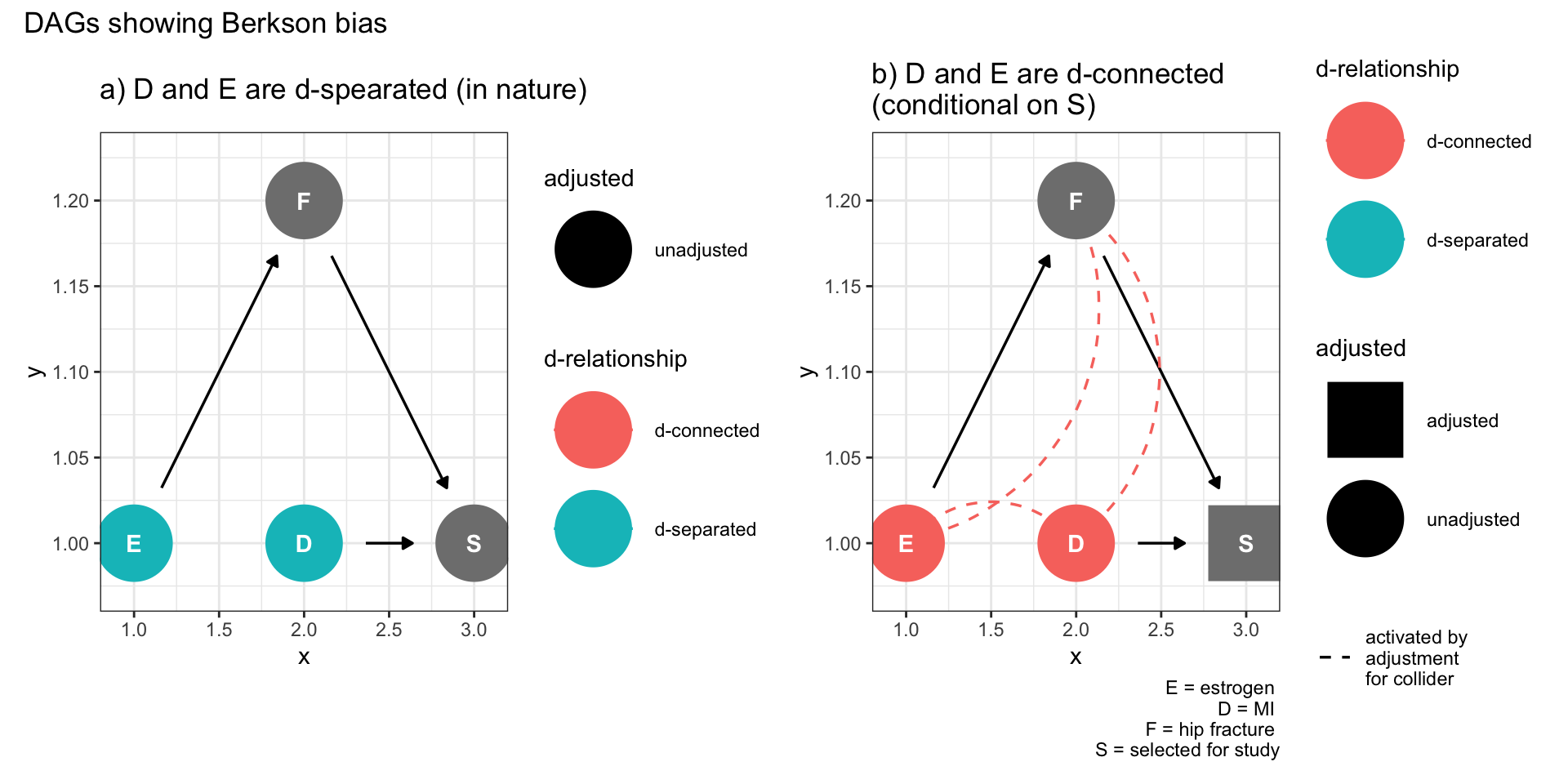
This structure is formally described in the "Understanding and Addressing Selection Bias" paper.
Understanding and Addressing Selection Bias
This section of the paper specifically discusses the structure of Berkson's bias.
Please find the paragraph that begins with Figure 2e. Notice that it explicitly labels the structure where selection is affected by both exposure and outcome as "Berkson's bias" and notes that this form of bias is particularly difficult to correct.
3. Application to the Vee-Triad Experiment
Now, let's bring this concept home to your proposed experiment. A significant challenge in longitudinal studies, especially those involving complex relationship dynamics, is participant attrition. The decision for the triad to remain in your study is not random; it is likely a function of how the relationship is faring. This is where Berkson's paradox can emerge.
Let's hypothesize we are interested in the relationship between two stable, pre-existing personality traits of the two partners in the vee: Partner 1's "Conscientiousness" () and Partner 2's "Neuroticism" (). In the general population, let's assume these two traits are independent.
However, both traits can plausibly influence the triad's ability to successfully navigate the challenges of the experiment and, therefore, their decision to remain in the study ().
- High conscientiousness () might make Partner 1 more likely to adhere to the study protocol and complete it. ()
- High neuroticism () might make Partner 2 more prone to stress from the experiment, increasing the likelihood of the triad dropping out. ()
This creates the classic collider structure:
If you then perform an analysis using only the data from triads who completed the study, you are conditioning on . This opens the non-causal path between and , inducing a spurious correlation. For instance, within your sample of completers, you might find that individuals with lower conscientiousness are disproportionately those with lower neuroticism. This is because a triad with a low-conscientiousness partner might only have "survived" the study if the other partner was also low on neuroticism (and thus less likely to be stressed into quitting).
This is a critical point: even in a perfectly randomized experiment, post-randomization selection can induce bias. The randomization ensures that your treatment is not confounded at baseline, but it does not protect against biases introduced by conditioning on post-treatment variables, including the decision to remain in the study.
This is a well-documented issue in longitudinal research, where conditioning on retention can create collider bias.
Causal inference, confounding, and directed acylical graphs (DAGS)
This practical guide illustrates several forms of selection bias.
Please review the short section titled "Selection bias in longitudinal research". It shows a DAG where being "retained" in a study is downstream of a collider, and how stratifying on retention introduces bias. This is precisely the structure we are concerned about in your experiment.
Conclusion
In this lesson, we have dissected Berkson's paradox, a subtle yet powerful form of selection bias. You've seen how conditioning on a collider—a common effect—can create spurious associations, and how this can happen implicitly in observational studies or explicitly in experiments with non-random attrition.
Key Takeaways:
- Collider Bias: Conditioning on a collider variable opens a non-causal path between its parents, inducing a statistical association even if one does not exist in the general population.
- Berkson's Paradox: This is a specific manifestation of collider bias where the selection process for inclusion in a study sample acts as the collider.
- Application to your Study: The joint decision of the triad to remain in your experiment is a likely collider. Analyzing only the completers means you are conditioning on this collider, which can create spurious correlations between pre-existing traits that influence retention. This is a threat to the validity of any secondary analyses you might perform on this subgroup.
We have now concluded our module on the complex topic of causal identification. You are equipped with a deep understanding of the key challenges, from confounding and interference to selection bias. We are now ready to pivot from identifying effects to reasoning with them.
In our next lesson, we will begin the final module of this course, "Counterfactual Reasoning in an Interconnected System." We will start by learning how to formulate precise counterfactual queries that capture the intricate, simultaneous effects within the vee-triad, setting the stage for estimating what would happen under different hypothetical scenarios.