Welcome to the fourth lesson in our module on modeling the triadic system. In our last session, we developed a more nuanced causal vocabulary, defining direct, indirect (spillover), total, and overall effects to handle the reality of interference. This gave us the formal tools to describe how an intervention might affect not only the person receiving it but also their partners.
Today, we will put this vocabulary to work. Our objective is to translate the broad, ambitious goal of "maximizing satisfaction" in the vee relationship into a set of precise, answerable research questions. This is a pivotal step in any rigorous study, moving from a general idea to a concrete analytical plan. By framing our questions in terms of the network-aware causal estimands we've just learned, we ensure that the answers we seek are well-defined and, ultimately, estimable.
1. The Anatomy of a Causal Research Question
Before we start formulating questions, let's establish what makes a research question effective in the context of causal inference. A simple question like "Does the intervention work?" is too vague. A strong causal question specifies four key components, often remembered by the acronym PICO:
- Population: For whom are we measuring the effect? Is it for the pivot, one of the wings, a specific dyad, or the triad as a whole?
- Intervention: What specific treatment or set of treatments is being applied? In a system with interference, this means defining the full treatment vector (e.g., Wing 1 is treated, but the Pivot and Wing 2 are not).
- Comparison: What is the alternative state to which we are comparing the intervention? This is another specific treatment vector (e.g., no one is treated).
- Outcome: What specific, measurable outcome are we interested in? (e.g., individual satisfaction score, dyadic relationship quality).
The causal estimands we defined in the previous lesson—direct, indirect, total, and overall effects—are precisely what allow us to structure the "Intervention vs. Comparison" part of our question with the necessary rigor.
2. A Sociological Analogy: Actor and Partner Effects
This way of thinking is not unique to theoretical statistics; it's fundamental to understanding any interconnected social system. Fields like sociology and psychology have long grappled with how one person's experiences and behaviors affect their romantic partners. They often use a framework that closely mirrors our own.
To see this in action, let's examine a study on work-family conflict in couples. The concepts of "spillover" and "crossover" used in this paper are conceptually identical to the direct and indirect effects we are working with.
[PDF] Spillover and Crossover Effects of Work-Family Conflict among ...
This paper provides a clear, applied example of decomposing effects within a dyad, which serves as a powerful analogy for our work with the triad.
Please read the Introduction and the section titled Theoretical Frameworks. As you read, focus on these key definitions and distinctions: Work-Family Conflict (WFC): Notice how this is defined as a stressor originating from a specific domain. This is analogous to our "treatment." Spillover Effects: The paper defines this as an intraindividual process. In their terminology, this is the effect of a stressor on the same person who experiences it. In the subsequent APIM (Actor-Partner Interdependence Model) section, this is called the Actor Effect. This is our Direct Effect. Crossover Effects: This is defined as an interindividual transmission of stress. In the APIM framework, this is the Partner Effect. This is our Indirect (Spillover) Effect. Pay attention to how the authors formulate distinct hypotheses (e.g., Hypotheses 1-4) based on these different types of effects. This is exactly what we are about to do for the vee triad.
The study you just read demonstrates how partitioning a general phenomenon (the impact of work-family conflict) into specific actor (direct) and partner (indirect) effects allows researchers to ask more sophisticated questions about the underlying mechanisms of a relationship. We will now apply this same logic to our triad.
3. Formulating Research Questions for the Vee Triad
Let's return to our vee triad, consisting of the Pivot (P), Wing 1 (W1), and Wing 2 (W2). Let's consider a simple, assignable intervention: a daily structured relationship check-in. We can define a treatment vector , where if individual participates in the check-in and if they do not. The outcome, , is a measure of satisfaction.
Using the exposure mapping from our previous lesson, we can now formulate a hierarchy of research questions, from broad to specific.
Primary Question: The Overall Impact
The most fundamental question concerns the global effect of the intervention.
- Research Question 1 (Overall Effect): What is the overall effect on the triad's average satisfaction of implementing daily check-ins for everyone, compared to a baseline where no one participates?
This question asks about the Overall Causal Effect, . It compares the average satisfaction of the entire system under two different policies: , where is the policy "everyone is treated" and is "no one is treated." This is useful for a high-level "go/no-go" decision but tells us nothing about how it works.
Secondary Questions: Decomposing the Effects
To understand the mechanisms, we must decompose the overall effect. Let's frame these questions from the perspective of Wing 1 (W1), examining their individual satisfaction .
-
Research Question 2a (Isolated Direct Effect): What is the effect of W1 starting the check-in practice on their own satisfaction, assuming their partners are not participating?
- Estimand: .
- This isolates the personal benefit or cost of the intervention itself, free from interference.
-
Research Question 2b (Direct Effect with Spillover): What is the effect of W1 starting the check-in practice on their own satisfaction, given that their partners are already participating?
- Estimand: .
- This measures the marginal contribution of W1's participation in an environment already saturated with the intervention. Comparing the results of 2a and 2b tests for synergistic effects.
-
Research Question 3a (Spillover Effect on Untreated): What is the spillover effect of W1's partners starting the check-in practice on W1's satisfaction, assuming W1 is not participating?
- Estimand: .
- This measures the positive or negative externality of the intervention. Are there benefits just from being around others who are doing the work?
-
Research Question 3b (Spillover Effect on Treated): For a W1 who is already doing check-ins, what is the additional spillover effect of their partners also starting the practice?
- Estimand: .
- This measures the interactive or amplifying effect of mutual participation.
These four questions break down the total effect into its constituent parts, allowing you to pinpoint the pathways of influence, just as the authors of the work-family paper distinguished between actor and partner effects.
4. Beyond Individuals: Dyadic and Network-Level Questions
Our analysis doesn't have to be limited to individual outcomes. The ultimate goal is the health of the relationship system, which exists at the level of dyads and the triad itself. We can define outcomes like (satisfaction of the Pivot-W1 dyad) or (a composite triadic satisfaction index).
This way of thinking—mapping treatments onto a network and measuring properties of its components—can be formalized using the concept of causal network motifs.
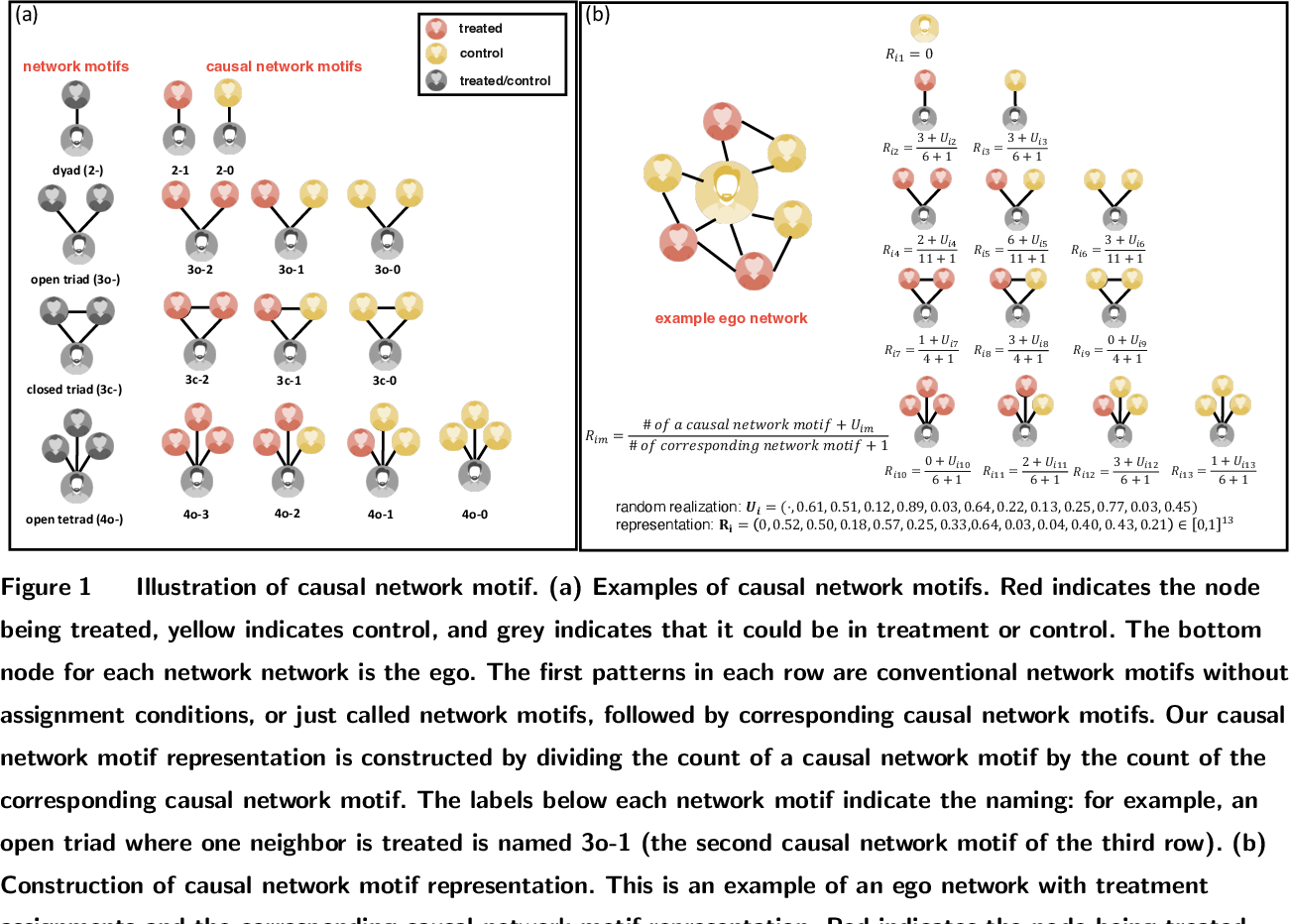
As the image shows, our simple vee triad (an "open triad" centered on the Pivot) can exist in several states depending on the treatment vector . Each of our research questions is a comparison between two of these causal motifs. We can now formulate questions about the dyads:
- Research Question 4 (Dyadic Spillover): What is the effect of W2 starting the check-in practice on the satisfaction of the unrelated dyad, P-W1, assuming neither P nor W1 are participating?
- Estimand: .
- This asks a more complex question about second-order interference: does an action by one wing affect the relationship between the pivot and the other wing?
Given your background in experimental design, the power of this approach should be evident. By precisely specifying our estimands, we are pre-defining the contrasts for our future analysis, ensuring every question we ask is conceptually distinct and empirically testable.
Conclusion
In this lesson, we have taken the crucial step of translating a general goal into a specific, structured research agenda. We have moved from the abstract definitions of causal estimands to their direct application in formulating meaningful questions about the vee triad.
The key takeaways are:
- A robust causal research question must be specific about the Population, Intervention, Comparison, and Outcome.
- The network-aware estimands we've defined (direct, indirect, total, overall) provide the formal language to specify the intervention-comparison contrast in a system with interference.
- Thinking in terms of "actor" and "partner" effects, or "causal network motifs," allows us to formulate hypotheses about individuals, dyads, and the entire triadic system.
You now have a clear set of questions that will guide the next stages of our experimental design. In our next lesson, we will focus on the "O" in PICO, drilling down on how to specify and measure our key variables: the living arrangement treatments and the multi-dimensional satisfaction outcomes for each component of the triad.