Introduction
In our last lesson, we focused on modeling mediating pathways, which allowed us to trace how a treatment like a living arrangement influences satisfaction through intermediate psychological mechanisms. We saw that understanding these indirect effects requires strong assumptions, namely sequential ignorability, to avoid confounding in the mediator-outcome relationship. Our guiding principle has been to identify and block non-causal "backdoor" paths to isolate the true causal effect.
This lesson addresses a critical and counterintuitive pitfall in that process. We will investigate a type of variable, the collider, that behaves in the opposite way to a confounder. While we control for confounders to close backdoor paths, controlling for a collider can rip open a path that was already closed, introducing spurious associations and biasing our estimates. This fulfills the learning outcome: Identify collider structures that introduce bias when conditioning on outcomes of interconnected individuals (e.g., the pivot's satisfaction). Understanding this is paramount for your study of the vee-triad, where many observable outcomes are the joint result of multiple actors' states and behaviors.
1. What is a Collider?
Let's start with a precise definition. In a Directed Acyclic Graph (DAG), a variable is a collider on a specific path if two arrows on that path point into it. The term "collider" evokes the image of causal forces colliding at that node.
Consider the three fundamental building blocks of paths in a DAG:
- Chain (Mediator):
- Fork (Confounder):
- Collider:
You are already very familiar with chains and forks. Colliders represent a different kind of causal structure. In a fork, is a common cause of and . In a collider structure, is a common effect of and .
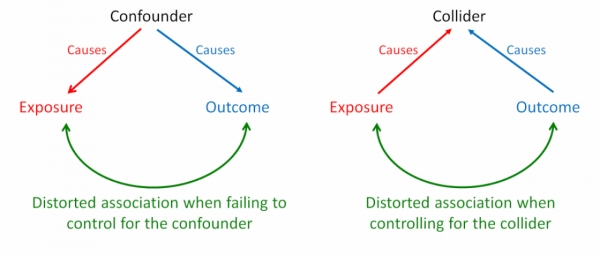
The resource "Causal Inference: The Mixtape" provides a clear definition and graphical example.
3 Directed Acyclic Graphs – <span style='font-weight
This chapter introduces the graphical definition of a collider and contrasts it with the confounder structures we've previously discussed.
Please read the subsection titled "Colliding". Focus on the graphical pattern: on the path D \rightarrow X \leftarrow Y, the variable X is a collider because it is caused by both D and Y. The crucial takeaway here is that the presence of an unconditioned collider closes the path.
2. The Strange Logic of Collider Bias
The defining characteristic of a collider is its effect on the flow of association along a path.
- An unconditioned collider blocks the path. No association flows between its causes.
- Conditioning on the collider (or any of its descendants) opens the path, creating a spurious association between its causes.
This is the exact opposite of a confounder, where conditioning is necessary to block the path. Conditioning on a collider is a major analytical error known as collider bias or endogenous selection bias.
The following video offers several excellent analogies and examples to build intuition for this seemingly strange phenomenon.
This video from the channel "Econometrics, Causality, and Coding with Dr. HK" provides highly intuitive explanations for why collider bias occurs.
First, watch the segment from the definition of a collider to understand the core rule: conditioning on a collider opens a closed path. Next, watch the eye color analogy from why this might be. This helps explain the underlying logic. A mother's and father's eye colors are typically independent. But if you know their child has blue eyes (conditioning on the collider), knowing the father has blue eyes gives you information about the mother's genes. Finally, see this applied to a more realistic scenario in the tech company example. Programming skill and social skill may be independent in the general population. But among people hired by a tech company (conditioning on a collider), they become negatively correlated. This is because to get hired, you need a sufficient combination of both; thus, someone with low programming skill must have high social skill to have cleared the bar.
3. Collider Bias in the Vee-Triad
Now let's apply this directly to your research question. The triad is full of potential colliders because many important variables are common effects of the states or actions of multiple members.
Consider the pivot's satisfaction. Let's label the three individuals A (the pivot), B, and C. It is plausible that the satisfaction of Person A, Satisfaction_A, is caused by both the behavior of Person B (Behavior_B) and the behavior of Person C (Behavior_C).
This creates the classic collider structure:Behavior_B Satisfaction_A Behavior_C
Let's assume that in the general population, Behavior_B and Behavior_C are independent. Now, imagine you make one of two analytical mistakes:
- Sample Selection: You decide to run your analysis only on data from weeks where Person A reported being "highly satisfied." This is equivalent to stratifying your sample based on a high value of
Satisfaction_A. - Statistical Control: You include
Satisfaction_Aas a control variable in a regression model attempting to find the relationship betweenBehavior_BandBehavior_C.
In either case, you have conditioned on the collider, Satisfaction_A. This will induce a spurious correlation between Behavior_B and Behavior_C within your selected data. For example, if you know Person A is highly satisfied (the collider is fixed at a high value) and you observe that Behavior_B was negative that week, you can infer that Behavior_C must have been exceptionally positive to achieve that high satisfaction. Behavior_B and Behavior_C now appear negatively correlated, even if they are independent in reality.
This error could lead you to fundamentally misunderstand the dynamics between partners B and C, concluding they have a competitive or compensatory relationship when no such direct link exists.
4. Subtle Forms of Collider Bias
Collider bias often appears in ways that are less obvious than including a variable in a regression.
Sample Selection Bias
As we saw in the "tech company" example, the way you select your sample can be a form of conditioning. If the process that gets a unit into your dataset is a common effect of two variables you are studying, your entire dataset may be compromised by collider bias.
3 Directed Acyclic Graphs – <span style='font-weight
This resource provides two compelling examples of how sample selection induces collider bias.
First, read the section "Sample selection and collider bias." The "movie star" example is a classic illustration of how selecting on a trait (being a movie star) that is a common effect of two other traits (beauty and talent) creates a spurious negative correlation between them. Next, read the following section, "Collider bias and police use of force." This is a sophisticated real-world example. It argues that analyzing administrative police data on use of force is inherently conditioning on a police stop. Since the stop is a common effect of various factors (e.g., suspect behavior and officer suspicion), analyzing only the data post-stop can introduce profound bias. This is highly relevant as you will be analyzing data collected from your own experiment, and you must be wary of any selection effects.
M-Bias and Conditioning on Pre-Treatment Variables
A particularly tricky form of collider bias is the M-bias structure. This can occur even when you control for a pre-treatment variable, which is typically considered safe.

The M-bias structure is , where and are unobserved. Here, is a collider. Even if is measured before the treatment , conditioning on it opens the path , creating a spurious association between and .
A Crash Course in Good and Bad Controls
This paper provides an excellent catalog of causal structures, highlighting which variables are "good" or "bad" to control for.
First, read section "Model 7." This formally introduces the M-bias structure and explains why conditioning on the pre-treatment variable Z induces bias. Next, read section "Models 16 and 17." This reinforces the classic collider structure and explicitly labels it "selection bias" or "collider stratification bias." Finally, read the real-world examples in the section that begins "Bad controls in applied research." The "birth-weight paradox" and "Antebellum Puzzle" are famous examples of collider bias in epidemiology and economics, demonstrating how widespread this issue is.
Conclusion
This lesson has introduced the concept of colliders and the dangerous bias they can introduce. Unlike confounders, which create non-causal associations that must be blocked by conditioning, colliders block paths by default. Conditioning on them actively creates spurious associations.
Key Takeaways:
- A collider is a variable on a causal path that receives arrows from two other variables (). It is a common effect.
- An unconditioned collider blocks the flow of association between its causes. Conditioning on a collider opens this path, inducing collider bias.
- This bias can arise from explicitly including a collider in a statistical model or, more subtly, through sample selection (e.g., studying only successful businesses, hospitalized patients, or "happy" triads).
- In your vee-triad model, any variable that is a joint outcome of multiple members' states or actions is a potential collider. Conditioning on shared outcomes like "triad satisfaction" or "relationship stability" is a critical mistake to avoid when analyzing the relationships between the individual components that cause them.
We have now examined confounding, mediation, and collider bias, giving you the primary tools to correctly specify the static relationships in your causal model. However, your N-of-1 crossover design is inherently dynamic. In our next lesson, we will begin to address this by exploring how to encode temporal structure (lagged effects, adaptation) in the causal model to align with the crossover design. This will involve transforming our static DAG into a model that can capture how the system evolves over time.