Introduction
Welcome to a new module in our course on symmetry methods. In our previous lesson, we investigated the chiral anomaly, a fascinating phenomenon where a classical symmetry is broken by quantum effects inherent to the quantization process itself. Today, we turn our attention to a different, yet equally fundamental, mode of symmetry breaking: spontaneous symmetry breaking (SSB).
This lesson will define spontaneous symmetry breaking and, crucially, distinguish it from the more straightforward case of explicit symmetry breaking. We will see that SSB occurs when the fundamental laws of a system are perfectly symmetric, but the system's lowest-energy state—its ground state or vacuum—is not. This single idea has profound consequences across physics, forming the conceptual basis for phenomena as diverse as ferromagnetism in condensed matter, the properties of superfluids, and the origin of particle masses via the Higgs mechanism in the Standard Model. We will explore the canonical model of SSB in field theory and connect it to tangible physical systems, leveraging your background in both quantum field theory and condensed matter physics.
Explicit vs. Spontaneous Symmetry Breaking
At its core, "breaking a symmetry" can mean two very different things. The distinction is about where the lack of symmetry originates: in the laws of physics themselves, or in the particular state the system happens to be in.
A short video from the ZAP Physics channel provides an excellent intuitive overview of this distinction.
Spontaneous Symmetry Breaking and The Higgs Mechanism
This video, "Spontaneous Symmetry Breaking and The Higgs Mechanism," offers clear analogies for both explicit and spontaneous symmetry breaking.
Please watch the section on explicit breaking, which uses the analogy of a deformed circle. Then, watch the following section on spontaneous breaking, which uses the analogy of a person on a symmetric hill.
Let's formalize the ideas from the video:
-
Explicit Symmetry Breaking: This is the most obvious case. The theory itself (i.e., the Lagrangian or Hamiltonian) is not perfectly symmetric. It may contain small terms that violate a potential symmetry. We might still speak of an "approximate symmetry" if these terms are small, but fundamentally, the symmetry isn't there in the laws of nature.
- Example: The Zeeman effect. The Hamiltonian of a hydrogen atom is rotationally symmetric. However, if we place it in an external magnetic field , the Hamiltonian gains a term like . This term is not rotationally invariant, as it singles out the direction of . The rotational symmetry is explicitly broken, and the degenerate energy levels split.
-
Spontaneous Symmetry Breaking (SSB): This is a far more subtle and powerful concept. The theory (the Lagrangian/Hamiltonian) is perfectly symmetric under some transformation group. However, the ground state of the system, often called the vacuum, is not invariant under that symmetry. The system must "choose" one ground state from a set of energetically equivalent, but distinct, possibilities.
- Example: A simple ferromagnet. The underlying interactions between electron spins are rotationally invariant. Above a critical temperature (the Curie temperature), the thermal energy randomizes the spins, and the system as a whole is rotationally symmetric, with zero net magnetization. Below this temperature, the spins align to minimize energy. They must align along some direction. This choice of a specific direction for the net magnetization breaks the original rotational symmetry. The laws are still symmetric, but the ground state is not.
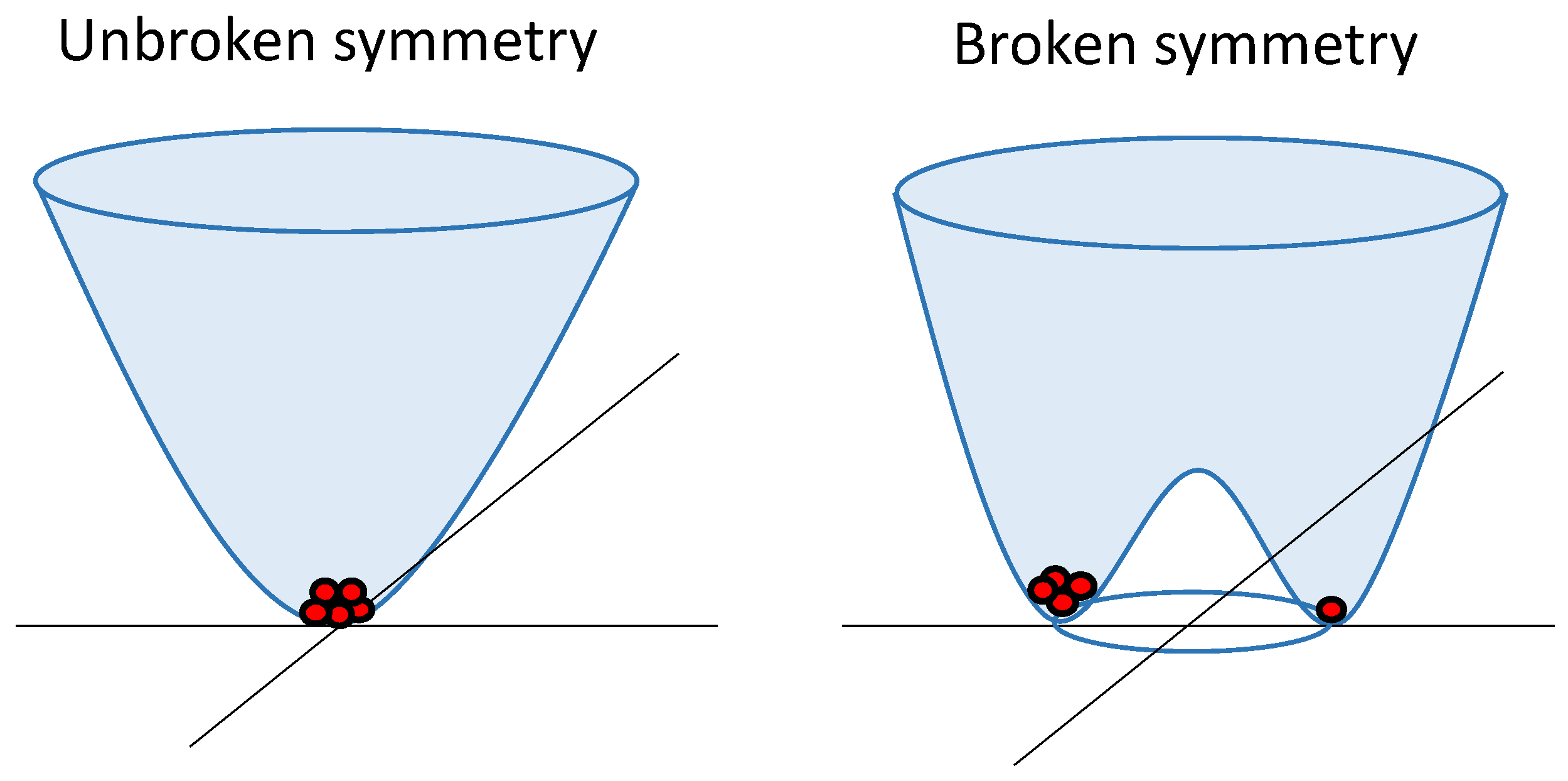
The Canonical Model: A Real Scalar Field
The quintessential model for SSB in quantum field theory involves a real scalar field with a specific type of potential. It's a concept you will encounter frequently in your QFT course. The Lagrangian density for this theory is:
We assume to ensure the potential is bounded from below. This Lagrangian is invariant under the discrete Z symmetry . The nature of the ground state depends critically on the sign of the term.
Case 1: Unbroken Symmetry ()
When is positive, the potential has a single minimum at , as shown on the left side of the image above. The classical ground state, or vacuum, corresponds to the field configuration that minimizes the potential energy, so . This vacuum state is unique and is itself invariant under the symmetry transformation: . In this case, we say the Z symmetry is unbroken. The parameter can be interpreted as the mass of the particle corresponding to excitations of the field.
Case 2: Spontaneous Symmetry Breaking ()
Now for the interesting part. Let's consider the case where is negative. To make this explicit, we write , where . The potential becomes:
This is the famous "Mexican hat" or "double-well" potential, shown on the right side of the image above.
Let's analyze this potential. The following video lecture by Prof. Sunil Mukhi provides a clear, step-by-step derivation of the consequences.
Quantum Field Theory II: Lecture 23 - Spontaneous symmetry breaking
This excerpt from a QFT lecture on Spontaneous Symmetry Breaking details the analysis of a scalar field with a "wrong sign" mass term.
Please watch from 7:01 to 14:29. The lecturer first introduces the concept of a negative m^2 term and then proceeds to find the minima of the resulting potential, distinguishing them from the unstable maximum at the origin.
As explained in the video, the stationary points of the potential are found by setting :
This gives three solutions:
By checking the second derivative, we see that is now a local maximum—an unstable equilibrium. The true ground states, the points of minimum energy, are . These are the vacuum expectation values (VEVs) of the field.
This is the essence of SSB:
- The Lagrangian still has the symmetry.
- The vacuum, however, is not unique. There is a degenerate set of ground states.
- The system must "settle" into one of these vacua, say . This particular choice is not symmetric, as the transformation would take it to the other vacuum, .
The symmetry of the laws is hidden by the asymmetry of the ground state.
The Meaning of Tachyons and Emergent Mass
What if we had naively tried to build a quantum theory around the point? The term in the Lagrangian looks like a mass term, but with the "wrong sign." This implies a particle with an imaginary mass (), often called a tachyon. As noted in David Tong's lecture notes, a tachyon in field theory is not a faster-than-light particle but a signal of instability. It tells you that you are expanding your theory around a maximum of the potential, not a minimum. The field wants to "roll down" to the true vacuum.
To find the actual particle spectrum, we must expand the field around a true vacuum, say . We define a new field, , representing fluctuations around this vacuum: . Substituting this into the Lagrangian is a bit of algebra, but it is illuminating.
Quantum Field Theory II: Lecture 23 - Spontaneous symmetry breaking
This part of the lecture carries out the expansion of the Lagrangian around the new vacuum. It shows how linear terms vanish and a new, physical mass term for the fluctuation field emerges.
Please watch from 19:54 to 30:08. Focus on how the Lagrangian for the fluctuation field \eta is derived and what its terms signify, particularly the absence of a linear term and the emergence of a new quadratic (mass) term.
After expanding the potential around and collecting terms in powers of , we find:
The key points are:
- The term linear in vanishes. This is guaranteed because we are expanding around a minimum of the potential.
- A new quadratic term, , appears. Comparing this to the standard form , we see that the fluctuation field describes a particle with a real, positive mass squared: .
A theory that appeared to have an imaginary mass particle (a tachyon) is now revealed to describe a perfectly healthy particle of mass once we correctly identify the stable ground state. The mass itself is a consequence of the symmetry breaking.
From Quantum Mechanics to Quantum Field Theory
You might ask: in a quantum mechanical double-well potential, doesn't a particle tunnel between the two wells, resulting in a symmetric ground state wavefunction that is a superposition of being in both wells? This is correct. For a single particle in QM, the Z symmetry is never truly spontaneously broken.
However, a crucial difference emerges in quantum field theory, a point that is essential for your work in both QFT and CMP.
This section from David Tong's notes on the Standard Model provides a fantastic explanation of this subtlety.
Please read the subsection <span data-type="resource_reading_textrange" data-resource-subitem-id="d4dbad02" data-range-start="2.1.2 Discrete Symmetry Breaking" data-range-end="as an order parameter to tell us which vacuum we live in">"Discrete Symmetry Breaking in Quantum Field Theory". It directly contrasts the QM and QFT pictures and explains why the infinite volume of space is the key difference.
In QFT, the field exists at every point in space. To transition from the vacuum to would require the field to change its value everywhere in the universe. The "energy barrier" for this transition is proportional to the volume of space, which is infinite. This infinite energy cost suppresses the tunneling, effectively "locking" the system into one of the chosen vacua. Therefore, while discrete symmetries cannot be spontaneously broken in single-particle quantum mechanics, they can be in quantum field theory.
This is why SSB is such a crucial concept for macroscopic systems in condensed matter and for the universe itself in particle physics.
Conclusion
In this lesson, we have established the crucial distinction between explicit and spontaneous symmetry breaking and laid the groundwork for understanding the latter's profound physical implications.
Key Takeaways:
- Explicit Symmetry Breaking: The laws of physics (Hamiltonian/Lagrangian) are not symmetric. The symmetry is broken "by hand."
- Spontaneous Symmetry Breaking (SSB): The laws of physics are symmetric, but the ground state (vacuum) of the system is not. The system "spontaneously" chooses a ground state from a degenerate set, hiding the underlying symmetry.
- The "Mexican Hat" Potential: The canonical model for SSB is a scalar field theory where the mass-squared term is negative, leading to a potential with an unstable maximum at the origin and a degenerate ring of minima away from the origin.
- Instability and Mass Generation: A "tachyonic" imaginary mass in a Lagrangian is not a physical particle but a signal of an unstable vacuum. Expanding the theory around the true, stable vacuum reveals the spectrum of physical particles with real, positive masses.
- SSB in QFT vs QM: Unlike in single-particle quantum mechanics, SSB of discrete symmetries is possible in QFT because the infinite volume of spacetime suppresses tunneling between the degenerate vacua.
Preview of the Next Lesson:
We have focused on the breaking of a discrete Z symmetry. What happens when a continuous global symmetry is spontaneously broken? As it turns out, this has a remarkable and universal consequence: the emergence of massless, propagating modes known as Goldstone bosons. In our next lesson, we will state and prove Goldstone's Theorem and explore its physical manifestations, from magnons in ferromagnets to the pions of QCD.