In our previous lesson, we systematically constructed character tables from the ground up using the powerful orthogonality relations. You now understand that these tables are not arbitrary collections of numbers, but are rigidly determined by the mathematical structure of the symmetry group. Our focus now shifts from construction to interpretation. What do all the symbols and numbers in a character table actually mean, and how do they provide a bridge between the abstract algebra of groups and the concrete physics of a quantum system?
This lesson will guide you through reading and understanding a character table. We will dissect its components, explain the conventions behind the symbols, and, most importantly, connect this information to the properties of quantum mechanical wavefunctions and operators. By the end, you will be able to look at a character table for a point group and deduce the symmetry properties and degeneracies of electronic orbitals, molecular vibrations, and other quantum states. This is a foundational skill for applying group theory in condensed matter physics, quantum chemistry, and spectroscopy.
1. Anatomy of a Character Table: The C₃ᵥ Example
Let's use the C₃ᵥ character table, which you constructed in the last lesson, as our specimen. Every part of this table contains specific, meaningful information. The group C₃ᵥ is isomorphic to the dihedral group D₃, which is often used in more mathematical physics contexts, so we will use the labels interchangeably.
| C₃ᵥ (D₃) | E | 2C₃ | 3σᵥ | ||
|---|---|---|---|---|---|
| A₁ | 1 | 1 | 1 | z | x²+y², z² |
| A₂ | 1 | 1 | -1 | R₂ | |
| E | 2 | -1 | 0 | (x, y), (Rₓ, Rᵧ) | (x²-y², xy), (xz, yz) |
a) The Header Row
The header lists the symmetry operations of the group, grouped into conjugacy classes.
- E: The identity operation, which is always in a class by itself.
- 2C₃: The class containing the two three-fold rotation operations, and . The coefficient '2' indicates the number of elements in this class.
- 3σᵥ: The class containing the three vertical mirror plane reflections.
b) The First Column and Irreducible Representations (Irreps)
The first column contains the Mulliken symbols, which are the standard labels for the irreducible representations (irreps) of the group. Each row corresponds to a unique irrep. The symbols encode the key symmetry properties of the irrep.
Group Theory in Chemistry: The Ultimate Guide to Matrix Magic!
The video "Group Theory in Chemistry: The Ultimate Guide to Matrix Magic!" provides a concise explanation of Mulliken symbols.
Please watch the segment from 00:15:34 to 00:18:01. The speaker breaks down the meaning of the letters A, B, E, and T, which relate to the dimension and symmetry of the representation.
Here's a systematic summary of the conventions:
- Dimensionality (Degeneracy): The dimension of an irrep is given by its character under the identity operation, .
- A or B: One-dimensional irreps (non-degenerate).
- E: Two-dimensional irreps (doubly degenerate).
- T: Three-dimensional irreps (triply degenerate).
- Symmetry with respect to the Principal Axis (Cₙ):
- A: Symmetric with respect to the principal Cₙ rotation ().
- B: Antisymmetric with respect to the principal Cₙ rotation ().
- Subscripts (1, 2): These distinguish irreps based on their symmetry with respect to a secondary axis or a vertical plane.
- 1: Symmetric with respect to a C₂ axis perpendicular to Cₙ, or with respect to a vertical plane .
- 2: Antisymmetric with respect to the same operation.
- In C₃ᵥ, A₁ is symmetric under (), while A₂ is antisymmetric ().
- Subscripts (g, u): For groups with an inversion center (), these denote symmetry with respect to inversion.
- g (gerade, "even"): Symmetric ().
- u (ungerade, "odd"): Antisymmetric ().
The central and most profound connection to physics is this: the eigenfunctions of a Hamiltonian that is invariant under a symmetry group must transform as one of the irreducible representations of that group. Furthermore, all eigenfunctions belonging to the same multi-dimensional irrep must be degenerate in energy.
Thus, the character directly tells you the degeneracy of an energy level with that symmetry. In C₃ᵥ, any state with A₁ or A₂ symmetry is non-degenerate, while any state with E symmetry must be part of a doubly degenerate pair.
This document provides the formal quantum mechanical argument for the link between symmetry and degeneracy.
Read the section "Representations in Quantum Mechanics". Focus on the core argument: if the Hamiltonian commutes with the group's symmetry operators ([H, â] = 0), then applying a symmetry operator to an eigenstate results in another eigenstate with the same energy. These degenerate eigenstates form a basis for an irreducible representation of the group.
2. The Basis Function Columns: Connecting to Physical Observables
The columns on the right side of the character table are perhaps the most practically useful part. They tell you how various basis functions transform under the group's symmetry operations. This information is crucial for understanding molecular properties, spectroscopy, and bonding.
-
Linear Functions (x, y, z): These indicate how the Cartesian coordinates, or vectors pointing along these axes, transform. For example, in C₃ᵥ:
zis listed in the A₁ row. This means a vector along the z-axis is unchanged by any symmetry operation of the group. It is totally symmetric.(x, y)are listed in the E row. This means that vectors in the xy-plane are transformed into linear combinations of each other by the group operations. They are not individually symmetric but transform as a pair. This implies that quantum mechanical objects that behave like vectors, such as p-orbitals (p₂, pₓ, pᵧ), transform according to these irreps. Theztells us p₂ transforms as A₁, while(x, y)tells us (pₓ, pᵧ) form a degenerate pair transforming as E.
-
Rotational Functions (Rₓ, Rᵧ, R₂): These represent rotations about the Cartesian axes. Their transformation properties are relevant to phenomena involving angular momentum, such as rotational spectroscopy.
-
Quadratic Functions (x², y², z², xy, xz, yz): These functions have the same transformation properties as the d-orbitals.
- In C₃ᵥ,
x²+y²andz²transform as A₁. (x²-y², xy)and(xz, yz)each form a degenerate pair transforming as E. This information is fundamental to crystal field theory, which you'll encounter in solid-state physics, as it predicts how the degeneracy of d-orbitals is lifted when an atom is placed in a crystal environment with a specific symmetry.
- In C₃ᵥ,
To truly understand how these basis functions relate to the characters, we need to see how applying symmetry operations to them generates the representation matrices.
mod07lec32 - Group Theory and Quantum Mechanics
This video from NPTEL-NOC IITM offers a detailed, first-principles derivation of the matrix representation generated by the (pₓ, pᵧ) orbitals in the C₃ᵥ point group. This is a fantastic example of the underlying mathematics.
Follow this derivation carefully: The first part establishes the functional forms of the pₓ and pᵧ orbitals in spherical coordinates and derives how the coordinates themselves (specifically the angle φ) change under C₃ rotation and σₓ₂ reflection. The second part applies these coordinate transformations to the pₓ and pᵧ wavefunctions, showing explicitly how they mix. For example, C₃(pₓ) becomes a linear combination of pₓ and pᵧ. The final part assembles the transformation matrices from these results and calculates their traces (the characters), which match the E irrep in the C₃ᵥ character table: \chi(C_3) = -1 and \chi(\sigma_{xz}) = 0.
This derivation is a crucial bridge. It shows that the characters in the table are not just abstract numbers; they are the traces of matrices that describe how physical objects, like atomic orbitals, are literally rotated and reflected in space.
3. Practical Application: Determining the Symmetry of Orbitals
Let's put this knowledge to work. A common task is to take a set of basis functions (like atomic orbitals) and determine how they transform under the symmetry operations of a group. The image below presents a typical problem for the C₂ₕ point group.
The C₂ₕ point group has four symmetry operations: E (identity), C₂ (rotation by 180° about the z-axis), i (inversion through the origin), and σₕ (reflection through the xy-plane). Its character table is:
| C₂ₕ | E | C₂ | i | σₕ | ||
|---|---|---|---|---|---|---|
| A₉ | 1 | 1 | 1 | 1 | R₂ | x², y², z², xy |
| B₉ | 1 | -1 | 1 | -1 | Rₓ, Rᵧ | xz, yz |
| Aᵤ | 1 | 1 | -1 | -1 | z | |
| Bᵤ | 1 | -1 | -1 | 1 | x, y |
Now, consider the exercise presented in the image.
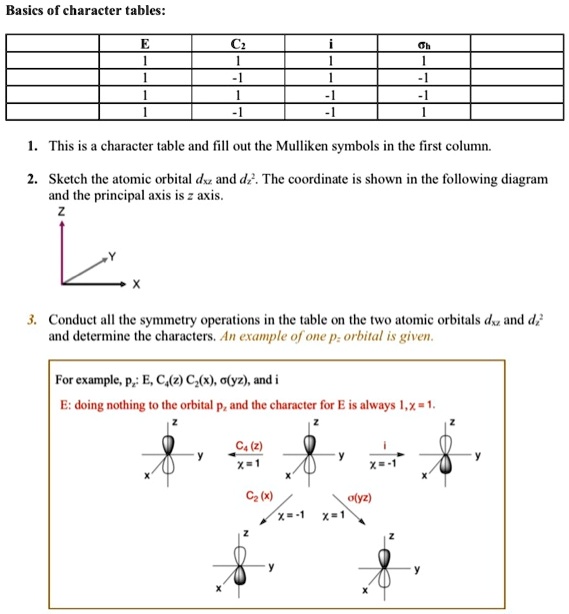
Let's work through this step-by-step to find the irreducible representation for the and orbitals. We determine the character for each operation by seeing if the orbital is transformed into itself (+1), into its negative (-1), or into a mixture of orbitals (trace of the matrix).
Orbital:
The orbital has a large lobe along the z-axis and a torus in the xy-plane. Both parts have a positive phase.
- E (Identity): The orbital is unchanged. Character = +1.
- C₂(z): Rotating by 180° around the z-axis leaves the orbital unchanged. Character = +1.
- i (Inversion): Inverting the orbital through the origin (x,y,z) → (-x,-y,-z) leaves it unchanged. Character = +1.
- σₕ(xy): Reflecting through the xy-plane leaves the orbital unchanged. Character = +1.
The characters for are (1, 1, 1, 1). Comparing this to the C₂ₕ character table, we see that the orbital transforms as the A₉ irreducible representation.
Orbital:
The orbital has four lobes in the xz-plane. Let's say the lobes in the (+x, +z) and (-x, -z) quadrants have positive phase, and lobes in the (-x, +z) and (+x, -z) quadrants have negative phase.
- E (Identity): The orbital is unchanged. Character = +1.
- C₂(z): Rotating 180° about z sends (x,y,z) to (-x,-y,z). A positive lobe at (+x, 0, +z) moves to (-x, 0, +z), where there was a negative lobe. The entire orbital is mapped to its negative. Character = -1.
- i (Inversion): Inverting sends (x,y,z) to (-x,-y,-z). A positive lobe at (+x, 0, +z) moves to (-x, 0, -z), where there was another positive lobe. The orbital is mapped onto itself. Character = +1.
- σₕ(xy): Reflecting through the xy-plane sends (x,y,z) to (x,y,-z). A positive lobe at (+x, 0, +z) moves to (+x, 0, -z), where there was a negative lobe. The orbital is mapped to its negative. Character = -1.
The characters for are (1, -1, 1, -1). This corresponds to the B₉ irreducible representation in the C₂ₕ character table. This confirms the placement of xz in the B₉ row of the table.
Conclusion
In this lesson, you've learned to decode the rich information contained within a character table. You can now interpret the meaning of Mulliken symbols, understand the profound connection between the dimensionality of an irrep and the degeneracy of quantum states, and see how the basis function columns provide a direct link between abstract group theory and the transformation properties of physical quantities like atomic orbitals.
Key Takeaways:
- A character table is a complete summary of the symmetry properties of a group.
- Mulliken symbols (A, B, E, T with subscripts) classify irreducible representations based on their dimensionality and symmetry with respect to key operations.
- The character under the identity, , gives the dimension of the irrep and thus the degeneracy of any quantum state transforming under it.
- The characters themselves are traces of transformation matrices that describe how basis functions (like wavefunctions) behave under symmetry operations.
- The basis function columns show how vectors (p-orbitals, dipole moments) and quadratic forms (d-orbitals, polarizability) transform, providing a key to predicting spectroscopic properties and energy level splittings.
You are now equipped not just to build a character table, but to read it like a language. In our next lesson, we will apply this skill to more complex physical problems. We will use character tables for tetrahedral and octahedral groups to determine the degeneracy of electronic energy levels and the parity of wavefunctions, and begin exploring how group theory provides powerful "selection rules" that dictate which spectroscopic transitions are allowed or forbidden.