Welcome to the second lesson of our module on point groups. In our last session, you learned the practical skill of identifying a molecule's or crystal's symmetry elements and classifying it into a specific point group using Schoenflies notation. Now that we can label a system's symmetry, our next task is to unpack what that label tells us about its physical properties.
The key to this is the character table. For any given point group, its character table serves as a complete, compact summary of all its possible symmetry behaviors. It is the master key that unlocks predictions about energy level degeneracies, spectroscopic selection rules, and the nature of molecular vibrations and electronic orbitals.
In this lesson, you will learn the systematic procedure for constructing the character table for any finite point group from first principles. We will leverage the powerful orthogonality relations that you studied in Module 2, which are direct consequences of the Great Orthogonality Theorem. By the end, you will be able to build these tables for simple groups yourself, giving you a deep understanding of their structure rather than just treating them as a given.
1. The Rules of the Game: Properties of Irreducible Representations
Before we begin construction, let's review the essential rules that govern the characters of irreducible representations (irreps). These rules, derived from the Great Orthogonality Theorem, provide a powerful and rigid framework that makes the construction of character tables a systematic, algorithmic process.
These notes concisely list the five essential rules for constructing character tables.
Please read the section titled "Irreducible Representations". Focus on committing these five rules to memory, as they are the toolkit we will use for the rest of the lesson.
To summarize and rephrase for practical use, here are the five rules:
- The number of irreducible representations is equal to the number of conjugacy classes in the group.
- The sum of the squares of the dimensions () of the irreps is equal to the order of the group (). Remember, the dimension of an irrep is simply its character for the identity operation, . So, .
- The sum of the squares of the characters in any single irrep equals the order of the group. This is the "normalization" condition for the character vectors. For a group with classes containing elements, this is written as: where is an operation from class .
- The character vectors of any two different irreps are orthogonal. This means their dot product is zero:
- Every group has a totally symmetric representation, conventionally labeled A or A₁, for which all characters are +1.
With these rules in hand, let's construct our first character table.
2. Constructing the C₂ᵥ Character Table
The C₂ᵥ point group (describing molecules like water, H₂O) is an ideal starting point. It is an abelian group of order 4, which simplifies the process considerably.
The following video provides an excellent step-by-step walkthrough of the entire construction.
Group Theory-3( Construction Of Character table of C2v Point Group)
This video, "Group Theory-3 (Construction Of Character table of C2v Point Group)" from FML Chemistry, demonstrates the application of the orthogonality rules.
Watch the construction process in these key stages: Determining the number and dimensions of the irreps. Filling the first row (totally symmetric irrep) and the first column (dimensions). Using orthogonality and normalization to deduce the remaining characters.
Let's recap the logic shown in the video, applying our five rules systematically.
-
Step 1: Group properties. The C₂ᵥ point group contains four symmetry operations: . Since it is an abelian group, every operation is in its own class. Thus, we have 4 classes and the order of the group is .
-
Step 2: Number and dimensions of irreps.
- Rule 1: Number of irreps = Number of classes = 4.
- Rule 2: Let the dimensions of these four irreps be . We must have .
- Since dimensions must be positive integers, the only solution is . Therefore, C₂ᵥ has four one-dimensional irreducible representations.
-
Step 3: Building the table. We start with an empty table and fill in what we know.
| C₂ᵥ | E | C₂ | σᵥ(xz) | σᵥ'(yz) |
|---|---|---|---|---|
| Γ₁ | ||||
| Γ₂ | ||||
| Γ₃ | ||||
| Γ₄ |
- The character of the identity element, , is the dimension of the representation. We know all irreps are 1D, so the first column is all 1s.
- Rule 5: There is always a totally symmetric representation (usually called A₁) with all characters equal to +1.
| C₂ᵥ | E | C₂ | σᵥ(xz) | σᵥ'(yz) |
|---|---|---|---|---|
| A₁ | 1 | 1 | 1 | 1 |
| Γ₂ | 1 | |||
| Γ₃ | 1 | |||
| Γ₄ | 1 |
- Step 4: Finding the remaining characters.
- Rule 3 (Normalization): For any irrep Γᵢ, . Since , we have . As the characters for 1D representations must be real numbers that satisfy this, they must be .
- Rule 4 (Orthogonality): The dot product of A₁ with any other irrep Γᵢ must be zero. For Γ₂, this means:
Since each character must be , this equation can only be satisfied if two of the remaining characters are +1 and two are -1. But we know , so Γ₂ must contain one other +1 and two -1s. The same logic applies to Γ₃ and Γ₄. - By filling in the remaining rows with combinations of +1 and -1 that ensure all rows are mutually orthogonal, we arrive at the complete table.
| C₂ᵥ | E | C₂ | σᵥ(xz) | σᵥ'(yz) |
|---|---|---|---|---|
| A₁ | 1 | 1 | 1 | 1 |
| A₂ | 1 | 1 | -1 | -1 |
| B₁ | 1 | -1 | 1 | -1 |
| B₂ | 1 | -1 | -1 | 1 |
(The assignment of the labels A₂, B₁, B₂ is determined by conventions we will discuss in the next lesson.)
3. Constructing the C₃ᵥ Character Table
Now let's tackle a slightly more complex, non-abelian group: C₃ᵥ (e.g., ammonia, NH₃). This will introduce the concept of multi-dimensional irreps.
-
Step 1: Group properties. The C₃ᵥ group has 6 elements: . The order is .
-
These elements are grouped into 3 classes:
- (the two rotations)
- (the three vertical reflections)
-
Step 2: Number and dimensions of irreps.
- Rule 1: Number of irreps = Number of classes = 3.
- Rule 2: Let the dimensions be . We have .
- The only integer solution is . So, C₃ᵥ has two one-dimensional irreps and one two-dimensional irrep.
-
Step 3: Building the table. We set up the table framework and fill in the dimensions () and the totally symmetric irrep (A₁).
| C₃ᵥ | E | 2C₃ | 3σᵥ |
|---|---|---|---|
| A₁ | 1 | 1 | 1 |
| Γ₂ | 1 | a | b |
| Γ₃ | 2 | c | d |
-
Step 4: Finding the characters for Γ₂ (a 1D irrep).
- Rule 4 (Orthogonality to A₁): The dot product must be zero. Remember to include the number of elements in each class ().
- Rule 3 (Normalization of Γ₂):
- We have a system of two equations. Since Γ₂ is 1D, its characters must be integers (in this case, ). The only integer solution that satisfies both equations is and . So, Γ₂ (labeled A₂) is .
-
Step 5: Finding the characters for Γ₃ (a 2D irrep, labeled E).
- Rule 4 (Orthogonality to A₁):
- Rule 4 (Orthogonality to A₂):
- We now have a simple system of two linear equations for and . Adding the two equations gives , which yields . Substituting this back into the first equation gives , yielding .
- So, Γ₃ (labeled E) is .
The final character table for C₃ᵥ is:
| C₃ᵥ | E | 2C₃ | 3σᵥ |
|---|---|---|---|
| A₁ | 1 | 1 | 1 |
| A₂ | 1 | 1 | -1 |
| E | 2 | -1 | 0 |
This entire algebraic process is demonstrated very clearly in the following video.
Character Tables (C3v) | Group Theory
The video "Character Tables (C3v) | Group Theory" from The Cynical Philosopher provides a concise derivation.
First, watch this segment to see how the classes are formed and the dimensions are determined. Then, watch the key calculation where the orthogonality relations are used to solve for the unknown characters of the A₂ and E representations.
To confirm your understanding, use the orthogonality rule (Rule 4) to verify that the A₂ and E representations we just derived are indeed orthogonal.
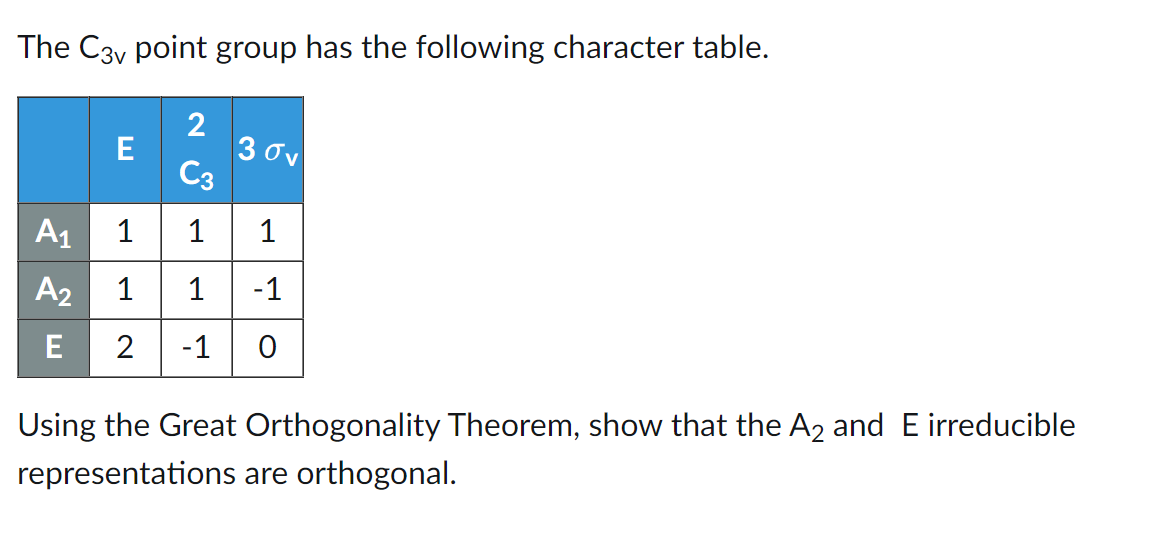
Solution:
We need to calculate and show it equals zero.
The dot product is zero, so the representations are orthogonal.
Conclusion
In this lesson, you have moved from simply identifying point groups to deconstructing their fundamental mathematical structure. You have seen that the character table is not an arbitrary object to be memorized, but a structure that is rigorously and uniquely determined by the group's properties via the orthogonality theorems.
Key Takeaways:
- Character tables are constructed using a set of five powerful rules derived from the Great Orthogonality Theorem.
- The process is algorithmic: determine the number and dimensions of irreps, fill in the totally symmetric representation, and then use the orthogonality and normalization conditions to solve for the remaining unknown characters.
- The presence of multi-dimensional irreps (like the E representation in C₃ᵥ) is a natural consequence of these rules for non-abelian groups.
Now that you know how to build a character table, the next logical step is to learn how to read and interpret one. In the next lesson, we will dissect the completed C₃ᵥ table and others, explaining the meaning of the Mulliken symbols (A, B, E), the physical significance of the characters themselves, and how the information in the table's final columns connects group theory to quantum mechanical observables like position, momentum, and atomic orbitals.