Welcome to the final lesson of our module on point groups and molecular symmetries. In our previous lesson, we developed a powerful, systematic method to determine the symmetries of molecular vibrations. The core idea was to construct a reducible representation based on how a set of basis vectors (the 3N Cartesian displacements) transforms under the molecule's symmetry group, and then decompose it into its irreducible components.
Today, we will apply this same group-theoretical machinery to a different, but profoundly important, physical problem: the behavior of atoms within a crystal. Specifically, we will explore Crystal Field Theory (CFT). This theory explains how the energy levels of an isolated atom, which are degenerate due to full rotational symmetry, split when the atom is placed in the lower-symmetry electrostatic environment of a crystal lattice. This is a cornerstone concept in condensed matter physics, crucial for understanding the magnetic, optical, and electronic properties of materials.
By the end of this lesson, you will be able to apply group theory to predict precisely how the degenerate orbital energy levels of an atom split in a crystal field of a given symmetry.
1. The Physical Picture: From Spherical to Point Group Symmetry
An electron in an isolated, free atom experiences a central potential, which is spherically symmetric. The symmetry group of the Hamiltonian is the full 3D rotation group, O(3). A key consequence of this high symmetry is that all atomic orbitals with the same principal quantum number and the same angular momentum quantum number are degenerate in energy. For example, the five d-orbitals () are all at the same energy level.
When this atom is placed into a crystal, it is no longer isolated. It is surrounded by other ions, called ligands, which create an electrostatic potential known as the crystal field. This field is not spherically symmetric; instead, it possesses the symmetry of the atom's local environment, which is described by a finite point group (e.g., octahedral or tetrahedral ).
The Hamiltonian of an electron on the central atom is now perturbed by this crystal field potential. The overall symmetry of the system is reduced from O(3) to the point group of the crystal site. This reduction in symmetry lifts the degeneracy of the atomic orbitals. Orbitals that point directly at the negatively charged ligands are repelled more strongly and increase in energy, while those that point between the ligands are less affected and decrease in energy relative to the average.
To build a solid physical intuition for this phenomenon, let's watch an introductory video on Crystal Field Theory.
Crystal Field Theory 1: Basics and High Symmetry Cases
This video, "Crystal Field Theory 1: Basics and High Symmetry Cases," provides an excellent conceptual overview of the theory. It begins with the core approximation of CFT and then explains the splitting of d-orbitals in an octahedral field from a qualitative, electrostatic perspective.
Please watch the first two sections of the video: The introduction explains the basic premise of CFT, treating ligands as point charges. The next section details how the d-orbitals, which are degenerate in a vacuum and a hypothetical spherical field, split into two distinct energy levels in an octahedral (O_h) field. Pay close attention to the argument based on orbital directionality.
The video shows that in an octahedral field, the five d-orbitals split into two groups:
- A higher-energy, doubly degenerate set: and .
- A lower-energy, triply degenerate set: , , and .
This splitting pattern is a direct result of the symmetry change. While electrostatics gives us the "why," group theory will provide the rigorous "how" and "what."
2. The Group Theoretical Approach to Level Splitting
The problem of predicting how energy levels split is perfectly suited for representation theory. The procedure is analogous to the one we used for molecular vibrations:
- Identify the Initial Representation: The set of degenerate atomic orbitals for a given forms a basis for a -dimensional irreducible representation of the SO(3) group, which we can denote .
- Form a Reducible Representation: When the symmetry is lowered to a finite point group , this representation becomes a representation of . Critically, it is now generally reducible.
- Decompose the Representation: We decompose this reducible representation into the irreducible representations (irreps) of the point group . The result of this decomposition tells us precisely how the level splits. Each resulting irrep corresponds to a new energy level, and its dimension, , gives the degeneracy of that level.
Calculating Characters of
To perform the decomposition, we first need the characters of our reducible representation under the symmetry operations of the point group . Since every operation in a point group is a type of rotation (or rotation-inversion), we can use the general formula for the character of a rotation by an angle in the -dimensional representation of SO(3):
For the identity operation (), the character is simply the dimension of the representation: .
This powerful formula allows us to generate the characters for any set of orbitals () in any point group, without having to construct a single matrix.
3. Worked Example: d-orbital Splitting in an Octahedral Field ()
Let's apply this method to the canonical example: the splitting of the five d-orbitals () in an octahedral () crystal field. The following reading provides the necessary character tables and walks through the calculation.
[PDF] Crystal-Field Theory, Tight-Binding Method and Jahn-Teller Effect
This excerpt from a condensed matter physics lecture script by Eva Pavarini provides a concise and rigorous group-theoretical treatment of crystal field splitting. It aligns perfectly with your background.
Please read the subsection titled "The crystal-field potential...can split...". This section covers three key steps: It introduces the character table for the rotational subgroup O. Since d-orbitals have even parity (gerade), we can simplify the problem by working with the O group instead of the full O_h group. It uses the character formula (or a pre-computed table based on it) to find the characters for the reducible representation \Gamma_d (for l=2). It states the result of the decomposition formula, showing how \Gamma_d splits into irreps of the O group.
Let's re-trace the key steps from the reading to solidify our understanding.
Step 1: Find the characters for () in the point group.
The classes of group are . We use the character formula for rotations .
- :
- :
- :
- :
- :
This gives the set of characters for our reducible representation : .
Step 2: Decompose using the reduction formula.
Using the character table for provided in the reading and our characters for , the reduction formula
yields and , while all other .
Step 3: Interpret the result.
The decomposition is . Since d-orbitals are even under inversion (gerade, or 'g'), we write this in the full notation as:
This result from group theory tells us, without any knowledge of the detailed Hamiltonian, that the five d-orbitals must split into a doubly-degenerate set with symmetry and a triply-degenerate set with symmetry. This is exactly what we saw from the qualitative electrostatic argument earlier. By inspecting the basis functions listed in the character table, we can even assign the specific orbitals:
- :
- :
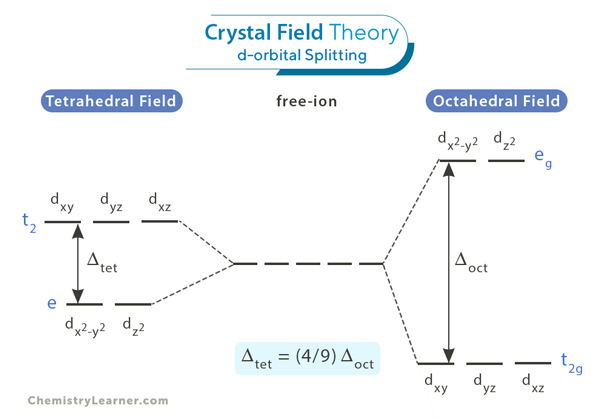
Group theory predicts how the levels split and their degeneracies, but not their energy ordering or the magnitude of the splitting (). To find that, one needs to perform a quantum mechanical calculation, as outlined briefly in the next part of the Pavarini notes.
4. Splitting in a Tetrahedral Field ()
The same method can be applied to any other crystal symmetry. Let's consider a tetrahedral field (), which is common in semiconductor physics (e.g., the environment of an atom in a silicon crystal).
The video you watched earlier also analyzed this case.
Crystal Field Theory 1: Basics and High Symmetry Cases
Let's return to the video to see the analysis for the tetrahedral (T_d) field.
Please watch from 09:45 to 14:33. The video explains the geometry and the resulting splitting pattern for d-orbitals in a T_d field, contrasting it with the octahedral case.
In a tetrahedral field, the d-orbitals also split into two sets, but the energy ordering is inverted compared to the octahedral case. The orbitals, now labeled with the irrep , are higher in energy, while the orbitals, labeled with , are lower. (Note the 'g' subscript is dropped because a tetrahedron does not have a center of inversion).
You could verify this result yourself by finding the characters of under the symmetry operations of the point group and performing the reduction. You would find that decomposes into .
5. Connecting to Broader Concepts
The splitting of energy levels due to a reduction in symmetry is a ubiquitous theme in physics. The method you've learned here is a direct application of perturbation theory in a group-theoretical framework.
[PDF] and its applications in physics - Group Theory - P. Cvitanovic
This reading from a course by Predrag Cvitanović formalizes the connection between symmetry breaking and the lifting of degeneracies.
I recommend reviewing two short sections: The section on Perturbation theory states the general principle: when a symmetry group G is reduced to a subgroup G_1, an irreducible representation of G may become reducible in G_1, leading to a splitting of the energy level. The example "Perturbation with discrete symmetry" provides a nearly identical calculation to our own, showing how the 5-dimensional l=2 representation of SO(3) splits under a tetrahedral (T) perturbation.
This principle is not limited to crystal fields. It applies to the Stark effect (atoms in an external electric field), the Zeeman effect (atoms in a magnetic field), and spin-orbit coupling. In each case, a new term in the Hamiltonian breaks a larger symmetry, and group theory allows us to predict how the degeneracies will be lifted.
Conclusion
In this lesson, we have connected the abstract framework of group theory to the concrete physical problem of atomic energy levels in a crystal. By treating the set of degenerate atomic orbitals as a basis for a representation of the crystal's point group, we can use the familiar tools of character theory and representation reduction to predict level splitting with precision and elegance.
Key Takeaways:
- When an atom is placed in a crystal, the symmetry of its environment is reduced from the full rotation group O(3) to a finite point group .
- This reduction in symmetry lifts the degeneracy of the atom's orbital energy levels.
- The set of degenerate orbitals forms a basis for a reducible representation, , of the point group .
- The characters of can be found using the formula for the characters of SO(3) representations.
- Decomposing into the irreps of reveals precisely how the energy level splits: each irrep corresponds to a new energy level with a degeneracy equal to the irrep's dimension.
- For d-orbitals () in an octahedral () field, the splitting is . In a tetrahedral () field, it is .
This concludes our module on point groups. You now have a comprehensive toolkit for analyzing the consequences of discrete symmetries in molecules and crystals. In our next module, we will elevate our study of symmetry to the fundamental level of quantum mechanics, starting with Wigner's theorem and the representation of symmetry transformations in Hilbert space.