In our last lesson, we developed a powerful tool—the direct product of representations—to establish selection rules for spectroscopic transitions. We saw that determining whether a vibrational mode is active in IR or Raman spectroscopy hinges on knowing the symmetry of that vibration. We worked through the example of water, but that was primarily to illustrate the selection rules themselves. Now, we will formalize and generalize the process of identifying the symmetries of these vibrational motions for any molecule.
Today's lesson focuses on a systematic procedure for determining the irreducible representations under which a molecule's normal modes of vibration transform. This technique is a cornerstone of molecular spectroscopy and also provides the conceptual foundation for understanding collective excitations, like phonons, in the crystalline solids you study in condensed matter physics. We will use the ammonia molecule (NH₃) as our primary example. Its C₃ᵥ symmetry introduces degenerate representations, offering a richer and more illustrative case than the water molecule.
1. The Framework: Degrees of Freedom and the 3N Cartesian Basis
A molecule with atoms has total degrees of freedom, as each atom can move in three Cartesian directions. These motions can be partitioned into three categories:
- Translation: The molecule moves as a whole (3 degrees of freedom).
- Rotation: The molecule rotates as a rigid body (3 degrees for non-linear molecules, 2 for linear ones).
- Vibration: The remaining motions, corresponding to changes in bond lengths and angles (3N-6 for non-linear, 3N-5 for linear).
Our goal is to find the symmetry species (the irreducible representations) of these vibrational modes. The strategy is to first construct a representation for all motions, called , and then subtract the representations corresponding to translation () and rotation ().
To construct , we need a basis that spans all possible motions. The most direct choice is a set of three Cartesian displacement vectors placed on each of the atoms. This is known as the 3N Cartesian basis. We then determine the characters of the matrix representation for this basis under each symmetry operation of the molecule's point group.
A full matrix construction is cumbersome. A more efficient method relies on a key insight: only atoms that are unshifted by a symmetry operation can contribute to the diagonal of the transformation matrix, and thus to its character. The character for a symmetry operation is therefore:
The character contribution from a single unshifted atom's (x,y,z) vectors is for a proper rotation by and for an improper rotation. For simple reflections () or inversions (), this formula simplifies. You can also find the character for the (x,y,z) vector set by summing the characters for the x, y, and z irreps as listed in the character table.
MOLECULAR SYMMETRY, GROUP THEORY, & ...
These lecture notes from the University of Oxford provide an excellent summary of this procedure.
Please read the section titled "Summary of applying group theory to molecular motions", focusing on points 3 and 4. This will give you a concise overview of the steps we are about to take.
2. A Complete Worked Example: Vibrational Modes of Ammonia (NH₃)
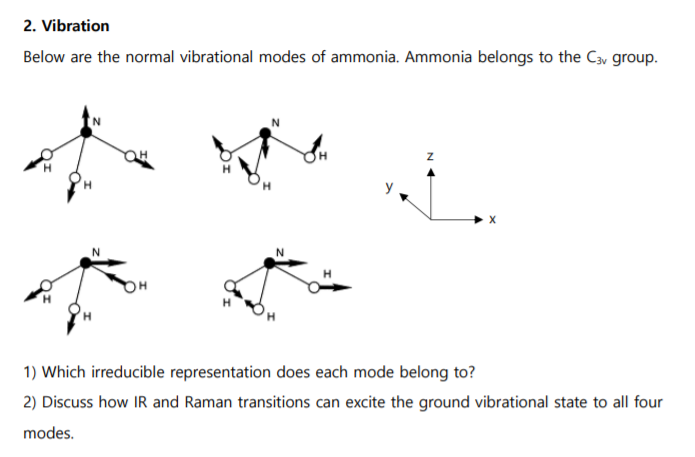
The ammonia molecule has a trigonal pyramidal shape and belongs to the C₃ᵥ point group. It has atoms, so we expect vibrational modes.
We will now walk through the entire process of finding the symmetries of these six modes. The following video provides a detailed, step-by-step calculation that perfectly illustrates the method. We will watch it in segments, pausing to reflect on each step.
Step 1: Generating the Reducible Representation
First, we apply the character formula described above to find the characters of the representation for the C₃ᵥ point group (classes: E, 2C₃, 3σᵥ).
- E: All 4 atoms are unshifted. The character contribution per atom is 3. Total: .
- C₃: Only the nitrogen atom lies on the C₃ axis and is unshifted. The character contribution is . Total: .
- σᵥ: Each mirror plane contains the nitrogen atom and one hydrogen atom. Two atoms are unshifted. The character contribution for reflection is . Total: .
So, the characters for are (12, 0, 2).
Step 2: Decomposing into Irreducible Representations
Now that we have the characters for the reducible representation , we use the reduction formula to find which irreducible representations (A₁, A₂, E for C₃ᵥ) it contains.
where is the order of the group (6 for C₃ᵥ), is the number of operations in the class, is the character of the irrep , and is our character set (12, 0, 2).
Projection operator method: vibrations of ammonia (NH₃)
The next part of the video applies this reduction formula for each irrep of the C₃ᵥ group.
Now, watch from 05:14 to 13:25. Follow the calculations closely as the presenter shows that \Gamma_{3N} = 3A_1 \oplus A_2 \oplus 4E.
Step 3: Isolating the Vibrational Modes
We have decomposed all 12 degrees of freedom. Now we must subtract those corresponding to translation and rotation. We find their symmetries by inspecting the final columns of the C₃ᵥ character table.
- Translations: The coordinate transforms as A₁, and the pair transforms as E. Thus, .
- Rotations: The rotation transforms as A₂, and the pair transforms as E. Thus, .
Now we perform the subtraction:
This is our final answer. The six vibrational modes of ammonia transform as two non-degenerate A₁ modes and two doubly-degenerate E modes.
Projection operator method: vibrations of ammonia (NH₃)
The video confirms this final step.
Please watch from 14:04 to 16:53 to see the subtraction performed, leading to the final result for \Gamma_{\text{vib}}.
3. Visualizing the Vibrational Modes
While we have now fully addressed the learning outcome, a physicist's curiosity demands we ask: what do these and vibrations actually look like? To answer this, we can use the projection operator technique you learned about in Module 2. This allows us to project out the specific atomic motions that correspond to each irreducible representation.
A more intuitive way to do this is to separate the vibrations into two types: stretches (changes in bond length) and bends (changes in bond angle). We can analyze these using a basis of internal coordinates (the N-H bond lengths and H-N-H bond angles) instead of the 3N Cartesian basis. The remainder of the video does exactly this, providing a masterclass in applying projection operators to a concrete physical problem.
Projection operator method: vibrations of ammonia (NH₃)
This extended segment shows how to use projection operators on internal coordinates to derive the physical form of each of the six vibrational modes. This is a powerful application of the theory we've built.
I encourage you to watch the following segments to see the full picture: Stretching Modes (A_1 + E): Watch from 16:53 to 26:57. You will see the derivation of the symmetric stretch (A_1) and the degenerate pair of asymmetric stretches (E). Bending Modes (A_1 + E): Continue from 26:57 to 33:44. This part derives the symmetric "umbrella" bend (A_1) and the degenerate pair of scissoring/rocking bends (E).
Finally, the video concludes by connecting back to our previous lesson, using the character table to determine that all and modes in ammonia are both IR and Raman active.
Conclusion
In this lesson, we have established and applied a robust, systematic method for classifying the symmetries of molecular vibrations. This is not just an academic exercise; it is the essential first step in interpreting vibrational spectra and understanding the dynamics of molecules and lattices.
Key Takeaways:
- The symmetries of a molecule's normal vibrational modes are found by determining the representation of the 3N Cartesian basis, , and subtracting the representations for translation and rotation.
- The character of for a given symmetry operation can be efficiently calculated as the number of unshifted atoms multiplied by the character contribution from a single (x,y,z) coordinate set.
- For ammonia (C₃ᵥ), we found , corresponding to two non-degenerate modes and two pairs of degenerate modes.
- Projection operators, applied to a basis of internal coordinates, can reveal the physical nature (stretching vs. bending) and atomic displacements of each mode.
Having now mastered the application of group theory to discrete symmetries in molecules, we are ready to broaden our scope. In the next module, we will explore the profound role symmetry plays at the very heart of the quantum mechanical formalism, starting with Wigner's theorem and the representation of symmetries as operators in Hilbert space.