Welcome to the first lesson of our module on Noether's theorem and gauge symmetries. In the previous module, we explored the powerful role of discrete symmetries—like translations, rotations, and time-reversal—in the context of crystalline solids. We saw how these symmetries dictate the structure of electronic bands and govern the rules for optical transitions.
Now, we shift our focus from the discrete symmetries of specific physical systems to the continuous symmetries that underpin the very fabric of our physical laws. This brings us to one of the most profound and elegant results in all of physics: Noether's theorem. It establishes a direct and deep connection between the continuous symmetries of a physical system and the conservation laws it obeys. Today, we will formally state this theorem for classical mechanical systems and work through its proof.
The Core Idea: Symmetries and Conservation Laws
Before diving into the mathematical formalism, let's establish the central idea. In physics, a "conservation law" tells us that a certain physical quantity—like energy, momentum, or charge—remains constant over time. A "symmetry" implies that the laws of physics are unchanged under some transformation, such as shifting the system in space or rotating it. Noether's theorem reveals that these are not independent concepts; rather, one implies the other.
The following video provides an excellent conceptual introduction to this beautiful relationship.
Symmetries & Conservation Laws: A (Physics) Love Story
This video from the channel "Physics with Elliot" offers a clear and engaging introduction to the love story between symmetries and conservation laws.
Please watch the introductory segment, from the beginning of the video. It will set the stage by defining conserved quantities and symmetries, and it lists the famous pairings that Noether's theorem explains: spatial translation with momentum conservation, time translation with energy conservation, and rotational invariance with angular momentum conservation.
The Lagrangian Framework and the Formal Statement
To prove Noether's theorem, we will work within the Lagrangian formulation of classical mechanics. As you know from your studies, this approach describes the dynamics of a system through a single scalar function, the Lagrangian , via the principle of least action. The equations of motion are given by the Euler-Lagrange equations:
Within this framework, we can state Noether's theorem formally. The following reading from David Tong's lecture notes on Classical Dynamics provides a concise and clear statement.
These notes from the University of Cambridge offer a standard, rigorous treatment of classical mechanics. We will use them to formally define the key concepts before we construct the proof.
Please read the section "Noether’s Theorem and Symmetries". Focus on the definitions of a constant of motion and an ignorable coordinate, and then the formal statement of Noether's Theorem itself.
As the reading states, Noether’s theorem asserts that for every one-parameter continuous symmetry of the Lagrangian, there exists a corresponding conserved quantity. Our goal now is to prove this assertion.
Proof of Noether's Theorem
We will construct the proof in two steps. First, we will watch a clear, simplified derivation that captures the essential logic. Then, we will work through a more formal and general proof that holds for a wider class of symmetries, including those you will encounter in field theory.
This first derivation, presented by Brian Greene, handles the case where the Lagrangian is strictly invariant under an infinitesimal change in the coordinates.
Your Daily Equation #25: Noether's Amazing Theorem: Symmetry and Conservation
Brian Greene's presentation for the World Science Festival provides a wonderfully accessible yet accurate derivation of the theorem in a simplified setting.
Please watch the segment covering the proof. He begins with a quick review of the Lagrangian and its equation of motion. Follow his steps closely as he considers a continuous transformation, applies the chain rule, and masterfully combines the Euler-Lagrange equation with the symmetry condition (dL/d\lambda = 0) to reveal a quantity whose total time derivative is zero.
This derivation beautifully illustrates the core mechanism of the proof. Now, let's advance to the most general form for classical systems, which you will find essential in your advanced courses. This version handles transformations that can also affect the time coordinate and considers cases where the action, not necessarily the Lagrangian itself, is the invariant quantity.
Noether's theorem - Physics Department, Oxford University
This document from Andrew Steane at the University of Oxford provides a complete and general proof. This is the version of the theorem that forms the foundation for its application in modern physics.
Please read section 3.2, "General case". The derivation is more abstract, as it considers a symmetry transformation that mixes coordinates and time: q_i \to q_i + \zeta_i and t \to t + \tau. The argument culminates in equation (55), which is the definitive statement of the conserved quantity, known as the Noether charge.
The Noether Charge Unpacked
Let's pause to write down and analyze the final result from Steane's notes. This is the formal statement of Noether's theorem.
Noether's Theorem: For a system described by a Lagrangian , if the action is invariant under a continuous infinitesimal transformation of the coordinates and time,
then the quantity
is a conserved quantity along the physical path of the system, meaning .
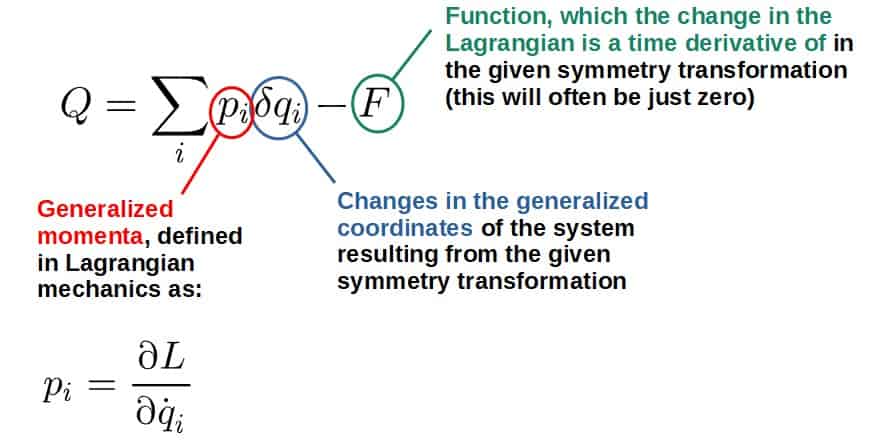
This conserved quantity, , is the Noether charge. Let's identify its components:
- , the canonical momentum conjugate to the coordinate .
- , the Hamiltonian of the system.
- and describe the infinitesimal transformation of the spatial coordinates and time, respectively.
So, we can write the Noether charge more compactly as:
This powerful equation is a machine for generating conservation laws. If you can identify a continuous symmetry of your system (i.e., find the transformations and that leave the action unchanged), this formula immediately gives you the corresponding conserved quantity.
The image below provides a helpful visual breakdown of a slightly less general form of the Noether charge, where the Lagrangian itself can change by a total time derivative, a case known as a quasi-symmetry.
Conclusion
In this lesson, we have formally stated and proven Noether's theorem, arguably one of the cornerstones of theoretical physics. You have seen how, within the elegant framework of Lagrangian mechanics, the invariance of a system's action under a continuous transformation inevitably leads to a conserved quantity.
Key Takeaways:
- Noether's Theorem: Every differentiable, continuous symmetry of the action of a physical system corresponds to a conserved quantity.
- The Proof: The proof relies on considering an infinitesimal transformation and using the Euler-Lagrange equations. The symmetry condition causes terms to cancel in such a way that the total time derivative of a specific combination of quantities—the Noether charge—vanishes.
- The Noether Charge: The conserved quantity is given by . This formula provides a direct recipe for finding conservation laws from symmetries.
We have done the hard work of proving the general theorem. In our next lesson, we will apply this powerful result to the fundamental symmetries of spacetime itself—homogeneity of space, isotropy of space, and homogeneity of time—to derive the conservation of linear momentum, angular momentum, and energy.