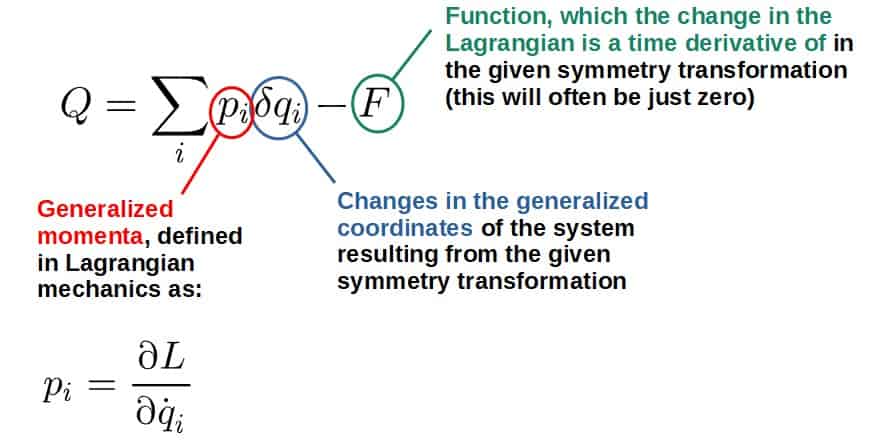
In our last lesson, we established one of the most elegant and powerful results in theoretical physics: Noether's theorem. We saw how the principle of least action, when combined with the existence of a continuous symmetry, inevitably leads to a conservation law. We concluded by deriving the master formula for the conserved quantity, the Noether charge:
This equation is a powerful machine for generating conservation laws. Given a symmetry transformation defined by the infinitesimal changes to coordinates () and time (), it hands us the corresponding conserved quantity on a platter.
Today, we will put this machine to work. We will move from the abstract proof to concrete physical applications by considering the three fundamental symmetries of spacetime itself: the homogeneity of time, the homogeneity of space, and the isotropy of space. By applying Noether's theorem to these symmetries, we will derive the three great conservation laws of classical mechanics: the conservation of energy, linear momentum, and angular momentum. This will demonstrate that these laws are not arbitrary rules but are deep consequences of the fundamental symmetries of our universe.
Homogeneity of Time and Conservation of Energy
The first fundamental symmetry we will consider is time-translation invariance, or the homogeneity of time. This principle states that the laws of physics are the same today as they were yesterday and will be tomorrow. An experiment conducted now should yield the same results as the identical experiment conducted an hour later, provided all other conditions are identical.
In the Lagrangian framework, this means the form of the Lagrangian does not explicitly depend on time. While the coordinates and velocities are functions of time, the function itself has no direct dependence on the variable . Mathematically, this condition is .
Let's see what conserved quantity this symmetry yields.
- The Transformation: An infinitesimal translation in time is given by: where is a small, constant time shift. The coordinates themselves are not transformed at a given instant, they simply evolve according to the same physical laws but on a shifted time axis.
- The Parameters: In terms of our Noether charge formula, this transformation corresponds to and for all .
- The Noether Charge: Plugging these into the formula for the Noether charge gives:
- The Conservation Law: Noether's theorem guarantees that . Since and is an arbitrary constant, it follows that:
The conserved quantity is the Hamiltonian, . For many classical systems, the Hamiltonian represents the total energy. Thus, we have derived the law of conservation of energy as a direct consequence of the symmetry of physical laws under time translation.
The following reading provides a detailed walk-through of this derivation.
Noether's Theorem: A Complete Guide With Examples
The article "Noether's Theorem: A Complete Guide With Examples" from Profound Physics offers a clear, step-by-step derivation. It uses a slightly different but equivalent method to calculate the change in the Lagrangian and arrive at the same conclusion.
Please read the section titled Conservation of Energy. Pay close attention to how the condition \partial L / \partial t = 0 is essential for the time translation to be a symmetry that leads to the conservation of the Hamiltonian.
Homogeneity of Space and Conservation of Linear Momentum
Next, we consider the homogeneity of space. This principle asserts that space is the same at all locations; there is no special or privileged point in the universe. The laws of physics are invariant under a rigid translation of the entire physical system.
This symmetry applies to isolated systems, where the potential energy depends only on the relative separation between its constituent parts, not on the absolute position of the system in space.
- The Transformation: Consider an infinitesimal translation of the entire N-particle system by a constant vector . The position vector of each particle transforms as: Time is unaffected by this transformation.
- The Parameters: This transformation corresponds to for each particle , and .
- The Noether Charge: We substitute these into the Noether charge formula, summing over all particles: We can factor out the constant vector : where is the total linear momentum of the system.
- The Conservation Law: Since and the translation vector is completely arbitrary (it can point in any direction), the only way for the dot product to be conserved for all is if the vector itself is conserved.
This is the law of conservation of linear momentum, which arises from the symmetry of physical laws under spatial translation.
The following video gives an exceptionally clear demonstration of this derivation for a single particle.
Your Daily Equation #25: Noether's Amazing Theorem: Symmetry and Conservation
This segment from Brian Greene's "Your Daily Equation" talk provides a clear and intuitive derivation of momentum conservation.
Please watch the section from Example 1. He applies Noether's theorem to a simple one-dimensional translation and shows how the momentum naturally emerges as the conserved quantity.
Isotropy of Space and Conservation of Angular Momentum
Finally, we turn to the isotropy of space. This principle states that space has the same properties in all directions; there is no preferred direction. The laws of physics are invariant under a rigid rotation of the entire physical system. Like homogeneity, this symmetry holds for isolated systems where the potential energy is spherically symmetric or depends only on the distances between particles.
- The Transformation: Consider an infinitesimal rotation of the system by a small angle about an axis defined by the unit vector . We can represent this rotation by the vector . Under such a rotation, the position vector of each particle transforms as: Time is again unaffected.

- The Parameters: The infinitesimal change in the coordinates is , and .
- The Noether Charge: Plugging this into our formula gives: Using the cyclic property of the scalar triple product, , we can rewrite this as: Factoring out the constant rotation vector , we get: where is the total angular momentum of the system.
- The Conservation Law: Noether's theorem tells us . Since the infinitesimal rotation vector can be chosen arbitrarily (i.e., we can rotate the system around any axis), the dot product is conserved only if the total angular momentum vector is itself conserved.
This is the law of conservation of angular momentum, derived from the rotational invariance (isotropy) of space.
To see this derivation in action, the same video by Brian Greene provides an elegant example in two dimensions.
Your Daily Equation #25: Noether's Amazing Theorem: Symmetry and Conservation
This segment continues from the previous example to tackle rotational symmetry.
Please watch the section from Example 2. He explicitly works out the infinitesimal transformation for a 2D rotation, calculates the corresponding variations \delta x_1 and \delta x_2, and shows how the Noether charge formula yields the expression for angular momentum. This is a masterful demonstration of the theorem.
The general form of the Noether charge from our previous lesson is summarized in the image below, which should now feel much more concrete. The terms are what we have identified as (or ), and in all three cases today, the Lagrangian was strictly invariant, so the function was zero.
Conclusion
In this lesson, we have reaped the rewards of our formal work in the previous session. By applying Noether's theorem, we have shown that the fundamental conservation laws of classical mechanics are not independent axioms but are direct and necessary consequences of the symmetries of spacetime.
Key Takeaways:
- Time Translation Symmetry (Homogeneity of Time) Conservation of Energy (Hamiltonian).
- Spatial Translation Symmetry (Homogeneity of Space) Conservation of Linear Momentum.
- Rotational Symmetry (Isotropy of Space) Conservation of Angular Momentum.
This profound connection is a central theme in modern physics. The conservation laws we rely on are reflections of the symmetries we observe in the universe.
In our next lesson, we will elevate these ideas from the mechanics of particles to the dynamics of fields. We will extend Noether's theorem to classical field theory, where it will give rise not to conserved quantities, but to conserved currents and continuity equations, a concept essential for your studies in quantum field theory and electromagnetism.