In our last lesson, we established a systematic and universal method for classifying the irreducible representations of SU(3) using Dynkin labels. We saw how the fundamental representations and correspond to labels and respectively, and the adjoint representation to . These irreps are the elementary building blocks of the theory.
The crucial next step, which forms the heart of this lesson, is to understand how to combine these building blocks. In the language of quantum mechanics, if we have a system composed of multiple particles, the state space of the composite system is the tensor product of the individual state spaces. For SU(3) flavor symmetry, this means understanding how to decompose tensor products like (a two-quark system) or (a quark-antiquark system, i.e., a meson) into a direct sum of irreducible representations.
Today, you will learn a powerful and elegant graphical technique for this purpose: the method of Young Tableaux. By the end of this lesson, you will be able to use these diagrams to decompose tensor products of SU(3) representations, providing a direct link between abstract group theory and the classification of composite particles.
From Tensor Products to Symmetry
Let's begin with the simplest non-trivial tensor product: combining two particles that each transform in the fundamental representation . This corresponds to the tensor product . Since the is a 3-dimensional representation, the product space is 9-dimensional. As we've seen many times, such a product representation is generally reducible.
A state in this product space can be represented by a tensor , where the indices and each run from 1 to 3 (or u, d, s for quark flavors). We can decompose this tensor into its symmetric and anti-symmetric parts with respect to the exchange of its indices:
This decomposition is significant because the symmetry operators of the group commute with the permutation of indices. This means the symmetric and anti-symmetric subspaces are invariant under the group action and thus correspond to sub-representations.
- The symmetric part, , has 6 independent components for SU(3). ( gives 3, gives ). This forms a 6-dimensional irreducible representation, denoted .
- The anti-symmetric part, , has 3 independent components (). This forms a 3-dimensional representation.
This decomposition under the permutation group (exchanging two objects) is the seed for the method of Young Tableaux. We introduce a graphical notation:
- A row of two boxes, , represents symmetrization.
- A column of two boxes, , represents anti-symmetrization.
So, the decomposition we just performed can be written as:
The dimensions must add up: . This is the decomposition . You might wonder why the 3-dimensional anti-symmetric part is the and not the . We will see shortly that for SU(N), a column of boxes corresponds to the conjugate representation. For SU(3), a column of two boxes is precisely the .
The following video lecture provides a good overview of this idea, linking the tensor product diagrams to physical combinations of quarks.
Lecture 50 : Young diagrams and tensor products
This video from NPTEL IIT Bombay introduces how tensor products are formed and decomposed using diagrammatic methods related to Young diagrams.
Watch the segment from quark combinations, where the lecturer discusses the three main ways to combine fundamental SU(3) representations. Then, continue from the decomposition of the two-quark system, where the 3 \otimes 3 = 6 \oplus 3 decomposition is explained in terms of dimensions.
Young Tableaux: The Rules of the Game
The method of Young Tableaux (or Young diagrams) provides a general and purely combinatorial algorithm for decomposing any tensor product of SU(N) representations. Each irreducible representation is uniquely identified by a diagram.
A Young Diagram is an arrangement of boxes in left-justified rows, where the length of each row is less than or equal to the length of the row above it.
For SU(N):
- Any column with boxes is an SU(N) invariant (a singlet, representation ). Such columns can be removed from a diagram without changing the representation it denotes.
- Consequently, diagrams with columns longer than boxes are redundant. For SU(3), we only need to consider diagrams with columns of length 1 or 2.
Algorithm for Decomposing :
Let's say we want to compute the tensor product of two irreps, and , represented by Young diagrams and .
- Label: In the diagram , fill all boxes in the first row with the letter 'a', all boxes in the second row with 'b', and so on.
- Append: Add the boxes of to the diagram , one by one, starting with all the 'a's, then all the 'b's, etc. At each step, you must form a valid new Young diagram.
- Apply Exclusion Rules: After appending all boxes, discard any resulting diagram that violates any of the following rules:
- Column Rule: No two identical letters may appear in the same column. This reflects the anti-symmetrization within columns.
- Reading Rule: Number the rows of the added letters from top to bottom. Reading the letters from right to left along each row, starting from the top row, the sequence of letters must be a "lattice permutation". This means that at any point in the sequence, the number of letters from row must be greater than or equal to the number of letters from row . For two rows ('a' and 'b'), this means at any point,
# of b's ≤ # of a's.
The set of valid, unique diagrams remaining after this procedure represents the direct sum of irreps in the decomposition. The following document provides a clear, step-by-step guide to this algorithm.
[PDF] Some Notes on Young Tableaux as useful for irreps of su(n)
This resource by K.S. Narain offers a detailed explanation of the rules for decomposing tensor products using Young Tableaux.
Please read the section that begins with the rules for calculating the Clebsch-Gordan series. The author walks through an example for SU(3) (\mathbf{3} \otimes \mathbf{8}) that illustrates the rules of labeling, appending, and deleting invalid diagrams. Focus on understanding the two exclusion rules presented.
Worked Examples for SU(3)
Let's solidify this by working through the two most important physical examples: combining two quarks () and combining a quark and an anti-quark ().
1. Two Quarks:
- Diagrams: and .
- Label: We label the box in with 'a': .
- Append: We add the 'a' box to . There are two ways to do this that result in a valid Young diagram:
- Exclusion Rules: Both diagrams are trivially valid. There is only one letter, so the column and reading rules are satisfied.
- Result: .
As we reasoned earlier, the horizontal diagram represents the symmetric representation, and the vertical diagram (a column of 2) represents the anti-symmetric representation.
This matches the diagrammatic result shown in the "Lecture 4 - SU(3)" notes.
Microsoft Word - Lecture_4 - UKRI
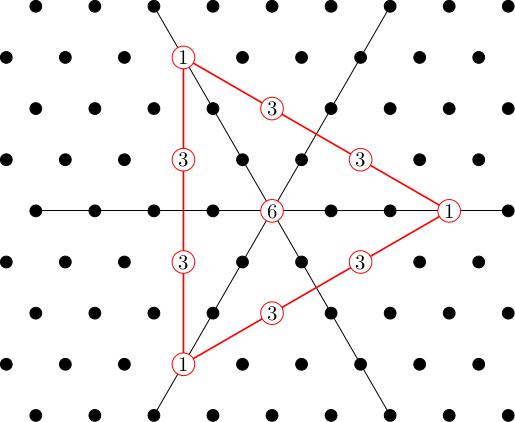
This diagram from the lecture notes by S. Haywood shows the graphical addition of weight diagrams for \mathbf{3} \otimes \mathbf{3}, resulting in the \mathbf{6} and \bar{\mathbf{3}} representations. This visually corresponds to our Young Tableaux result.
2. Quark and Anti-Quark (Mesons):
This is the key to understanding meson multiplets.
- Diagrams: The is . The is a column of boxes, so .
- Label: We label the boxes in : .
- Append: We add 'a' and then 'b' to .
- First, add 'a': and .
- Now, add 'b' to each of these intermediate diagrams:
- From : We can form and .
- From : We can form (not a valid Young diagram) and .
- Exclusion Rules:
- : Reading rule: 'b', 'a'. Sequence is valid. Keep.
- : Reading rule: 'b', 'a'. The number of 'b's (1) exceeds the number of 'a's (0) at the first step. Delete.
- : Reading rule: 'b', 'a'. Valid. Keep.
- Final Diagrams: The valid diagrams are and .
- Result for SU(3):
- The diagram corresponds to the adjoint representation, . (Its Dynkin labels are (1,1)).
- The diagram is a column of 3 boxes. For SU(3), this is a singlet, .
So, the decomposition is:
This result is profound. It tells us that combining a quark and an anti-quark yields an octet of mesons (like pions, kaons) and a singlet meson (like the eta-prime, ). This is a cornerstone of the Eightfold Way classification, which we will explore next.
Conclusion
In this lesson, we have added a powerful computational tool to our arsenal: the method of Young Tableaux. You have learned how these simple diagrams encode the permutation symmetry of tensor states and provide a graphical algorithm for decomposing tensor products.
Key Takeaways:
- Tensor products of representations are generally reducible. Decomposing them reveals the irreducible components of composite systems.
- Young Tableaux provide a diagrammatic way to represent irreducible representations of SU(N). For SU(3), columns of length 3 can be removed (singlets), and columns of length 2 represent the conjugate representation.
- A concrete set of rules (labeling, appending, and two exclusion rules) allows for the systematic decomposition of any tensor product, such as and .
- These decompositions have direct physical meaning, predicting the multiplet structure of composite particles like mesons and baryons.
In our next lesson, we will briefly touch upon another important concept, Casimir operators, which provide invariant labels for representations. Then, armed with our full toolkit, we will see how all these pieces—weight diagrams, Dynkin labels, and tensor product decompositions—come together in the triumphant success of the Eightfold Way, which brought order to the chaotic "particle zoo" of the mid-20th century.