Welcome back. In our last lesson, we put the theorem of the highest weight into practice by constructing the weight diagrams for the fundamental (3 and ) and adjoint (8) representations of SU(3). We used a notation to label these representations, which corresponded to the coordinates of the highest weight in a specific basis.
While useful, that notation depends on the particular basis vectors chosen for the weight space. Today, we will develop a more profound and universal language for labeling representations. We will introduce Dynkin labels, a system built directly from the intrinsic geometry of the Lie algebra's root system. This formalism not only provides a basis-independent classification scheme but also streamlines the process of finding all the weights of a representation. By the end of this lesson, you will be able to define Dynkin labels for SU(3) and use them to classify its low-dimensional representations, connecting them back to the ones we already know.
From Roots to a Fundamental Basis
The key to a more fundamental description lies in choosing a special basis for the root space—not just any two linearly independent roots, but a set of simple roots.
An ordering is first imposed on the root space. A common choice for su(3) is to define a weight as positive if , or if and . With this, the roots of su(3) are partitioned into positive and negative sets.
A simple root is defined as a positive root that cannot be expressed as the sum of two other positive roots. For su(3), which has rank 2, there are two simple roots. They form a basis for the root space with the special property that any root can be written as an integer linear combination of simple roots where the coefficients are either all non-negative or all non-positive.
The following reading formally introduces simple roots and uses su(3) as the primary example to identify them.
[PDF] Semi-Simple Lie Algebras and Their Representations
This excerpt from Howard Georgi's text (though the PDF is from a course by Savdeep Sethi) provides a clear definition of simple roots and the Cartan matrix.
Please read the first part of Chapter VII, from the beginning up to the calculation of the SU(3) Cartan matrix. Focus on these concepts: The definition of a simple root. The property that the difference is not a root. The property that the inner product of two distinct simple roots is non-positive. How the simple roots \alpha_1 and \alpha_2 are chosen for SU(3).
Once we have the set of simple roots , we can encode their geometric relationship—their relative lengths and the angles between them—in the Cartan matrix:
As the reading shows, for su(3) (also known as the algebra), with simple roots and , the Cartan matrix is:
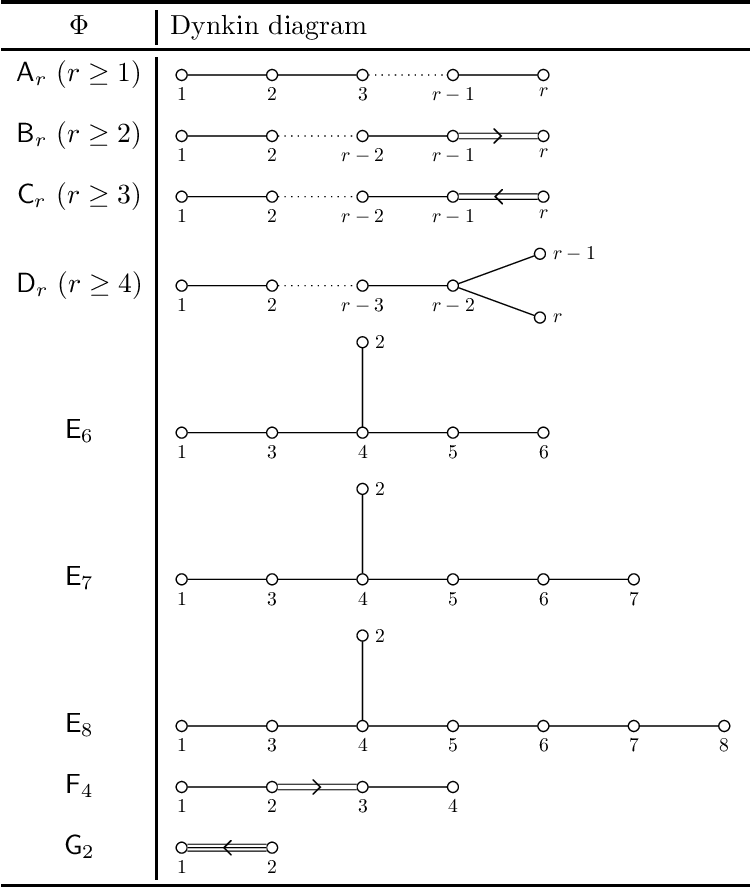
This matrix is not just a collection of numbers; it encapsulates the fundamental structure of the su(3) algebra itself. Its diagrammatic representation is the Dynkin diagram we've seen before, where two nodes are connected by a single line.
Fundamental Weights and Dynkin Labels
The simple roots form a basis for the root lattice. We now introduce a "dual" basis for the weight lattice, called the fundamental weights. For a rank- algebra with simple roots , the fundamental weights are defined by the relation:
This definition is pivotal. It establishes a basis for the space of all possible weights that is intrinsically tied to the simple roots. The crucial result, which forms the foundation of this classification scheme, is the following theorem:
Theorem: Every irreducible representation of a semi-simple Lie algebra has a unique highest weight . This highest weight can be written as a linear combination of the fundamental weights with non-negative integer coefficients:
These integers are the Dynkin labels (or Dynkin coefficients) of the irreducible representation. They provide a unique and universal label for every irrep.
The following reading provides the formal definitions of fundamental weights and this classification theorem.
[PDF] PART II: Classification of semi-simple Lie algebras. - DAMTP
These notes from a DAMTP course at Cambridge formally define the concepts we need.
First, read the section defining fundamental weights. Then, focus on Theorem 3 and the subsequent paragraph, which explains how Dynkin labels classify representations. Finally, read the first part of section 1.9.1, which computes the simple roots and fundamental weights for SU(3).
The SU(3) Zoo Revisited
Let's now use Dynkin labels to classify the representations we studied in the last lesson. For su(3), the highest weight is given by , and the Dynkin labels are .
-
The Fundamental Representation (3): In the previous lesson, we saw this was labeled . This is not a coincidence. The highest weight of this representation is precisely the first fundamental weight, . Thus, its Dynkin labels are .
-
The Conjugate Representation (): The highest weight of this representation is the second fundamental weight, . Its Dynkin labels are .
-
The Adjoint Representation (8): The highest weight of the adjoint representation is the sum of the two fundamental weights, . Its Dynkin labels are . The corresponding weight diagram is the familiar hexagon.

The integers used to label the diagrams in Jonathan Evans' video Classification of SU(3) representations that we saw before are precisely these Dynkin labels. The notation from that video is a concrete realization of the Dynkin labels.
Finding All Weights from Dynkin Labels
The power of this formalism is that it provides a systematic algorithm to find all weights of an irrep starting from its Dynkin labels. The procedure is a more rigorous version of the graphical "shell-stripping" method.
Given a weight with Dynkin coefficients , the string of weights is constrained by the master formula from our earlier lessons: .
Starting with the highest weight , we know for all simple roots . So, for each simple root , the string extends downwards times. The weight is a new weight in the representation, and its Dynkin coefficients are found by subtracting the -th row of the Cartan matrix from the coefficients of .
Let's see this for the representation of SU(3).
[PDF] Semi-Simple Lie Algebras and Their Representations
This text provides a concise walkthrough of the algorithm.
Read the example for SU(3) starting with this demonstration on page 75. It shows how, starting from the highest weight with Dynkin labels (1,0), one systematically subtracts simple roots to find all three weights of the fundamental representation.
The procedure is as follows:
- Start: The highest weight has Dynkin labels . This is our first weight. The value of the first label (1) means we can subtract once. The value of the second label (0) means we cannot subtract .
- Level 1: We find the new weight . Its labels are found by subtracting the first row of the Cartan matrix from :
This gives the second weight of the representation. - Level 2: From the weight with labels , we check subtractions. The second label (1) is positive, so we can subtract . We find the new weight . Its labels are found by subtracting the second row of the Cartan matrix from :
This is the third and final weight. From here, no further subtractions are possible (since the labels are non-positive). We have successfully recovered the three weights of the fundamental representation.
This algorithmic approach, combining Dynkin labels with the Cartan matrix, is a powerful and general tool applicable to any semi-simple Lie algebra, far beyond su(3).
Conclusion
Today we have formalized our method for labeling the irreducible representations of SU(3). We moved from a coordinate-dependent notation to the universal language of Dynkin labels, which are grounded in the algebra's fundamental structure of simple roots and fundamental weights.
Key Takeaways:
- An irreducible representation is uniquely specified by its highest weight.
- The highest weights of irreps form a discrete set of dominant weights, which can be expressed as non-negative integer linear combinations of fundamental weights.
- These integers are the Dynkin labels, a universal identifier for an irrep.
- For SU(3), the fundamental, conjugate, and adjoint representations correspond to Dynkin labels , , and , respectively.
- The full set of weights for any irrep can be algorithmically generated from its Dynkin labels and the algebra's Cartan matrix.
We now have a robust system for describing individual building blocks of su(3). In our next lesson, we will address the crucial question of how to combine these representations. We will introduce the elegant diagrammatic method of Young Tableaux, a powerful tool for decomposing tensor products of SU(3) representations. This will be the key to understanding how composite physical states, such as mesons and baryons, are constructed from their fundamental quark constituents.