Welcome back to our exploration of symmetry in physics. In the last lesson, we established that symmetry transformations in quantum mechanics are embodied by unitary or anti-unitary operators, as dictated by Wigner's theorem. We learned how to construct these operators and saw how they act on states and observables.
Today, we will uncover one of the most significant and predictive consequences of this formalism. We will connect the symmetry group of a Hamiltonian directly to the structure of its energy spectrum. You will learn why certain energy levels in quantum systems are degenerate and how group theory provides the precise mathematical language to predict and classify these degeneracies. This is where the abstract theory of groups begins to yield concrete, physically observable results.
1. Symmetry, Commutation, and Degeneracy
The bridge between a system's symmetry and its energy spectrum is built upon a simple but profound commutation relation. A quantum system's Hamiltonian is said to possess a symmetry described by a group if it is invariant under all transformations of the group. As we saw last lesson, this invariance of an operator means it must commute with the unitary operators that represent the group elements .
This commutation has an immediate and crucial consequence. Let be an eigenstate of the Hamiltonian with energy , so that . Now, consider a new state , which is the original state transformed by a symmetry operation. Let's see what happens when the Hamiltonian acts on this new state:
Because and commute, we can swap their order:
This result is fundamental: the transformed state is also an eigenstate of the Hamiltonian with the exact same energy .
If is linearly independent of , then we have found a distinct state with the same energy, which is the definition of degeneracy. This implies that the entire set of degenerate eigenstates corresponding to an energy level , known as the eigenspace , must be closed under the action of the symmetry group. Any state in the eigenspace, when acted upon by a symmetry operator, yields another state within the same eigenspace.
This means the eigenspace itself carries a representation of the symmetry group .
2. Irreducible Representations and Essential Degeneracy
Now, we can connect this physical observation to the formal machinery of representation theory you'll be studying in this course. While an eigenspace carries a representation of the symmetry group , this representation can be either reducible or irreducible.
However, a key principle of quantum mechanics is that unless there's a special reason (which we'll call an "accidental" degeneracy), a symmetry will not leave degeneracies unexplained. The representation carried by an eigenspace is, in the generic case, irreducible. If it were reducible, one could generally introduce a small perturbation that preserves the symmetry but splits the energy level, which contradicts the idea that the degeneracy is a fundamental consequence of the symmetry.
This leads to the central conclusion of this lesson:
The set of eigenstates for a given energy level forms a basis for an irreducible representation (irrep) of the system's symmetry group. The degeneracy of the energy level is therefore equal to the dimension of that irreducible representation.
This insight is immensely powerful. If we know the symmetry group of a Hamiltonian, we can immediately classify its possible energy degeneracies by simply listing the dimensions of the group's irreps. For example, if a group has irreps of dimensions 1, 1, and 2, we should expect to find non-degenerate energy levels (singlets) and two-fold degenerate levels (doublets) in the spectrum.
This is formalized in the following resource.
[PDF] . Lecture notes: Group theory
These notes from Nagoya University clearly state the relationship between symmetry, Hamiltonian block-diagonalization, and degeneracy.
First, read the section "Proposition 1.2." which begins on this page. This shows how the commutation [H, D(g)] = 0 leads to the Hamiltonian being block-diagonal, where each block corresponds to an irrep and H is proportional to the identity matrix within that block. This is the formal reason why all states in the irrep's subspace have the same energy. Then, turn to the next document in the same PDF and read the section "1. Spectral decomposition", focusing on the summary points. They explicitly state that the spectrum splits into sectors corresponding to the irreps of G, with degeneracy equal to the dimension of the representation.
3. The Algebraic Origin of Degeneracy
The link between group properties and degeneracy becomes clearer when we look at continuous symmetries and their generators. As you know from quantum mechanics, continuous symmetries (like rotations) are associated with conserved quantities (like angular momentum) which are the generators of the symmetry transformations.
Let's consider two symmetry operators, and . If they do not commute, the group is non-abelian. Their generators, say and , will also fail to commute. It is this non-commutativity that lies at the heart of symmetry-induced degeneracy.
If a Hamiltonian has a non-abelian symmetry group, its spectrum must have degenerate levels. If all energy levels were non-degenerate, the eigenstates of would form a unique basis. Since all generators commute with , they would all be diagonal in this same basis, which would mean they all commute with each other—a contradiction.
The following lecture by Leonard Susskind provides a wonderful, physics-first development of these ideas.
Advanced Quantum Mechanics Lecture 2
This excerpt from a Stanford Advanced Quantum Mechanics lecture builds the connection between non-commuting symmetries and degeneracy from the ground up.
First, watch the introduction from the beginning to see the concepts of symmetry and degeneracy introduced. Next, watch the example of a particle on a circle. Note how rotational symmetry alone is not enough to guarantee degeneracy between states with angular momentum +M and -M. However, when reflection symmetry is added, the degeneracy becomes necessary. Continue watching as the lecturer demonstrates that the operators for rotation (L) and reflection (M) do not commute. This is presented as the crucial ingredient for degeneracy. Finally, jump to the case study of angular momentum, from 1:18:23 to 1:43:50. Here, the non-commuting angular momentum operators L_x, L_y, L_z are used to build raising and lowering operators, L_\pm. Pay close attention to the argument that because [H, L_\pm]=0, applying L_\pm to an energy eigenstate generates a new eigenstate with a different L_z value but the same energy. This is a direct, algebraic proof of how the non-abelian structure of the rotation group generates a multiplet of degenerate states.
This final point about angular momentum is a cornerstone example. The set of states that are connected by the raising and lowering operators form a basis for a -dimensional irreducible representation of the rotation group SO(3). Because the Hamiltonian of a system with rotational symmetry (like the hydrogen atom) commutes with all the angular momentum operators, all these states must be degenerate.
4. Accidental Degeneracy
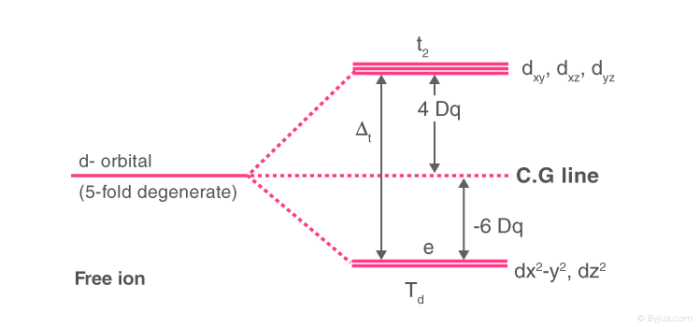
Not all degeneracies are a direct consequence of a system's symmetry group. Sometimes, for a specific set of parameters in the Hamiltonian (e.g., specific values for masses, coupling constants, or field strengths), energy levels belonging to different irreducible representations might happen to coincide. This is called accidental degeneracy.
The key difference is that accidental degeneracies are not "protected" by symmetry. A small change in the Hamiltonian's parameters that still respects the overall symmetry of the system can lift an accidental degeneracy. In contrast, an "essential" degeneracy—one corresponding to a multi-dimensional irrep—cannot be lifted without breaking the symmetry of the system itself.
Your background in condensed matter physics makes tight-binding models an excellent context for exploring this. Consider the following example.
This text introduces the crucial distinction between essential and accidental degeneracies using a detailed example from a condensed matter context.
Please read section 3.1.2 Accidental degeneracies. Pay close attention to the example of the six-site cluster with D_{3h} symmetry. Follow the derivation of the eigenvalues in Eq. 3.12 and see how a specific choice of hopping parameters, t1 = 3/2 t0, leads to a degeneracy between levels belonging to different irreps (A'_{2} and E). Then, briefly skim the discussion of the C60 molecule, which provides another compelling real-world example of how modifying Hamiltonian parameters while preserving symmetry can lift accidental degeneracies.
This example with the C60 molecule is particularly illustrative. The icosahedral symmetry of the molecule dictates that there must be degeneracies of dimension 1, 3, 4, and 5, corresponding to the dimensions of the group's irreps. However, for a simple model where all hopping parameters are equal, a 9-fold degenerate level appears. This does not match any irrep dimension and is an accidental degeneracy between a 4-fold and a 5-fold degenerate multiplet. Making the model more realistic by distinguishing between two inequivalent types of bonds—a change that preserves the full symmetry—lifts this accidental degeneracy while preserving the essential ones.

Conclusion
In this lesson, we have forged the crucial link between the abstract definition of a symmetry group and the concrete, observable structure of a quantum system's energy spectrum.
Key Takeaways:
- If a Hamiltonian is symmetric under a group , it commutes with all the group's representation operators: .
- This commutation implies that the eigenspace corresponding to a specific energy level is closed under the group's action and thus carries a representation of .
- In general, this representation is irreducible, and the degeneracy of the energy level is equal to the dimension of the irrep. These are known as essential degeneracies.
- The non-commutativity of generators in a non-abelian group is the algebraic origin of multi-dimensional irreps and, consequently, of essential degeneracies.
- Accidental degeneracies are coincidences of energy levels from different irreps, which occur for specific parameter values in the Hamiltonian and are not protected by the group symmetry.
You now understand not just that energy levels are degenerate, but why they are, and how to classify them using the language of group theory. This principle is a cornerstone of spectroscopy, condensed matter physics, and particle physics.
In our next lesson, we will examine the other side of this coin. We've seen how symmetry constrains the static properties of the Hamiltonian (its spectrum). Next, we will see how symmetry constrains the dynamics of the system by giving rise to conservation laws, a principle encapsulated in Noether's theorem.