Welcome to our third lesson. In our previous discussion, we explored how a subgroup allows us to partition a group into cosets, leading us to the powerful constraints of Lagrange's theorem. This partitioning was based on the structure of a chosen subgroup. Today, we will investigate a different, more intrinsic way to partition a group's elements, one based on the concept of "sameness" within the group's operational structure.
This lesson introduces the idea of conjugacy classes. Two elements are considered conjugate if they represent the same type of group operation, just viewed from a different "perspective" or, in physical terms, in a different coordinate system. For example, a 90-degree rotation about the z-axis and a 90-degree rotation about the x-axis are intrinsically similar operations. The algebraic concept of conjugacy makes this notion precise. We will define what it means for elements to be conjugate, see how this relationship partitions a group into disjoint classes, and develop systematic methods for computing these classes for finite groups, with a focus on examples relevant to physical symmetries.
1. Conjugacy: A New Equivalence Relation
At its core, conjugation is a relationship between elements mediated by other elements of the group.
Definition: In a group , two elements and are said to be conjugate if there exists an element such that:
In this case, we say that conjugates into .
This relationship is an equivalence relation, meaning it is:
- Reflexive: Any element is conjugate to itself (choose , the identity).
- Symmetric: If is conjugate to (i.e., ), then is conjugate to (since ).
- Transitive: If is conjugate to and is conjugate to , then is conjugate to .
Because conjugacy is an equivalence relation, it partitions the group into disjoint sets called conjugacy classes. The conjugacy class of an element , denoted , is the set of all elements in that are conjugate to .
To build a solid foundation, let's turn to a formal reading that defines these concepts and proves some of their most important initial properties.
[PDF] CONJUGATION IN A GROUP 1. Introduction A reflection across one ...
This document by Keith Conrad provides a clear and rigorous introduction to conjugacy, conjugacy classes, and their fundamental properties.
Please read the first three sections: "Introduction": This section gives the intuition behind conjugacy and the formal definition. "Conjugacy classes: definition and examples": This section formally defines a conjugacy class and provides several crucial examples, including the symmetric group S_3 and the quaternion group Q_8. "Some basic properties of conjugacy classes": Focus on Theorems 3.2 and 3.4. Theorem 3.2 proves that all elements in a conjugacy class have the same order, a vital tool for computation. Theorem 3.4 proves that distinct conjugacy classes are disjoint, confirming that they form a partition of the group.
The analogy to linear algebra, where similar matrices () share properties like eigenvalues and trace, is particularly apt. The following video elaborates on this connection.
This video by Matthew Salomone provides a concise overview of the definition of conjugate elements and highlights some of their shared properties.
Watch the first part of the video, up to this point. The presenter explicitly draws the parallel to similar matrices and proves that conjugate elements must have the same order.
2. The Class Equation: A Tool for Counting
We now have a picture of a group partitioned into conjugacy classes. A natural question follows: what determines the size of each class? The answer lies in another important substructure: the centralizer.
Definition: The centralizer of an element , denoted or , is the set of all elements in that commute with :
It is straightforward to verify that is always a subgroup of . The centralizer should not be confused with the center of the group, , which is the set of elements that commute with all elements in . The center is the intersection of all centralizers: .
The size of a conjugacy class is directly related to the size of the centralizer of any of its elements. The following theorem makes this connection precise.
Theorem: The size of the conjugacy class of , denoted , is equal to the index of its centralizer subgroup, .
This is a powerful result. By Lagrange's theorem, it immediately implies that the size of every conjugacy class must be a divisor of the order of the group.
Summing the sizes of all the disjoint conjugacy classes must yield the total order of the group. This gives us the class equation:
where the sum is over a set of representative elements from each distinct conjugacy class. It is often useful to separate the terms for the center of the group, since for any element , its class size is 1. The equation can then be written as:
where the sum now runs over representatives of classes with more than one element.
Let's watch a short segment that clearly defines the centralizer.
Group Actions and the Class Equation
This video by MathMajor introduces the centralizer and contrasts it with the conjugacy class itself.
Please watch from this segment for the definitions of the conjugacy class and the centralizer.
For a rigorous proof of the relationship between the class size and the centralizer, we return to Conrad's notes.
[PDF] CONJUGATION IN A GROUP 1. Introduction A reflection across one ...
This section provides the formal proof linking the size of a conjugacy class to the index of the centralizer, and formally states the class equation.
Please read the first part of Section 6, "Centralizers and the class equation", up to the proof of Theorem 6.5. This formalizes the counting argument we've just discussed.
3. Computing Conjugacy Classes: Examples
With these tools, we can now systematically determine the conjugacy classes for some important finite groups.
Example 1: The Quaternion Group,
The quaternion group is a non-Abelian group of order 8 with multiplication rules . This group is intimately related to the Lie group SU(2), which describes spin in quantum mechanics and rotations. A group generated by the Pauli matrices is closely related to , a connection you can explore in Problem 15 of the tutorial sheet from Universität Bielefeld.
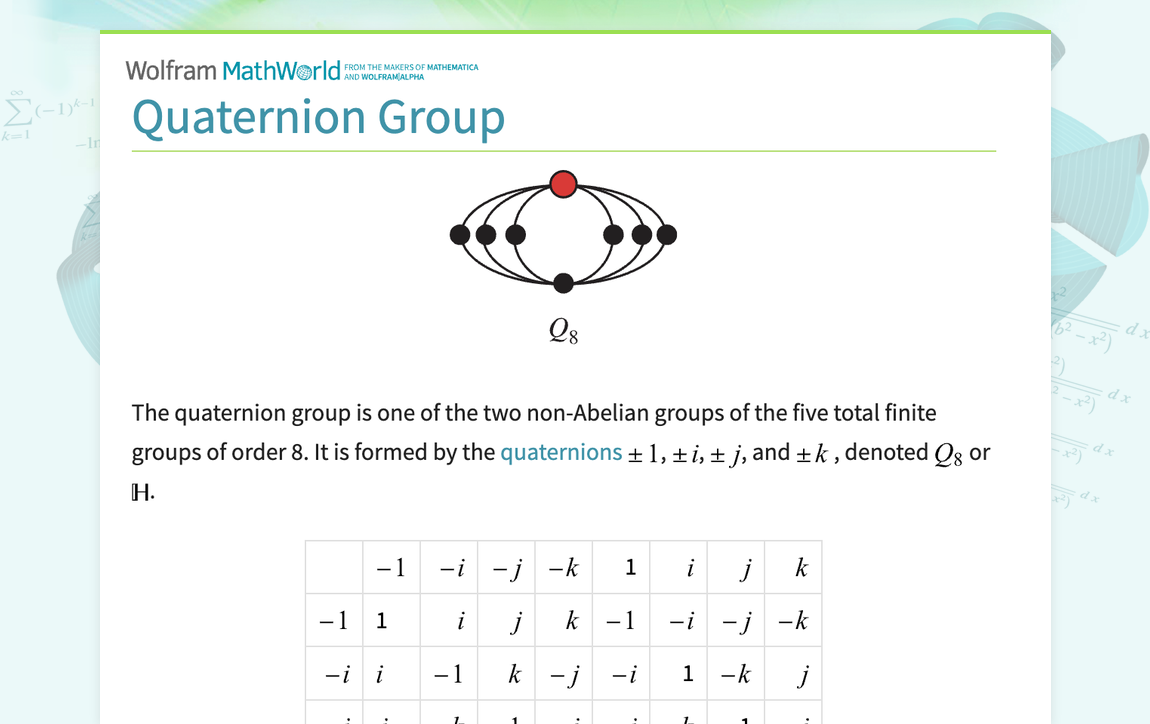
Let's compute the conjugacy class of the element .
- Center: First, we identify the center . The elements and commute with all other elements, so . These each form a conjugacy class of size 1: and .
- Centralizer of : We find the elements that commute with . By inspection or direct calculation (), we find that and do not commute with . The elements that do commute are . Thus, .
- Class Size: The size of the centralizer is . Using our theorem, the size of the conjugacy class of is .
- The Class: We know is in its own class. We need to find one other element. Let's conjugate by : So, is in the class of . Since we know the class has exactly two elements, we are done: .
- By symmetry, the other classes are and .
The class equation for is .
Example 2: The Dihedral Group,
The group is the group of symmetries of a square, with 8 elements: four rotations () and four reflections (). This is a classic example in physics. The following video provides a detailed, step-by-step computation of its five conjugacy classes.
This part of the video walks through the entire calculation for the conjugacy classes of D4.
Please watch the segment from 5:00 to 9:08. Notice how the classes correspond to geometrically distinct types of symmetry operations: the identity, a 180-degree rotation, 90-degree rotations, reflections across diagonals, and reflections across lines bisecting opposite sides.
The resulting classes for are: , , , , and . The class equation is .
Example 3: The Symmetric Group,
For the symmetric groups , there is a remarkably elegant result: two permutations are conjugate if and only if they have the same cycle structure.
The cycle structure (or cycle type) of a permutation is the list of the lengths of its disjoint cycles, including 1-cycles for fixed points. For example, in , the permutation has cycle structure (2, 3). The permutation leaves 3 fixed, so its disjoint cycle decomposition is , and its cycle structure is (1, 2, 2).
This theorem means that to find the conjugacy classes of , we simply need to find all possible ways to partition the integer . For , the partitions of 4 are:
- 1+1+1+1 The identity . Class size: 1.
- 2+1+1 Transpositions like . Class size: 6.
- 2+2 Products of two disjoint transpositions like . Class size: 3.
- 3+1 3-cycles like . Class size: 8.
- 4 4-cycles like . Class size: 6.
The class equation is . The following reading formalizes this powerful theorem.
[PDF] CONJUGATION IN A GROUP 1. Introduction A reflection across one ...
This section proves the fundamental theorem that cycle type determines conjugacy in symmetric groups.
Please read Section 5, "Conjugacy classes in Sn and An". The key result is Theorem 5.7, which you should read carefully.
This principle extends to continuous groups as well. For the rotation group SO(3), which is central to your study of quantum mechanics and field theory, all rotations by the same angle , regardless of the axis of rotation, form a single conjugacy class.
Conclusion
In this lesson, we have introduced a powerful new way to analyze the internal structure of a group. By partitioning a group into its conjugacy classes, we group together elements that are algebraically and geometrically "of the same type."
Here are the main points we have covered:
- Two elements are conjugate if for some . This defines an equivalence relation that partitions the group into disjoint conjugacy classes.
- All elements within a single conjugacy class have the same order.
- The centralizer is the subgroup of elements that commute with .
- The size of a conjugacy class is given by the index of the centralizer: . This implies the size of any class must divide the order of the group.
- The class equation, , provides a fundamental constraint on the structure of a finite group.
- We learned how to compute conjugacy classes for specific groups like and , and saw that for , conjugacy is determined by cycle structure.
In our last lesson, we partitioned into cosets of a subgroup . In this lesson, we partitioned into conjugacy classes. What is the connection? A particularly important class of subgroups are those that are themselves a union of entire conjugacy classes. Such subgroups are called normal subgroups, and they are precisely the subgroups for which the set of cosets can be endowed with a group structure of its own. In our next lesson, we will formally define normal subgroups and begin constructing these new "quotient groups."