Introduction
Welcome to the final lesson in our first module on the foundations of audiovisual translation. In the last session, we investigated the "why" behind AVT's unique character by exploring its core constraints: time, space, and synchrony. You now understand that these are not arbitrary rules but necessary adaptations to the multimodal nature of film and video.
Having established the fundamental concepts of AVT, this lesson will address the "where to go next." As we conclude our foundational module, we will focus on equipping you with the tools for continuous learning, which is a vital practice for any professional translator. Your goal is to master this field, and that journey extends far beyond any single course.
This lesson directly addresses the learning outcome: Identify major professional AVT organizations and key reference materials for further study. We will map out the landscape of essential books, journals, and professional bodies that will support your development as an audiovisual translator.
Part 1: Building Your Professional Library
One of your goals is to acquire tangible resources, and building a professional library is an excellent first step. While the internet is full of information, having a core collection of authoritative textbooks provides a structured and reliable foundation for your knowledge. Let's start by looking at some of the most important books in the field.
These two texts are often considered essential starting points for students of AVT.
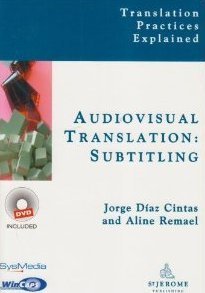

The book by Díaz Cintas and Remael is particularly famous and is a cornerstone for anyone serious about the practice of subtitling.
Beyond these introductions, the field has a rich body of literature. The following reading provides a curated list of essential textbooks that delve into specific areas of AVT.
[PDF] Audiovisual translation: Subtitling and revoicing
To expand our list of key reference materials, let's turn to an academic paper that includes a 'Further Reading' section. This is a common feature in scholarly work and an excellent way to discover more key resources.
Please read the short section titled 'FURTHER READING' at the end of the paper (page 28 of the PDF). Take note of the four books listed and their descriptions. These are considered landmark texts in AVT education.
Based on your reading, you've now been introduced to these crucial texts:
- Audiovisual Translation: Subtitling by Jorge Díaz Cintas and Aline Remael: The definitive practical guide to subtitling.
- Audiovisual Translation: Dubbing by Frederic Chaume: The equivalent foundational text for the practice of dubbing.
- The Didactics of Audiovisual Translation edited by Jorge Díaz Cintas: A collection of articles on how to teach and learn AVT.
- Audiovisual Translation: Theories, Methods and Issues by Luis Pérez-González: A more theoretical book that explores research methods in AVT.
Having these titles on your radar gives you a clear roadmap for future study.
Part 2: Joining the Professional Community
Translation is not a solitary activity. It's a profession with a vibrant community of academics and practitioners who share knowledge, set standards, and create opportunities. Engaging with this community is crucial for your growth.
Professional and Academic Associations
Associations are formal groups that bring together professionals in a field. They are invaluable for networking, finding job opportunities, and staying current with industry best practices.
Let's look at a resource that lists several key associations.
Audiovisual Translation - Inside Book Publishing
The companion website for the textbook Audiovisual Translation: Theories, Methods and Issues provides a fantastic collection of online resources, including a list of relevant professional associations.
On the webpage, scroll down to the blue bar that says 'Online Resources' and click on it. From the list that appears, please click on 'Associations'. Take a few minutes to look through the list. You don't need to visit every link, but get a sense of the organizations that exist.
One of the most significant organizations for students and academics in our field is mentioned in the paper we looked at earlier.
In "Audiovisual translation: Subtitling and revoicing," the authors highlight the European Association for Studies in Screen Translation (ESIST). They note it's a non-profit association for teachers, practitioners, and students, established to facilitate the exchange of information and promote professional standards in the training and practice of AVT. This makes ESIST a particularly relevant organization for you as a student.
Beyond academic associations, there are also industry bodies. The same paper mentions MESA's (Media & Entertainment Services Alliance) Content Localisation Council, an organization that aims to "expand the talent pool in audiovisual translation." This shows that the industry itself is actively seeking new, well-trained professionals.
Conferences and Journals
The AVT community shares knowledge through two primary channels: conferences and academic journals.
- Conferences: These are events where professionals and researchers present their latest work. The "Audiovisual translation: Subtitling and revoicing" paper mentions the Languages & the Media conference in Berlin as a renowned and long-running international event. Attending such events is a goal to aspire to later in your career.
- Journals: These are periodical publications featuring peer-reviewed research. The same paper highlights the Journal of Audiovisual Translation (JAT) as the first international journal dedicated entirely to AVT studies. Following such journals is an excellent way to keep up with the cutting edge of the field.
Part 3: Essential Technological Resources
Finally, as you know from your goal to learn the technical side of AVT, a translator's resources aren't just books and journals. The software we use is just as critical. While we will dedicate Module 3 to hands-on training with subtitling software, it's important to recognize these tools as key resources you should be aware of now.
The paper "Audiovisual translation: Subtitling and revoicing" provides a great overview of the software landscape.
[PDF] Audiovisual translation: Subtitling and revoicing
Let's review two short sections from the paper we've been using to identify some of the key software tools used in the industry. This will give you a concrete list of names to know.
Please find and quickly read the following two paragraphs: In the 'Subtitling' subsection (page 22), find the paragraph that begins 'Of all the various modes within AVT...'. Note the names of the freeware and commercial programs listed. In the 'Revoicing' subsection (page 26), find the paragraph that begins 'To keep up with the current increase...'. Note the software mentioned for dubbing and voiceover.
From this reading, you have a list of important tools:
- Subtitling Freeware: Aegisub, Subtitle Edit, Subtitle Workshop. (You'll be pleased to see Aegisub, which you specifically mentioned wanting to learn, is a key tool).
- Subtitling Commercial Software: EZTitles, Spot, Wincaps Q4.
- Revoicing Software: VoiceQ, Capella.
Knowing these names is the first step toward gaining the technical proficiency required in the modern AVT industry.
Conclusion
This lesson concludes our foundational module by mapping the key resources that will guide your continued learning. Mastering a field like AVT is a long-term journey, and knowing where to find reliable information and a supportive community is just as important as learning the techniques themselves.
Here are your key takeaways:
- Core Reference Books: There is a set of foundational textbooks on subtitling, dubbing, and AVT theory, authored by scholars like Díaz Cintas, Remael, and Chaume, that form the basis of a strong professional library.
- Professional Organizations: Groups like ESIST provide a community for students and professionals to network, share knowledge, and uphold standards.
- Knowledge Hubs: The field evolves through major conferences like Languages & the Media and specialized publications like the Journal of Audiovisual Translation.
- Technological Tools: Your resource kit must also include familiarity with key subtitling and revoicing software, from freeware like Aegisub to professional platforms.
You have now built a solid foundation in the principles of AVT. You know what it is, what its main modes are, how it conveys meaning, what constraints it operates under, and where to look for more information.
In our next lesson, we will begin Module 2: Interlingual Subtitling: Principles and Strategies. We will immediately put our foundational knowledge to work by diving into the first practical learning outcome: Explain the standard technical specifications for subtitles: reading speed, characters per line, and display duration. We're moving from the 'what' and 'why' to the 'how'.