Introduction
Welcome to your first lesson in the course on Audiovisual Translation (AVT)! I'm excited to guide you as you build your skills in this dynamic field.
This initial lesson is all about building a solid foundation. Our goal is to define audiovisual translation (AVT) and distinguish it from other forms of translation. We will explore what makes AVT a unique discipline, moving beyond the translation of static, written text to the complex world of translating for the screen, where dialogue, sound, and visuals all work together to create meaning.
Understanding this fundamental concept is the first step toward your goal of mastering English-to-Arabic AVT techniques. It will set the stage for all the practical and technical skills we'll cover in later lessons, from subtitling software to dubbing strategies.
Let's begin by establishing what we mean by "audiovisual translation."
What is Audiovisual Translation?
At its core, translation is about transferring meaning from one language to another. You're familiar with this in the context of written documents. Audiovisual translation, however, deals with a different kind of "text."
To get a formal and contextually relevant definition, let's turn to a key academic paper that specifically discusses AVT in our region.
[PDF] Audiovisual Translation in the Arab World (v 04): Mapping the Field
This reading from the paper 'Audiovisual Translation in the Arab World' by Muhammad Y. Gamal provides a clear definition of AVT and contrasts it with traditional print translation. It highlights how digital technology has shaped this field.
Please read the 'Introduction' and the first three paragraphs of the following section, which begins 'of audiovisual translation it is perhaps important...'. The relevant text ends just before the discussion on Arabic diglossia. Focus on how the author defines AVT, the different types it includes, and why it's different from 'print translation'.
As the reading highlights, audiovisual translation is not just about words; it's about translating a multimodal text. This means the text is delivered through multiple channels simultaneously:
- The Visual Channel: Images, on-screen action, characters' gestures, and any written text appearing on screen (e.g., signs, newspaper headlines).
- The Audio Channel: Spoken dialogue, narration, sound effects, and music.
Unlike a translator working on a book, an audiovisual translator must ensure their translation works in harmony with all these elements. This is why AVT is fundamentally about translation for the screen.
The main modes, or types, of AVT mentioned in the reading are:
- Subtitling: Displaying written text, usually at the bottom of the screen, that translates the spoken dialogue.
- Dubbing: Replacing the original speech with a recording of translated speech, aiming to match the lip movements of the on-screen actors.
- Voice-over: Layering a narrator's translated voice over the original audio, which remains audible at a lower volume. This is common in documentaries.
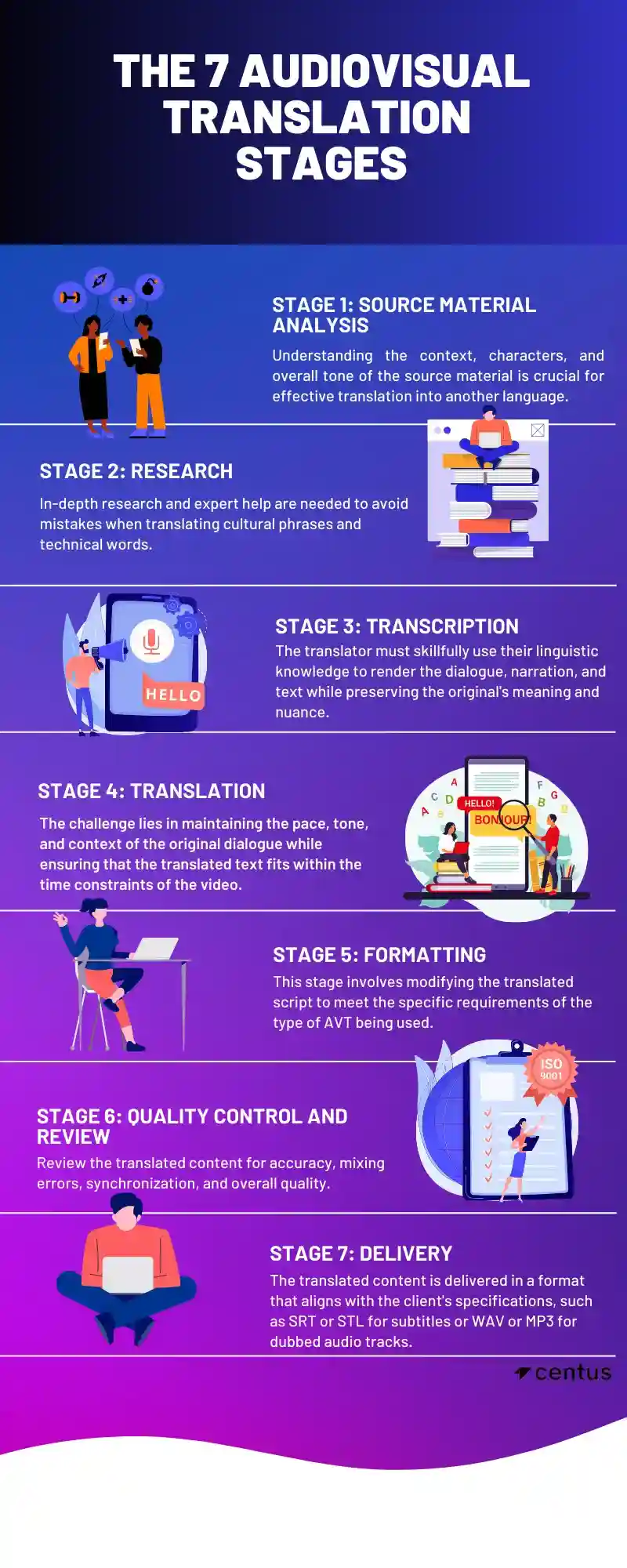
Because AVT involves this complex interplay of elements, the process itself is more than just a simple act of translation.
How is AVT Different from Traditional Translation?
Now that we have a working definition, let's sharpen it by comparing AVT to the kind of print translation you might be more familiar with. The key differences lie in the unique characteristics and constraints of the audiovisual medium.
To explore this, let's look at another resource that breaks down the specific features of "film translation," a major part of AVT.
[PDF] A Tentative Analysis of English Film Translation Characteristics and ...
The following excerpt from 'A Tentative Analysis of English Film Translation Characteristics and Principles' clearly outlines the unique properties of translating for film. This will help you understand the practical challenges that distinguish AVT from other translation work.
Please read Section II, titled 'CHARACTERISTICS OF FILM TRANSLATION' (subsections A through E). Pay close attention to the concepts of 'Multimedia,' 'Spoken Language,' and 'Transience,' as these are the most fundamental distinctions.
Based on that reading and what we've already discussed, we can summarize the key distinctions in a few points:
-
Source Text:
- Traditional Translation: The source is a static, written text (e.g., a book, an article, a contract). The translator works with words on a page.
- AVT: The source is a dynamic, multimodal product. The dialogue is just one layer. The translator must account for body language, tone of voice, background music, and on-screen visuals.
-
Constraints:
- Traditional Translation: Constraints are primarily related to style, grammar, and layout on a page. The reader can control the pace of consumption.
- AVT: The translator is bound by what are called spatio-temporal constraints:
- Space: Subtitles have a character limit per line and can only occupy a small portion of the screen.
- Time: Subtitles must appear and disappear in sync with the dialogue, giving the viewer enough time to read them but not so much that they linger after the character has finished speaking. This fleeting nature is what the reading called "Transience."
-
Language Style:
- Traditional Translation: Often deals with formal, edited written language.
- AVT: Primarily deals with spoken language, which is often informal, unscripted, and full of colloquialisms, hesitations, and interruptions. The translation must sound natural and authentic.
Let's watch a brief video that introduces subtitling. Notice how it defines different types of subtitles, which reinforces the idea that even within one mode of AVT, there are different functions and purposes.
Subtitles — The Ultimate Guide to Movie Subtitling Format, Style & Etiquette
This clip from StudioBinder's 'Subtitles — The Ultimate Guide' explains the main categories of subtitling. This will give you a concrete example of how AVT functions to serve different audience needs.
Watch the section from 02:15 to 03:55. Focus on the distinction between interlingual subtitles (translation) and intralingual subtitles (transcription in the same language).
The video's distinction between interlingual and intralingual subtitles is important. Our focus in this course is interlingual subtitling (English to Arabic). However, understanding other forms, like captions for the hearing impaired, helps you appreciate the breadth of the AVT field.
To bring these ideas together, this chart offers a clear, side-by-side comparison of two major AVT modes: subtitling and dubbing.

Conclusion
In this lesson, we established the foundational concepts of audiovisual translation. We now have a clear understanding of what AVT is and what makes it a specialized field of translation.
Here are the key takeaways:
- Definition: Audiovisual translation (AVT) is the transfer of multimodal content (combining audio and visuals) from one language to another for consumption on a screen.
- Distinction from Traditional Translation: Unlike print translation, AVT is defined by its multimodal nature, its reliance on spoken language, and its strict spatio-temporal constraints (limitations of space and time).
- Key Process: An AVT professional is not just a translator but also a technician who must manage timing, formatting, and software to integrate the translation with the original audiovisual product.
In our next lesson, we will build directly on this foundation by taking a closer look at the main modes of AVT we introduced today: subtitling, dubbing, and voice-over. We'll explore the specific characteristics and use cases for each, preparing you to eventually practice them yourself.