Hello! Welcome to the final lesson in our module on navigating disagreement and pushback.
In our last session, we focused on the crucial how of managing challenges: maintaining calm body language and a neutral tone. You learned to use your physiology as an ally, employing breathing and grounding techniques to stay in a state of social engagement, and leveraging vocal tone to de-escalate tension. You now have the foundational tools to hold your ground without losing your cool.
Today, we move from tactics to strategy. Our learning outcome is to recognize when to hold your ground versus when to concede gracefully to preserve a relationship. In the world of finance, networking, and leadership you're passionate about, building long-term capital—both financial and social—is key. This lesson is about making strategic conversational investments, understanding that "winning" an argument can sometimes be a net loss if it damages a valuable connection.
1. Beyond Winning: The Goal is Resolution, Not Victory
Your goal is to build genuine relationships with industry professionals. In that context, approaching every disagreement as a battle to be won can be counterproductive. It frames the interaction as zero-sum, creating a "loser" who may feel resentful, hurting future collaboration and trust.
A more effective approach is to shift your mindset from "winning arguments" to "resolving disagreements." This reframes the process as a collaborative effort to find the best path forward, preserving relationships and team cohesion.
How PMs can win more arguments at work
This article, 'How PMs can win more arguments at work', makes a compelling case for why focusing on 'winning' is often a flawed strategy. It introduces the idea of reframing your goal to resolving disagreement as a team sport.
Please read the first section, 'Don’t argue; instead, resolve disagreements'. Pay attention to the author's reasoning that creating a 'loser' in an argument is a poor long-term business strategy.
This shift is the first step. The next is having a clear framework to decide your approach in any given conflict.
2. A Strategic Framework: The Thomas-Kilmann Conflict Model
To move beyond instinct or habit, we can use a proven model from social psychology: the Thomas-Kilmann Conflict Mode Instrument (TKI). It maps five distinct styles for handling conflict onto two simple axes:
- Assertiveness: The extent to which you try to satisfy your own concerns.
- Cooperativeness: The extent to which you try to satisfy the other person's concerns.
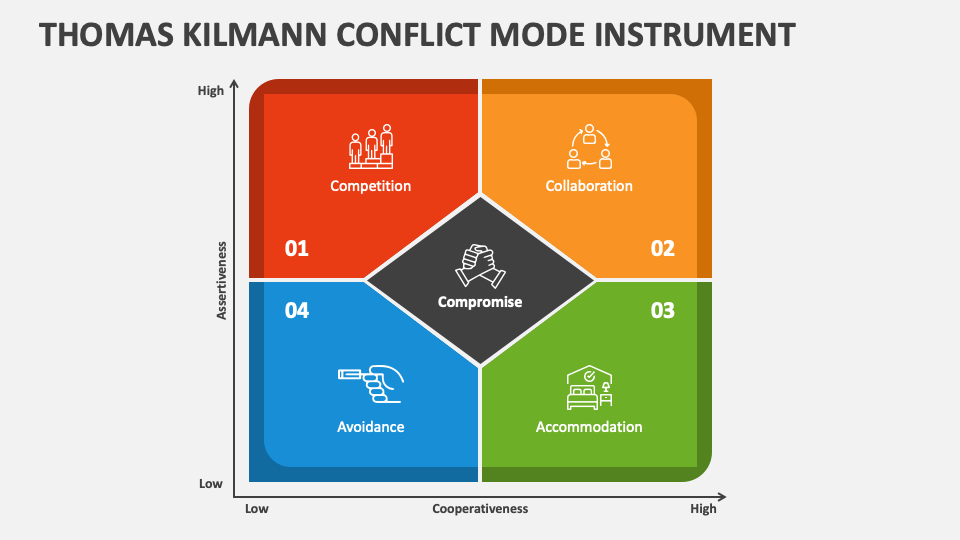
Let's watch a quick video that introduces these five styles.
Thomas Kilmann Conflict Mode Instrument
This short video provides a clear and concise overview of the five conflict modes in the Thomas-Kilmann model. It will give you a mental map for the different strategic options you have in a disagreement.
Watch the entire video. As you watch, identify which mode corresponds to 'holding your ground' and which corresponds to 'conceding gracefully.'
As you saw, the two modes most relevant to our lesson today are:
- Competing (Holding Your Ground): High Assertiveness, Low Cooperativeness. This is a power-oriented mode where you use whatever power seems appropriate to win your own position.
- Accommodating (Conceding Gracefully): Low Assertiveness, High Cooperativeness. This is the opposite of competing. When you accommodate, you neglect your own concerns to satisfy the concerns of the other person.
The crucial question is: when should you use each one?
3. Making the Call: Issue vs. Relationship
The decision to compete or accommodate isn't about being "strong" or "weak." It's a strategic calculation based on the situation. Two of the most important factors are the importance of the issue and the importance of the relationship.
Eight Key Attributes in a Conflict Situation
This article by Ralph Kilmann, one of the creators of the TKI model, provides the official guidance on when to use each conflict mode. We'll focus on the criteria that help you make a quick, effective decision.
Please read two key sections: Start at 'The third key attribute...' and read to the end of that section. This part explains how to choose a mode based on how important the topic is to each person. Then, find 'The eighth key attribute...' and read that section. This is the most critical part, as it discusses how relationship maintenance dictates your conflict strategy over the long term. Focus on the calculus: When is accommodating the right move? When is it essential to be assertive to preserve the relationship itself?
Here’s a summary of the decision-making matrix you just read about:
| Issue is Unimportant to You | Issue is Important to You | |
|---|---|---|
| Issue is Unimportant to Them | Avoid: The issue isn't worth the time for either of you. | Compete: Hold your ground. The issue matters to you, not them. |
| Issue is Important to Them | Accommodate: Concede gracefully. The relationship is likely more valuable than the issue. | Collaborate/Compromise: This is where you negotiate. We covered this in previous lessons. |
Crucially, as Dr. Kilmann notes, for a relationship to last, you must get your important needs met over time. Constant accommodation, especially on issues you care about, leads to disengagement and resentment. You have to be willing to use the assertive modes (competing and collaborating) to maintain healthy, balanced relationships.
4. The Art of Concession: Banking Social Capital
Thinking in terms of your finance background, view every interaction as an opportunity to manage your "social capital." Conceding on a low-stakes issue isn't a loss; it's a strategic deposit. By demonstrating flexibility and generosity, you build goodwill that you can draw upon when an issue is truly important to you.
How PMs can win more arguments at work
Let's return to the 'SaaS PM' article for a fantastic, practical take on this idea. The author explicitly frames conceding as a way to build a 'bank' of social capital.
Read the section titled 'Concede small disagreements; only fight for really important things'. Notice the tactical advice: figure out your priorities ahead of time and be clear about your 'red lines'.
This strategy allows you to save your energy and political capital for the battles that truly matter, making it more likely that others will support you when you decide to hold your ground.
Test your understanding!
You're at a mixers event you volunteer for. A fellow volunteer wants to change the background music from the curated playlist to their personal favorite, which you feel is inappropriate for the event's atmosphere. Using the Issue vs. Relationship matrix, which mode should you choose and why?
Show answer
This is a classic "Compete" scenario.
- Issue Importance to You: High. The event's atmosphere is your responsibility and reflects on the organizers.
- Issue Importance to Them: Likely moderate to high (it's their preference), but their stake is personal preference, not professional responsibility.
- Relationship Importance: Important, as they are a fellow volunteer.
While the relationship is important, the integrity of the event is a core professional concern. In this case, you should hold your ground. The goal is to do so respectfully, explaining why the curated playlist is important for the event's brand, rather than just saying "no." You are asserting your role-based responsibility.
5. The Script: How to Hold Ground and Concede Gracefully
Knowing when to act is half the battle. The other half is knowing what to say. Here are powerful, scripted phrases for both scenarios.
Why the Top 1% of Communicators Never Defend Themselves at Work (Do This Instead)
The Wizard of Words provides two phenomenal scripts for these exact situations. This is the practical language you need to implement the strategy.
Please watch these two clips: Holding Your Ground (31:03 - 34:31): Listen for the phrase 'I understand that's the way you see it; I simply see it differently.' Notice how it's non-combative but firm. Conceding Gracefully (36:07 - 38:44): This part is gold. Pay close attention to the script: 'It's difficult for me to see how that's going to work. That said, I trust your judgment and you have my support.' Analyze why this is so effective.
Let's break down these powerful scripts:
To Hold Your Ground Respectfully:
"I understand that's the way you see it. I simply see it differently."
- Why it works: It validates their perspective ("I understand...") without agreeing with it. It states your position as a simple fact ("I simply see it differently") rather than an attack. It closes the door on the argument without escalating it.
To Concede Gracefully (and Strategically):
"It's difficult for me to see how that's going to work. That said, I trust your judgment and you have my support."
- Why it works:
- "It's difficult for me to see...": You put your disagreement on the record calmly and professionally.
- "That said...": This is a powerful pivot.
- "I trust your judgment...": You transform the concession from a defeat into an expression of confidence in the other person. This is a huge relationship-builder.
- "...and you have my support.": You commit to being a team player, aligning with the "disagree and commit" principle, which builds immense credibility for future interactions.
Conclusion
You now have a complete strategic framework for navigating disagreements. You can move beyond a simple win/lose mentality and make conscious choices that serve your long-term goals, whether that's advancing a key project or building a lasting professional network.
Key Takeaways:
- Reframe your goal: Aim to resolve disagreements, not win arguments.
- Use the TKI model: Assess the situation based on the importance of the issue versus the importance of the relationship.
- Compete (Hold Ground) when the issue is critical to you and less so to others.
- Accommodate (Concede Gracefully) when the relationship is more valuable than the low-stakes issue.
- View concession as strategy: You are "banking" social capital for future use on high-stakes issues.
- Use precise language: Employ scripts like "I simply see it differently" to hold your ground and "I trust your judgment and you have my support" to concede with strength.
Daily Drill (10 minutes): Mental Simulation
For the next few days, take a moment to reflect on a past or upcoming disagreement.
- Analyze it with the TKI model: On a scale of 1-10, how important is/was the issue to you? How important to them? How important is the long-term relationship?
- Choose Your Mode: Based on your analysis, was your chosen mode (or the one you plan to use) the most effective? Should you compete, accommodate, avoid, or collaborate?
- Script Your Response: Write down the exact phrase you would use. If you need to hold your ground, use the script. If you decide to concede, use the graceful concession script. Practice saying it out loud.
This mental rehearsal will build the neural pathways to make these strategic decisions more automatic in real-time conversations.
Preview of the Next Module:
Congratulations on completing this intensive module on navigating disagreement! You've built skills in regulating your nervous system, structuring your thoughts, controlling your delivery, and now, making strategic choices.
In our next module, "Application: One-on-One and Small Groups," we will begin integrating all these micro-skills into the dynamic environment of real conversations. We'll start with low-stakes practice to build your confidence and fluency, moving from conscious practice to spontaneous, effective communication.