Introduction
Welcome back! In our previous lesson, we began our exploration of "The Desi Touch" by identifying foundational Indian design motifs like paisley, mirror work, and block prints. We analyzed them as individual decorative elements that can be applied to swimwear.
Today, we'll build on that by addressing the next layer of fusion design. This lesson focuses on the learning outcome: to describe how Indian textiles and color palettes are fused with Western bikini silhouettes. We will explore the materials and colors that form the canvas for the motifs we've just studied.
For your goal of building a design repertoire, understanding this interplay of color, fabric, and form is critical. It's the difference between simply adding a motif and creating a cohesive, culturally resonant fusion piece. We will look at how designers overcome technical challenges to bring the visual richness of Indian textiles into the functional world of swimwear.
1. The Vibrant Language of the Bollywood Color Palette
Color is one of the most immediate and powerful tools in design, and in the context of Bollywood, it's rarely subtle. The color palettes used in on-screen swimwear are intentionally chosen for high impact, drawing from a long tradition of rich, saturated color in Indian aesthetics.
To understand this better, let's start with a short reading that outlines the typical color choices in Bollywood swimwear.
Bollywood Actress Bikini: Types, Key Features, and How It Is Applied ...
This brief excerpt from 'Bollywood Actress Bikini: Types, Key Features, and How It Is Applied...' on Alibaba.com provides a good overview of the most common color trends.
Please read the introduction and the section titled 'Color and Patterns'. Focus on the list of common colors and the rationale given for their use.
As the text highlights, colors like fiery red, deep black, electric blue, and sunny yellow are staples. These aren't just random brights; they are often jewel tones and elemental colors that feature prominently in Indian celebrations, textiles, and art.
From a design perspective, these choices serve two key functions:
- On-Screen Impact: They create a strong visual contrast against natural backdrops like water and sand, ensuring the actress and the design stand out.
- Aesthetic Enhancement: As the article notes, they are selected to "enhance skin tones and photo aesthetics," a crucial consideration for cinematography.
While Western fashion may cycle through periods of muted or pastel tones, the Bollywood aesthetic consistently retains a space for this bold, unapologetic use of color.
2. From Handloom to High-Performance: Adapting Traditional Textiles
Now, let's talk about fabric. India has a rich heritage of textiles, from fine silks and cottons to intricate weaves. However, these traditional materials are generally unsuitable for functional swimwear. Your experience in lingerie design will immediately highlight the technical problem: fabrics like handloom cotton or silk lack the necessary stretch, chlorine resistance, and quick-drying properties of modern swimwear.
So, how do designers bridge this gap? The innovation lies in transposing the visual language of these textiles onto high-performance fabrics.
This is typically achieved through two methods:
- Digital Printing: Allows for highly detailed and photorealistic reproduction of complex patterns onto stretch fabrics like nylon, spandex (Lycra), and polyester blends.
- Screen Printing: Better for simpler, graphic patterns with fewer colors, mimicking the effect of techniques like block printing.

The result is a bikini that has the look of a traditional Indian textile but the function and fit of contemporary swimwear. This allows for the use of countless traditional patterns—from the paisley you see above to complex floral or geometric designs—without compromising the garment's performance.
3. Fusion in Practice: Combining Form, Fabric, and Style
Fusing Indian design with Western silhouettes goes beyond just printing a pattern on a bikini. It involves a more holistic approach that can blend structure, styling, and fabric choices. Let's look at two primary ways this fusion is manifested.
Method 1: Layering with Traditional Textiles
The simplest and most common method is to pair a standard Western-style bikini with cover-ups made from or inspired by Indian textiles. This creates a complete look that is both beach-appropriate and culturally expressive.
The article we looked at earlier provides a perfect description of this.
Bollywood Actress Bikini: Types, Key Features, and How It Is Applied ...
Let's revisit the 'Bollywood Actress Bikini' article to see how it describes this layering and fusion approach.
Please read the final section titled 'Cultural Fusion and Personal Expression'. Focus on the examples given for blending silhouettes.
As the text states, this often involves "bikini sets paired with sheer kimonos adorned with zari work, or sarong wraps featuring traditional block prints." This method allows the core bikini to remain simple, while the 'desi touch' is added through styling. It’s a versatile approach that allows for mixing and matching.
Method 2: Structural Fusion and Hybrid Garments
A more advanced form of fusion involves creating hybrid garments that structurally merge Indian and Western clothing concepts. The most famous example of this is the Bikini Sari.
The design duo Shivan & Narresh pioneered this concept, creating a garment that addresses both aesthetics and cultural context. The following article explains their innovation.
Shivan And Narresh - Modest Indian Swimsuit Brand - Refinery29
This article from Refinery29, 'This Brand Created The Bikini Sari...', explains the origin and design of this unique hybrid garment. It offers a fascinating look into the thought process behind true fusion design.
Please read the introduction and the sections that answer the questions 'What are you doing that other modest-swimwear competitor brands aren't?' and 'How does the Bikini Sari work?'. Focus on what the Bikini Sari is and the design problem it was created to solve.
The Bikini Sari is a landmark in fusion swimwear. Let's break down its design:
- The Base: A one-piece maillot, which is a classic Western swimsuit silhouette.
- The Fusion Element: A panel of wrappable fabric sewn into the front.
- The Result: A garment that provides the coverage and elegance of a sari drape while functioning as a swimsuit. It ingeniously 'counter-fuses' the boldness of a bikini with the modesty of a sari.
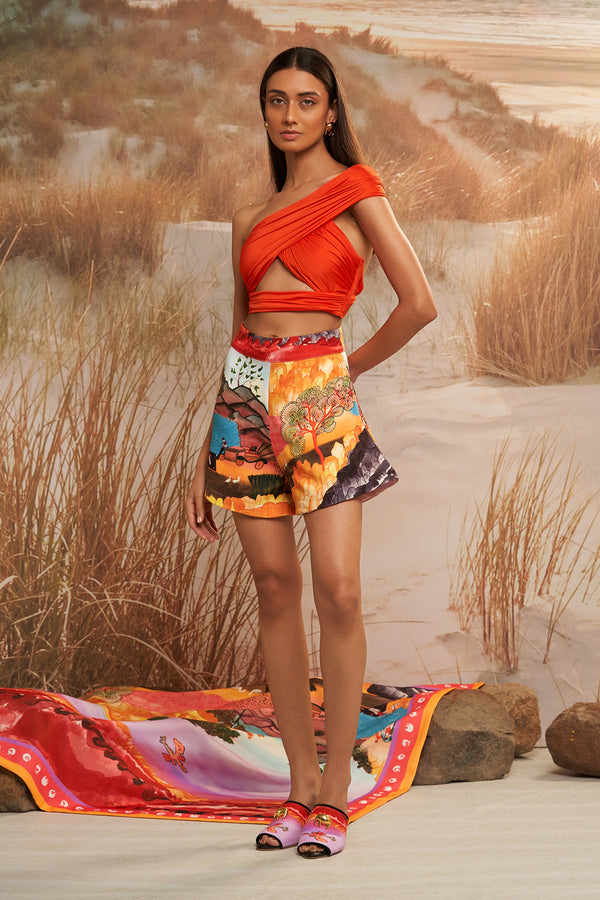
This concept moves beyond surface decoration into the realm of silhouette innovation. Shivan & Narresh are masters of this, often using prints inspired by Indian art on very modern, clean silhouettes, as seen below.
A Note on Classification
As we continue to build this style repertoire, you can use your analytical skills to start classifying these fusion designs. Think of each piece as a combination of variables:
- Silhouette Base: e.g., Triangle, Bandeau, Maillot
- Fusion Method: e.g., All-over Print, Structural Hybrid, Layering
- Traditional Element: e.g., Paisley Motif, Block Print Aesthetic, Sari Drape
- Color Palette: e.g., Jewel Tones, Earthy/Natural Dyes
This structured approach will be the foundation for Module 9, where we will perform a quantitative analysis of these style trends over time.
Conclusion
In this lesson, we moved from individual motifs to the broader context of textiles and color. We've seen how the "Desi Touch" is not just about adding an embellishment but about a thoughtful fusion of color, pattern, and form.
Key Takeaways:
- Color Palette: Bollywood bikini design leverages vibrant, high-impact jewel tones and primary colors that are deeply rooted in the Indian aesthetic and optimized for on-screen presence.
- Textile Adaptation: Since traditional Indian textiles are unsuitable for swimwear, their visual properties (patterns, prints) are transposed onto modern, high-performance stretch fabrics using digital or screen printing.
- Fusion Methods: The fusion of Indian and Western styles is achieved through two main approaches: layering (pairing bikinis with traditional cover-ups) and structural fusion (creating hybrid garments like the Bikini Sari that merge silhouettes).
Preview of the Next Lesson:
Now that we have covered motifs, textiles, and color palettes, it's time to see them all come together. In our next lesson, we will conduct the first case study for this module: deconstructing a Bollywood bikini that heavily incorporates traditional Indian embellishments or embroidery. This will be an excellent opportunity to apply everything you've learned about the "Desi Touch" to a specific, iconic look.