Hello and welcome to your next lesson in Herbal Pharmacology.
In our last lesson, we explored the significant pharmacokinetic challenges posed by herbal medicines—namely, their variable composition and the multiplicity of their chemical constituents. We discussed how these factors make it difficult to ensure consistent dosing, predict effects, and study them with the same precision as single-molecule drugs.
Today, we'll see how traditional Ayurvedic practice developed sophisticated methods to address these very problems thousands of years ago. This lesson directly addresses the learning outcome: Relate traditional Ayurvedic preparation methods (e.g., Shodhana) to potential effects on bioavailability and toxicity.
We will delve into the concept of Shodhana, or purification, a cornerstone of Ayurvedic pharmaceutics (Rasaśāstra and Bhaishajya Kalpana). You'll learn how these ancient techniques, far from being mere rituals, often involve scientifically understandable processes that alter a plant's chemical profile to reduce its toxicity and, in some cases, enhance the bioavailability of its therapeutic compounds. This lesson is a perfect example of how your goal of bridging Ayurveda and modern science can be achieved, translating traditional wisdom into the language of modern pharmacology.
The Principle of Shodhana: From Poison to Nectar
In Ayurveda, it is said that proper processing can turn a visha (poison) into an amṛta (nectar). This captures the essence of Shodhana. Many potent medicinal plants are inherently toxic in their raw form. Ayurvedic physicians developed specific purification procedures to make them safe for therapeutic use.
To begin, let's establish a modern scientific definition for this traditional process.
Śodhana: An Ayurvedic process for detoxification and ...
The review article 'Śodhana: An Ayurvedic process for detoxification and ...' provides an excellent scientific introduction to this concept. It frames Shodhana in modern terms, which will be central to our discussion.
Please read the Introduction and the section titled 'Plants are the prime source of medicine in Ayurveda...' (up to the heading 'VARIOUS TOXIC MEDICINAL PLANTS'). Focus on how the authors define Shodhana. Note its key objectives: Converting poisonous drugs into beneficial ones. Removing physical and chemical impurities (doṣās). Minimizing side effects. Improving the potency/therapeutic efficacy.
As the article explains, Shodhana is not just one method but a range of processes tailored to a specific substance. These processes primarily impact the herb's properties in two ways: by reducing its toxicity and by enhancing its bioavailability. Let's examine each of these.
1. Reducing Toxicity through Chemical Transformation
The most critical function of Shodhana is detoxification. This is often achieved by inducing chemical changes in the plant's toxic constituents, transforming them into less harmful or even beneficial molecules. Let's explore this through the classic example of Vatsanabha (Aconite).
Case Study: Vatsanabha (Aconitum ferox)
Vatsanabha is classified as a mahavisha (a major poison) in Ayurveda but is a component of many important formulations for conditions like fever and arthritis. Its use is entirely dependent on proper purification.
To understand the traditional context and methods, please watch the following video.
Vatsanabha - Benefits, Purification, Uses, Toxic Effects, Dose As Per Ayurveda
The video 'Vatsanabha - Benefits, Purification, Uses...' from Easy Ayurveda Hospital gives a practical overview of this herb from an Ayurvedic perspective.
Please watch the following segments: Introduction to Vatsanabha (00:00 - 01:31): Note its classification as a visha. Toxic Effects (03:03 - 03:55): Understand the severity of its toxicity as described in classical texts. Purification Procedure (06:10 - 07:20): Pay close attention to the specific media used, such as cow's urine (Gomutra) and cow's milk (Godugdha), and the process of boiling (Svedana).
Now that you've seen the traditional process, let's look at the science behind it. What exactly happens when Vatsanabha is boiled in milk or cow's urine?
Śodhana: An Ayurvedic process for detoxification and ...
The 'Śodhana' article provides the scientific explanation for what you just observed.
Read the subsection on 'Aconitum species' within the main section 'VARIOUS TOXIC MEDICINAL PLANTS...'. Focus on the chemical explanation for the detoxification. The text states that the process causes a 'conversion of the toxic aconitine into aconine or hydrolysis of the alkaloids'. This is the key mechanism.
The core scientific principle here is hydrolysis. Aconite's extreme toxicity comes from diester alkaloids, primarily aconitine. The process of boiling (Svedana) in a liquid medium like milk provides the heat and water necessary to hydrolyze aconitine. This chemical reaction cleaves ester groups from the molecule, converting it into less toxic derivatives like aconine and benzylhypoaconine, which are thousands of times less toxic but may retain therapeutic properties like anti-inflammatory and analgesic effects.
So, Shodhana in this case is a targeted chemical reaction that detoxifies the herb while preserving its medicinal value.
Visualizing Chemical Change: The Case of Bhallataka
Another excellent example is Bhallataka (Semecarpus anacardium). Its pericarp contains oils that can cause severe contact dermatitis and blistering. The Shodhana process involves rubbing the fruits with brick powder and processing them in media like cow's milk.
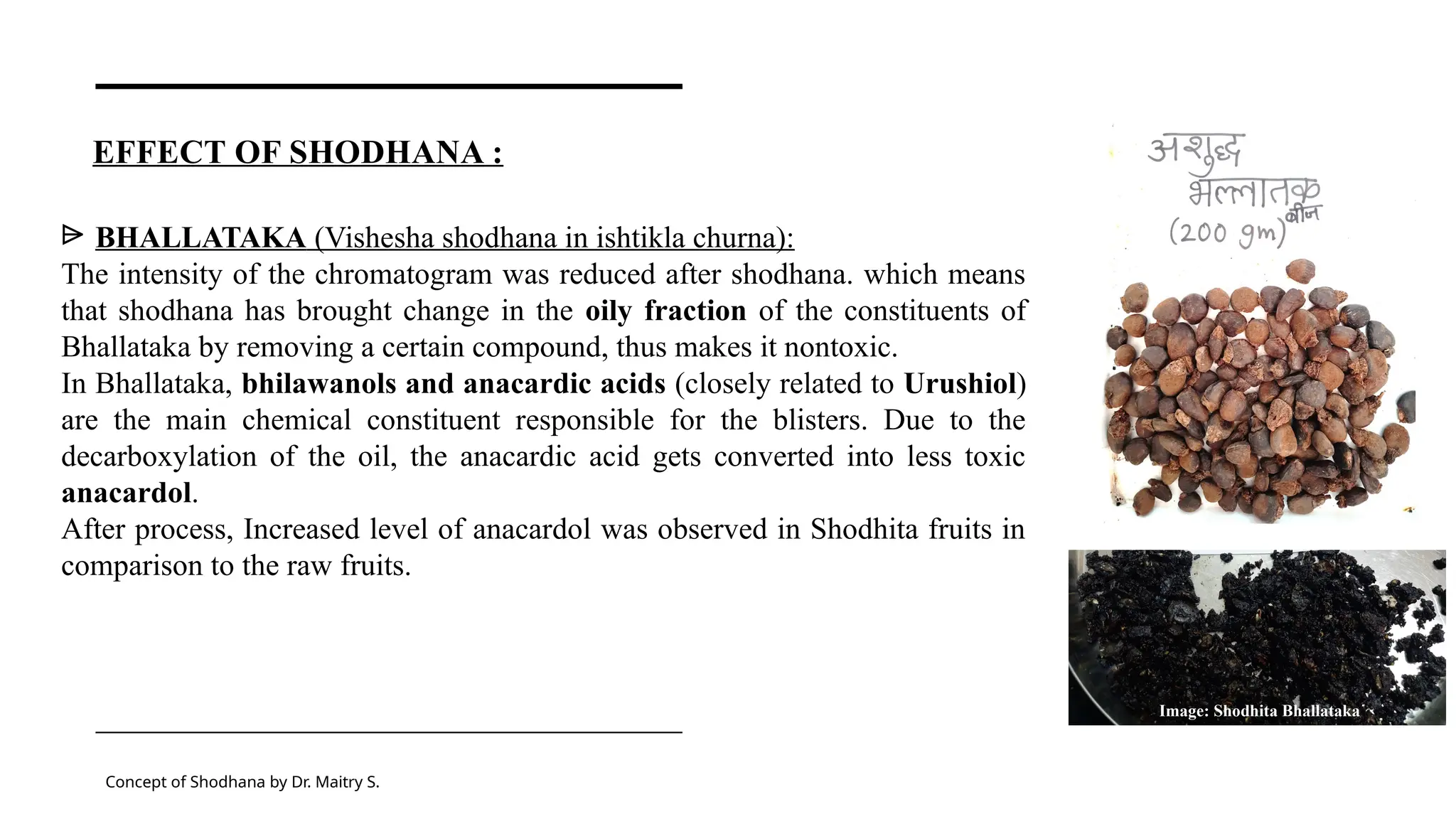
As the image and scientific literature explain, this process works in two ways:
- Adsorption: The brick powder physically absorbs some of the irritant oils.
- Decarboxylation: The heat and processing cause the primary irritant, anacardic acid, to lose a carboxyl group (–COOH), converting it into anacardol, a much less toxic phenolic compound.
2. Enhancing Bioavailability
While reducing toxicity is often the main goal, Ayurvedic processing methods can also influence the bioavailability of the remaining therapeutic compounds. The very media used for detoxification can sometimes act as bio-enhancers.
Let's explore this concept, which is deeply connected to the Shodhana processes we've just discussed.
An appraisal of the bioavailability enhancers in Ayurveda ...
The paper 'An appraisal of the bioavailability enhancers in Ayurveda...' explains several traditional concepts that aim to improve a drug's absorption and effect.
Please read two key sections: 'Bhavana (trituration)': This section discusses how processing a drug with certain liquid media (Bhavana Dravya) can enhance its properties. Notice that Gomutra (cow urine) is highlighted as a well-established bio-enhancer. 'Samshodhana (bio-purification)': This section makes an important distinction. While we are discussing Shodhana of substances (dravya), this discusses Samshodhana of the body (deha, i.e., Panchakarma). Note the principle: by cleansing the body's channels (Srotas) and strengthening digestive fire (Agni), the body's ability to absorb and utilize any subsequent drug is enhanced.
The key takeaway is that the media used in Shodhana are not always inert.
- Cow Urine (Gomutra), used in the purification of Vatsanabha and other herbs, is described as a bio-enhancer. Modern research suggests it may enhance the transport of drugs across the membranes of the gastrointestinal tract. So, while it helps detoxify the herb, it may simultaneously increase the absorption of the remaining therapeutic compounds.
- Cow's Milk (Godugdha) is another common medium. Its lipid content can help in the extraction and absorption of fat-soluble active compounds from the herbs being processed.
Therefore, a single Shodhana process can have a dual effect: reducing the concentration of toxic molecules while potentially increasing the absorption and bioavailability of therapeutic ones.
Test your understanding!
A researcher is investigating the Ayurvedic use of Kupīlu (Strychnos nux-vomica) for nervous system disorders. They know that raw Kupīlu seeds are highly toxic due to the alkaloid strychnine. The traditional Shodhana process involves boiling the seeds in cow's milk (Godugdha) for several hours.
Based on today's lesson, what are two distinct potential effects of this Shodhana process on the pharmacokinetic properties of the seeds?
Show answer
- Reduced Toxicity: The primary effect is the reduction of toxicity. The boiling process likely causes chemical changes, such as hydrolysis or oxidation, to the strychnine molecule, converting it into less toxic derivatives (like isostrychnine or strychnine N-oxide, as mentioned in the research paper). This reduces the risk of poisoning.
- Enhanced Bioavailability: The medium, cow's milk, contains lipids (fats). The active alkaloids in Kupīlu may have some fat solubility. Boiling the seeds in milk could help extract these therapeutic compounds from the seed matrix and emulsify them, potentially leading to better absorption in the gut compared to consuming the raw powder.
Conclusion
Today, we have bridged a crucial gap between traditional Ayurvedic pharmacy and modern pharmacology. We've seen that Shodhana is a set of deliberate, sophisticated techniques designed to modulate the chemical profile of medicinal herbs.
Key Takeaways:
- Shodhana is a scientific process: It is not merely a ritual but a form of traditional pharmaceutical processing aimed at enhancing safety and efficacy.
- Toxicity is reduced via chemical change: Processes like boiling (Svedana) can induce hydrolysis (e.g., Aconite) or decarboxylation (e.g., Bhallataka), converting highly toxic molecules into less harmful versions.
- Bioavailability may be enhanced: The media used in Shodhana, such as cow's urine and milk, can act as bio-enhancers, potentially improving the absorption of the desired therapeutic compounds across the gut wall.
- A traditional solution to a modern problem: These methods demonstrate an ancient understanding of the very challenges of toxicity and variability in herbal medicine that we discussed in our last lesson.
Preview of the Next Lesson:
Understanding how Shodhana alters the chemical makeup of an herb is fundamental to predicting its interactions. By removing or changing certain compounds, Shodhana can significantly alter how an herb interacts with metabolic enzymes (like the CYP450 system) and drug receptors. In our next lesson, we will explore the common pharmacokinetic and pharmacodynamic mechanisms of herb-drug interactions, and you will see how a "purified" (Shodhita) herb might have a very different interaction profile than its raw form.