Hello! Welcome to your next lesson in the "Clinical Trial Design and Critical Appraisal" module.
In our last lesson, we focused on how to define and interpret primary and secondary outcomes, which are the essential measures of a trial's success. We established that to rigorously test an intervention, we need to decide in advance exactly what we are going to measure.
Now that we know what to look for in terms of outcomes, the next logical step is learning how to find the studies that measure them. This lesson will equip you with the practical skills to navigate the vast world of scientific literature. Your ability to find relevant evidence is the first step in building the bridge between Ayurveda and modern science, forming the foundation for all the critical appraisal and research design skills we will develop later.
Today's learning outcome is to conduct a systematic literature search on an Ayurvedic intervention using databases like PubMed and the AYUSH Research Portal. We will cover the entire process, from structuring a research question for a search to executing it in both a major international database and a specialized national one.
1. The Systematic Approach: More Than Just Googling
When conducting scientific research, simply typing a few words into a search engine is not enough. We need a systematic approach. This means using a planned, documented, and reproducible method to find as much of the relevant evidence as possible, while minimizing irrelevant results. This ensures that our conclusions are based on a comprehensive view of the existing research, not just the first few articles that appear.
The key steps in a systematic search are:
- Frame a clear question using the PICO framework.
- Identify keywords for each part of the PICO question, including both modern biomedical terms and traditional Ayurvedic terms.
- Select appropriate databases to search.
- Combine keywords using special commands (Boolean operators) to build a search strategy.
- Document your process so that you or someone else could repeat the search and get the same results.
Building Keywords: The Bridge Between Systems
Let's use a sample research question: In adults with insomnia, is Ashwagandha effective for improving sleep quality?
Using the PICO framework we learned previously, we can break this down and generate keywords:
| PICO Component | Concept | Keywords (Biomedical) | Keywords (Ayurvedic/Botanical) |
|---|---|---|---|
| Population | Adults with Insomnia | "Insomnia", "Sleep Initiation and Maintenance Disorders", "sleep disorder" | "Anidra" |
| Intervention | Ashwagandha | "Withania" | "Ashwagandha", "Withania somnifera", "Indian ginseng" |
| Comparison | (Not always searched) | "placebo" | - |
| Outcome | (Not always searched) | "sleep quality", "sleep", "Pittsburgh Sleep Quality Index" | - |
Notice that we often don't include the Comparison or Outcome in our initial search. This makes the search broader, ensuring we don't miss studies that used a different comparison (e.g., another herb) or measured a slightly different outcome.
Searching for Ayurvedic concepts has unique challenges. To appreciate these, it's helpful to see how researchers approach this problem in practice.
Literature searches on Ayurveda: An update - PMC
The paper 'Literature searches on Ayurveda: An update' from the journal AYU provides a detailed guide on this very topic. It highlights the specific difficulties and best practices for creating a search strategy that incorporates Ayurvedic terminology.
Please read the subsection 'Search question' (under 'Methods') and the subsection 'Search strategy' (under 'Discussion'). Focus on how the authors translate a condition into both biomedical and Ayurvedic keywords for their PICO table and the challenges they note regarding different spellings, synonyms, and botanical names.
As you've just read, a comprehensive search requires a rich list of keywords, accounting for variations in spelling (e.g., Kustha/kushta), synonyms, and the botanical names of herbs.
2. Searching PubMed: The Global Standard
PubMed is the most important database for biomedical literature worldwide, maintained by the U.S. National Library of Medicine. It contains millions of citations, and many important studies on Ayurveda published in international journals are indexed here.
To search PubMed effectively, we use two types of terms:
- MeSH (Medical Subject Headings): This is a controlled vocabulary or thesaurus. Professional indexers read each article and assign it specific MeSH terms. Searching for the MeSH term
Insomniawill find all articles about insomnia, even if the authors used the words "sleep disorder" or "poor sleep." It is a powerful tool for comprehensive searching. - Keywords (Title/Abstract): These are the regular words you type into a search box. We use them to find very new articles that haven't been assigned MeSH terms yet, or to search for concepts (like "Anidra") that may not have a specific MeSH term. We often tell PubMed to look for these keywords in the title or abstract (
[tiab]).
We combine these terms using Boolean operators:
- OR: Broadens the search. Use it to combine synonyms within a single concept. (e.g.,
Insomnia OR Anidra). - AND: Narrows the search. Use it to combine different concepts. (e.g.,
(Insomnia terms) AND (Ashwagandha terms)).
The following video demonstrates this "building block" method of creating a systematic search.
How to search PubMed in a systematic way
This demonstration from MedSearchSolution clearly illustrates how to translate a PICO question into a practical search strategy in PubMed.
Please watch the video from 00:42 to 06:34. Pay close attention to how the presenter: Breaks the question down using PICO. Finds and adds MeSH terms from the MeSH database. Adds keywords for the title/abstract, using truncation (*) to find word variations (e.g., antibiotic* finds antibiotic and antibiotics). Combines the search blocks using 'OR' and 'AND' in the advanced search builder.
To summarize the process shown in the video, we build our search concept by concept (or "block by block").

For our Ashwagandha example, a simplified search in PubMed might look like this in the advanced search box:
("Sleep Initiation and Maintenance Disorders"[Mesh] OR "insomnia"[tiab] OR "anidra"[tiab]) AND ("Withania"[Mesh] OR "ashwagandha"[tiab])
Test your understanding!
You want to find studies on the use of Turmeric (Curcuma longa) for knee osteoarthritis. The Ayurvedic term for osteoarthritis is Sandhivata. Write a simple PubMed search string using the building block method, including at least one MeSH term and one keyword for each concept.
Show answer
A good search string would be:
("Osteoarthritis, Knee"[Mesh] OR "Sandhivata"[tiab]) AND ("Curcuma"[Mesh] OR "turmeric"[tiab])
- Concept 1 (Population):
"Osteoarthritis, Knee"[Mesh]is the official MeSH term. We add"Sandhivata"[tiab]with an 'OR' to catch papers that use the Ayurvedic term in the title or abstract. - Concept 2 (Intervention):
"Curcuma"[Mesh]is the MeSH term for the plant genus. We add"turmeric"[tiab]with an 'OR' to catch papers that use the common name. - We combine the two concepts with 'AND'.
3. Searching the AYUSH Research Portal: A Specialized Resource
The paper on Ayurvedic literature searches you read earlier highlighted a critical point: many journals publishing Ayurvedic studies are not indexed in PubMed. Therefore, to conduct a truly comprehensive search, you must also look in specialized databases.
The most important of these is the AYUSH Research Portal, the official evidence repository from the Ministry of AYUSH, Government of India.
Top Ayurvedic Research Tools Every Practitioner Should ...
Let's get a quick overview of the AYUSH Research Portal from the AyurCDS blog to understand its role, strengths, and limitations.
Please read section '1. AYUSH Research Portal'. Note its primary strengths (high credibility, official source) and limitations (less sophisticated search, not designed for clinical decision-making).
The AYUSH portal is your go-to source for research conducted, funded, and compiled within India's official AYUSH ecosystem.
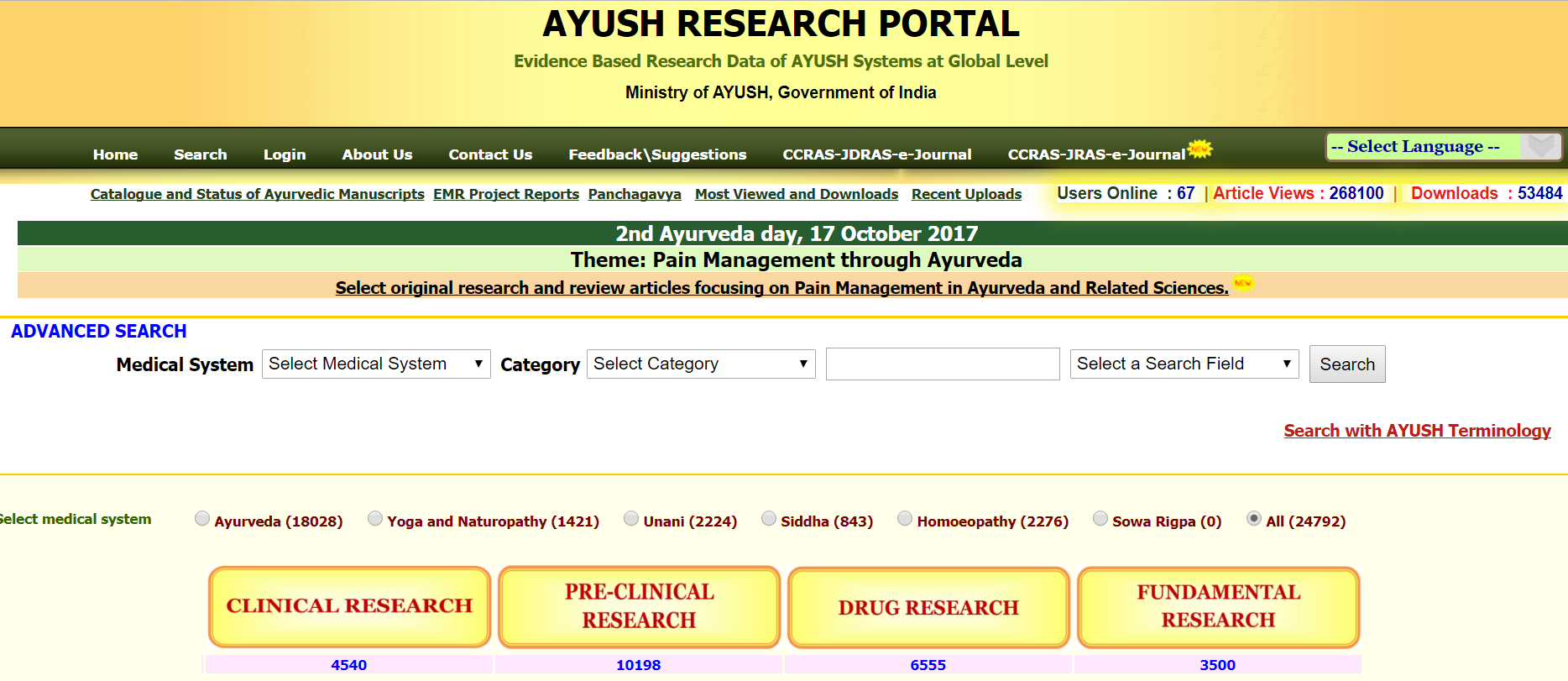
When searching the AYUSH Research Portal, keep in mind:
- The search is simpler: It does not have a MeSH system or support complex search strings with multiple Boolean operators like PubMed does. You will typically search with simpler keywords (e.g., "Ashwagandha insomnia").
- It's a complementary tool: Because its collection of journals is different from PubMed's, you will find different articles. A complete search strategy for an Ayurvedic topic involves searching both PubMed and the AYUSH Research Portal.
- Look for more than just articles: The portal also provides links to clinical trials, drug research, and disease-specific summaries. Another key resource mentioned in the overview is the Clinical Trials Registry of India (CTRI), which is essential for finding ongoing or recently completed trials that may not be published yet.
Conclusion
You now have a foundational method for systematically finding scientific evidence on Ayurvedic interventions. This is a crucial skill for separating opinion from evidence and is the starting point for any research project or evidence-based practice.
Key Takeaways:
- A systematic search is a planned and reproducible process that starts with a PICO question.
- To build a search strategy, you must identify both biomedical and Ayurvedic keywords for your concepts.
- In PubMed, you combine MeSH terms (controlled vocabulary) and keywords (from the title/abstract) using Boolean operators (
AND/OR). - Searching PubMed is essential but not sufficient for Ayurvedic topics, as many relevant journals are not indexed there.
- You must supplement your search with specialized databases, with the AYUSH Research Portal being the most critical one for Indian research.
Preview of the Next Lesson:
Knowing how to find a study is the first step. The next, more challenging step is to determine if the study you found is trustworthy. Is it well-designed? Are its results believable? In our next lesson, we will move on to the core of this module: Critically appraise a randomized controlled trial for internal validity (risk of bias) and external validity (applicability). You will learn to use a structured approach to evaluate the quality of the evidence you find.