Hello! Welcome to your third lesson in the "Molecular Biology and Genetics" module.
In our last session, we explored the fascinating world of gene regulation—the molecular "switches" that cells use to turn genes on and off. We established that this control is what allows cells with the same DNA to specialize into different types. We also briefly hinted at another, more subtle layer of control: chemical tags that attach to our DNA and influence its activity.
Today, we delve into that very topic: epigenetics. The learning outcome for this lesson is to describe epigenetic mechanisms (e.g., methylation) and their role in modifying gene expression.
The term epigenetics literally means "above" or "on top of" genetics. It refers to modifications that don't change your DNA sequence but instead affect how your cells "read" your genes. This field is incredibly exciting because it provides a scientific framework for understanding something you are deeply familiar with from your Ayurvedic studies: how our lifestyle, diet, and environment can profoundly influence our health and physiology. This lesson will form a crucial bridge, connecting ancient wisdom about wellness with modern molecular science.
1. What is Epigenetics? The Big Picture
Imagine two identical twins with the exact same DNA. Why might one develop a particular health condition while the other remains healthy? The answer often lies in their unique life experiences, which can leave different "epigenetic marks" on their genomes.
To introduce this concept, let's watch a short video that explains the fundamental idea of epigenetics.
This video from Amoeba Sisters, titled 'Epigenetics,' provides a clear and engaging introduction to the topic using the example of identical twins.
Please watch from the beginning until 02:14. Focus on how the prefix 'epi-' helps define the term and why identical twins are a perfect example to illustrate the concept.
As the video explains, epigenetics involves factors that work on the genome to alter its expression. These epigenetic modifications act as a layer of information that instructs the cellular machinery on which genes to use and which to ignore.
This image provides a great overview of the entire process, from external factors to molecular changes and eventual health outcomes.
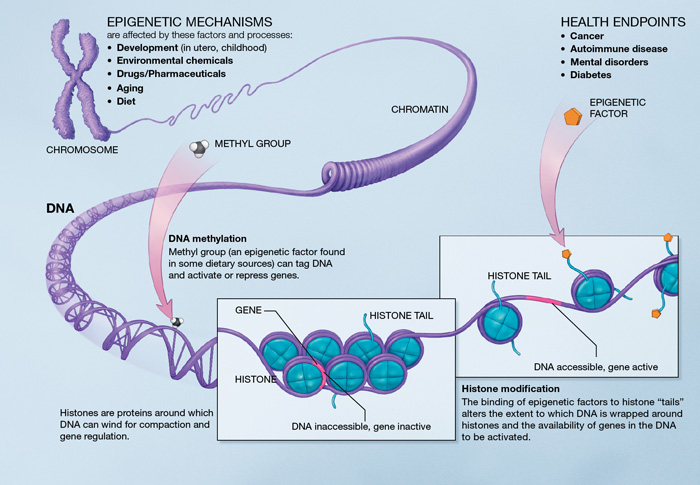
2. The "How": Key Epigenetic Mechanisms
Now, let's examine the molecular machinery behind these changes. There are several epigenetic mechanisms, but we will focus on the two most well-understood: DNA methylation and histone modification.
2.1. DNA Methylation: The "Off" Switch
One of the most common epigenetic marks is the direct attachment of a small molecule called a methyl group () to the DNA molecule itself.
- What it is: DNA methylation is a chemical reaction where a methyl group is added to a DNA base, typically cytosine (C), especially when it's located next to a guanine (G). These "CpG sites" are often clustered together in regions called CpG islands, which are frequently found in the promoter regions of genes.
- What it does: Think of methylation as a physical barrier or a "do not read" sign. When a gene's promoter is heavily methylated, transcription factors and RNA polymerase find it difficult to bind to the DNA. This effectively "silences" or turns the gene off.
To see this explained, let's return to the video.
The Amoeba Sisters video offers a simple explanation of DNA methylation.
Watch the segment from 02:14 to 03:05. Notice how the attachment of methyl groups prevents transcription from occurring.
For a slightly more detailed look at where this happens, let's consult a technical guide.
The resource 'Epigenetics Overview' from Promega provides a more technical description of DNA methylation and CpG islands.
Please read the first two paragraphs under the 'DNA Methylation' section. Your goal here is to understand the terms '5-methylcytidine' and 'CpG dinucleotides,' and to reinforce the idea that DNA methylation is typically associated with gene repression.
2.2. Histone Modification: Adjusting DNA Accessibility
In our cells, DNA isn't just a loose strand; it's tightly coiled around proteins called histones, like thread around a spool. This DNA-protein complex is called chromatin. The way DNA is packaged has a huge impact on gene expression.
- Loose Chromatin (Euchromatin): When the DNA is loosely wrapped, genes are accessible and can be easily transcribed. They are "on."
- Tight Chromatin (Heterochromatin): When the DNA is tightly packed, the transcriptional machinery can't access the genes. They are "off."
Epigenetics can control this packaging by modifying the histone proteins themselves. Histones have long "tails" that stick out, and various chemical groups can be attached to them. Let's look at two key modifications:
- Histone Acetylation: The addition of an acetyl group (). This modification neutralizes the positive charge on the histones, causing them to loosen their grip on the negatively charged DNA. This "unspooling" makes the DNA more accessible for transcription. Generally, acetylation turns genes ON.
- Histone Methylation: The addition of a methyl group (). Unlike DNA methylation, histone methylation is more complex. Depending on which amino acid on the histone tail is methylated and how many methyl groups are added, it can either activate or repress gene expression.
Let's watch how these histone modifications work.
The Amoeba Sisters video provides an excellent visual analogy for histone modification.
Watch from 03:05 to 04:03. Focus on the difference between histone acetylation (loosening the DNA) and histone methylation (generally preventing transcription).
Test your understanding!
A scientist discovers that a specific gene responsible for inflammation is highly expressed in a patient's cells. Based on what you've just learned, what kind of epigenetic marks would you expect to find at the promoter region of this overactive gene?
Show answer
You would expect to find:
- Low levels of DNA methylation at the gene's promoter, allowing transcriptional machinery to access it.
- High levels of histone acetylation around the gene, indicating that the chromatin is in a "loose" and accessible state, which promotes transcription.
3. Epigenetics in Action: The Bridge to Ayurveda
So, what causes these epigenetic marks to change? As we've hinted, the answer lies in our interaction with the world. Diet, stress, toxins, and even our social interactions can alter our epigenome.
Classic experiments have demonstrated this powerfully.
Let's watch the final segment from the 'Epigenetics' video, which provides two powerful examples of how environment and behavior can shape the epigenome.
Watch from 04:03 to 05:50. Pay attention to the two examples: Rat Pup Grooming: How a mother's care can epigenetically alter the stress-response genes in her offspring. Agouti Mice: How a pregnant mouse's diet can change the coat color and health of her pups by methylating a specific gene.
These examples demonstrate a clear molecular link between behavior (licking), diet (methyl-rich foods), and gene expression. This is where the connection to your Ayurvedic background becomes most apparent. Ayurveda has long emphasized that health and disease are not just predetermined but are dynamically influenced by Ahara (diet), Vihara (lifestyle), and Manas (mental state).
A growing body of research is now exploring this very connection. Let's look at a paper that directly proposes epigenetics as a modern scientific explanation for Ayurvedic principles.
Ayurveda and Epigenetics - PMC
This paper, titled 'Ayurveda and Epigenetics,' published in a peer-reviewed journal, explicitly makes the case that epigenetics is an important mechanism underlying the effects described in Ayurveda.
Please read the following parts of the article: The Abstract (Section 0) for a concise summary of the paper's argument. The first paragraph of Section 3, 'Epigenetics and Ayurveda' (Section 1), which directly links the mechanisms to the concept of Deha Prakriti (phenotype) and Karma (action). The first paragraph of Section 4, 'Research on the Four Major Factors that Cause Epigenetic Changes' (Section 2), and then the first two sentences of subsection 4.2 'Diet and Digestion'. This highlights how factors like diet (e.g., curcumin from turmeric) are known epigenetic regulators, providing a molecular basis for the dietary recommendations in Ayurveda.
This paper beautifully illustrates your goal of bridging the two sciences. It reframes Ayurvedic concepts like Dinacharya (daily routine), Ritucharya (seasonal routine), and the importance of Agni (digestive fire) in the language of molecular biology. It suggests that these practices are, in effect, ways of managing our epigenome for optimal health.
Conclusion
In this lesson, we have explored the dynamic and responsive world of epigenetics. You've learned how chemical modifications to our DNA and its packaging proteins can regulate gene expression, shaping who we are and how our bodies function.
Key Takeaways:
- Epigenetics refers to heritable changes in gene expression that occur without altering the underlying DNA sequence.
- The two primary mechanisms are DNA methylation (which typically silences genes) and histone modification (like acetylation, which typically activates genes by making them more accessible).
- These epigenetic marks are not static; they can be influenced by a wide range of factors, including diet, lifestyle, stress, and environmental exposures.
- Epigenetics provides a powerful scientific framework for understanding how the principles of wellness central to Ayurveda can exert their effects at a molecular level, influencing health and disease.
This understanding is fundamental for translating Ayurvedic wisdom into a modern scientific context and for designing research to validate its practices.
Preview of the Next Lesson:
Today, we focused on how the expression of the same gene can be modified. In our next lesson, we will shift our focus to the DNA sequence itself. We will explore genetic variations (polymorphisms)—the small differences in DNA sequence that exist between individuals. You will learn how these variations can affect protein function and contribute to individual differences in traits and susceptibility to disease, providing another powerful lens through which to view the Ayurvedic concept of Prakriti (individual constitution).