Hello! Welcome to the final lesson in our module on "Molecular Biology and Genetics."
In our last lesson, we established a crucial link between genetic variations—specifically Single Nucleotide Polymorphisms (SNPs)—and the function of proteins. We saw how this can lead to different responses to medications, a field called pharmacogenomics. This provided us with a powerful modern scientific parallel to the Ayurvedic concept of Prakriti.
Today, we will synthesize what you've learned throughout this module. Our goal is to relate molecular mechanisms to potential variations in an individual's response to treatments. We'll move beyond single gene variations to appreciate how a combination of genomics, epigenetics, and even our microbiome creates a unique biological identity that dictates how we respond to therapies. This lesson will serve as a capstone for the module, explicitly bridging these advanced molecular concepts with the holistic Ayurvedic view of the individual.
1. The Full Scope of Pharmacogenomics
In the previous lesson, we focused heavily on how genetic variations in the Cytochrome P450 enzymes affect drug metabolism. However, this is just one piece of the puzzle. An individual's genetics can influence their response to a treatment at multiple stages of a drug's journey through the body.
Let's watch a video that provides a broader overview of pharmacogenomics, illustrating how genetic variations can affect not only metabolism but also drug transporters, drug targets (receptors), and drug safety.
Pharmacology - PHARMACOGENOMICS (MADE EASY)
This video, 'Pharmacology - PHARMACOGENOMICS (MADE EASY)' from Speed Pharmacology, expands on what we learned previously. It provides excellent examples across different medical fields, showing the wide impact of our genetic makeup on treatment outcomes.
Please watch the following segments: 01:12 - 03:20: This part reviews the ADME process and explains how genetic variations affect not just metabolizing enzymes, but also transport proteins and drug receptors. 05:19 - 06:31: A review of the Codeine example, reinforcing your understanding of how metabolizer status affects a prodrug. 07:45 - 08:35: An example with Clopidogrel, showing how genetics can determine if a drug is activated effectively. 08:16 - 09:30: Examples with Carbamazepine and Abacavir, demonstrating how genetic screening can prevent severe and life-threatening adverse reactions. As you watch, notice the different ways genetics can influence a drug's effect: by changing its concentration, its activation, or the body's reaction to it.
As the video illustrates, our individual genetic blueprint can determine:
- Pharmacokinetics: How a drug is absorbed, distributed, metabolized, and eliminated. This is influenced by variations in metabolizing enzymes (like CYP450) and transport proteins (like P-glycoprotein).
- Pharmacodynamics: How a drug acts on its target. This is affected by variations in the genes coding for receptors or other target proteins.
- Idiosyncratic Reactions: Severe, unpredictable adverse reactions. Genetic variations in immune-related genes (like the HLA-B gene) can predispose certain individuals to dangerous hypersensitivity reactions to specific drugs.
This shows that predicting a person's response is more complex than looking at a single gene. It involves a network of genes that control a drug's entire interaction with the body.
2. Beyond the Genome: Epigenetics and the Microbiome
Our inherited DNA sequence is not the only factor. As we learned in a previous lesson, epigenetics—chemical modifications to DNA that regulate gene expression—plays a huge role. Furthermore, emerging science shows that the trillions of microbes living in our gut also have a profound impact on how we process medications.
Let's return to the Speed Pharmacology video to explore these additional layers of individuality.
Pharmacology - PHARMACOGENOMICS (MADE EASY)
The final part of the 'Pharmacogenomics' video looks to the future, discussing how fields like epigenetics and the study of the microbiome are deepening our understanding of personalized medicine.
Please watch the segment from 10:25 to 13:58. Focus on understanding: How epigenetic changes (like DNA methylation) can alter the expression of genes involved in drug metabolism. How the gut microbiome can metabolize drugs before they even reach our own cells, altering their efficacy and toxicity. This connects our current topic back to the earlier lesson on epigenetics and introduces a new, important factor.
This brings together several concepts we've discussed:
- Genetics (The Blueprint): The DNA sequence you are born with (Janma Prakriti).
- Epigenetics (The Annotations): How your lifestyle, diet, and environment modify the expression of that blueprint (Deha Prakriti).
- Microbiome (The Ecosystem): The community of microorganisms that co-exist with you and have their own metabolic capabilities, influencing your own.
These factors combined create a highly personalized biological landscape, explaining why a "one-size-fits-all" approach to medicine is often inadequate. This multi-layered view of individuality resonates deeply with the holistic perspective of Ayurveda.
3. Ayurgenomics: Building the Bridge
You are now equipped with the key modern concepts that explain individual variation. The final step is to formally connect them to the principles of Ayurveda. This is the goal of an exciting and growing field called Ayurgenomics.
Ayurgenomics seeks to correlate the Ayurvedic concept of Prakriti with modern molecular data from genomics, epigenomics, and other "omics" fields. Let's explore a foundational paper on this topic.
An Ayurgenomics Approach: Prakriti-Based Drug ...
This research article, 'An Ayurgenomics Approach: Prakriti-Based Drug...', directly addresses your goal of bridging Ayurveda and modern science. It discusses how the ancient concept of constitutional types can be explored using modern molecular tools.
Please read the following sections to understand the conceptual framework of Ayurgenomics: Introduction (Section 1): Read this to understand the basic premise of Ayurgenomics and the definition of Prakriti in this context. Genomics in Ayurveda (Section 3, beginning with 'A genome is a complete set of DNA...'): This section explains how genomics provides a tool to investigate the genetic basis of Prakriti. Epigenetics in Ayurveda (Section 4): This is a key section. It explicitly links epigenetic mechanisms to the Ayurvedic understanding of how lifestyle and environment influence an individual's constitution (Deha Prakriti). Focus on how these authors are framing a research agenda to find the molecular underpinnings of Ayurvedic principles.
The article lays out a clear vision for integrating these two systems of knowledge. This isn't just a theoretical idea; it's a practical research approach.
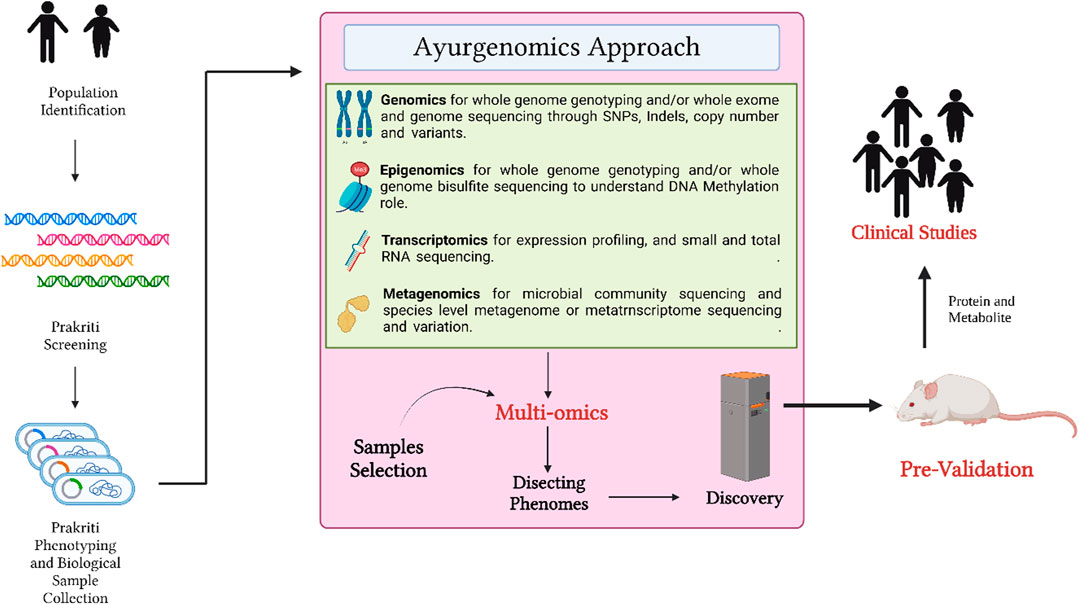
Concrete Evidence: Linking Genes to Prakriti
The most compelling part of this research is the discovery of actual correlations between specific genetic variations and Prakriti types. Let's dive into the evidence presented in the article.
An Ayurgenomics Approach: Prakriti-Based Drug ...
We will now read the section of the article that details the specific research findings.
Please read Section 5, which begins with the sentence 'Over a decade ago, a link between the concept of Prakriti and genetics was proposed.' This is the core of the paper, presenting specific study results. As you read, look for these key findings: The association of the CYP2C19 gene (a drug-metabolizing enzyme) with Pitta and Kapha types. The association of HLA DRB1 alleles (immune function) with different Prakriti types. The link between the EGLN1 gene (involved in high-altitude adaptation) and Pitta and Kapha types. The connection of the PGM1 gene (involved in carbohydrate metabolism) with the Pitta phenotype.
These findings are profound. They provide the first molecular evidence that the ancient, observation-based classification of Prakriti may correspond to tangible, measurable genetic differences between individuals.
For example, the finding that the CYP2C19 gene—a member of the same CYP450 family we've been studying—is expressed differently between Prakriti types provides a direct, testable hypothesis for why a Pitta-dominant individual might respond differently to a drug or herb than a Kapha-dominant individual. It scientifically grounds the Ayurvedic principle of tailoring dravya (substance) to the prakriti (constitution) of the person.
Test your understanding!
The article states that the CYP2C19 gene was found to be down-regulated (less active) in Kapha types and up-regulated (more active) in Pitta types.
Imagine a drug that is active upon administration and is later inactivated by the CYP2C19 enzyme. Based on this finding, who would likely clear the drug from their system faster: a Pitta-dominant person or a Kapha-dominant person? What might be the clinical implication of this difference?
Show answer
A Pitta-dominant person, with up-regulated (more active) CYP2C19 enzymes, would likely inactivate and clear the drug faster than a Kapha-dominant person, who has down-regulated (less active) enzymes.
The clinical implication is that a standard dose of the drug might be less effective for the Pitta person because it's cleared too quickly. Conversely, the same standard dose could lead to higher drug levels and an increased risk of side effects in the Kapha person because it lingers in their system for longer. This demonstrates a potential molecular basis for Prakriti-based dose adjustments.
Conclusion
This lesson concludes our journey through the molecular basis of individuality. We have seen that the unique way each person responds to treatments is not a mystery, but a complex interplay of multiple biological factors.
Key Takeaways:
- Individual treatment response is shaped by genetic variations in a wide array of genes, including those for metabolizing enzymes, transport proteins, and drug receptors.
- This genetic blueprint is further modulated by epigenetic factors (influenced by diet and lifestyle) and the metabolic activity of the gut microbiome.
- The emerging field of Ayurgenomics provides a formal framework for investigating the molecular basis of Ayurvedic concepts, particularly Prakriti.
- Scientific studies have already identified significant correlations between specific genetic polymorphisms and Prakriti types, offering the first steps toward a unified, evidence-based model of personalized medicine that respects both ancient wisdom and modern science.
Preview of the Next Module:
Having built a strong foundation in biochemistry and molecular biology, we will now move to a higher level of organization: human physiology. In the next module, "Essentials of Human Physiology," we will begin by exploring how different organ systems communicate to maintain balance. Our first lesson will focus on the principles of neuro-endocrine signaling, using the Hypothalamic-Pituitary-Adrenal (HPA) axis—the body's central stress response system—as a prime example. This will provide a physiological lens to understand concepts like stress, adaptation, and dosha imbalance.