Hello! Welcome to your fourth lesson in the module on Fundamentals of Modern Pharmacology.
In our last lesson, we explored pharmacodynamics, focusing on what a drug does to the body. We learned how to quantify a drug's effect using dose-response curves, distinguishing between a drug's maximal effect (efficacy) and the dose required to achieve it (potency).
Today, we delve deeper to answer the question: How does a drug produce these effects at the molecular level? The answer lies in receptor theory, which is one of the most fundamental concepts in pharmacology. Our learning outcome for this lesson is to describe the principles of receptor theory as a primary mechanism of drug action.
Understanding this is a critical step in your goal to bridge Ayurveda and modern science. It provides the mechanistic framework to hypothesize how the active compounds in Ayurvedic herbs, known as Dravyas, might exert their effects, or Karma, on a cellular level.
1. The Receptor Concept: A Lock and Key
For a drug to work, it can't just float around in the body; it must interact with specific molecular components of our cells. While there are a few exceptions, the vast majority of drugs produce their effects by binding to specialized protein molecules called receptors.
The interaction between a drug and its receptor is often described using the "lock and key" analogy.
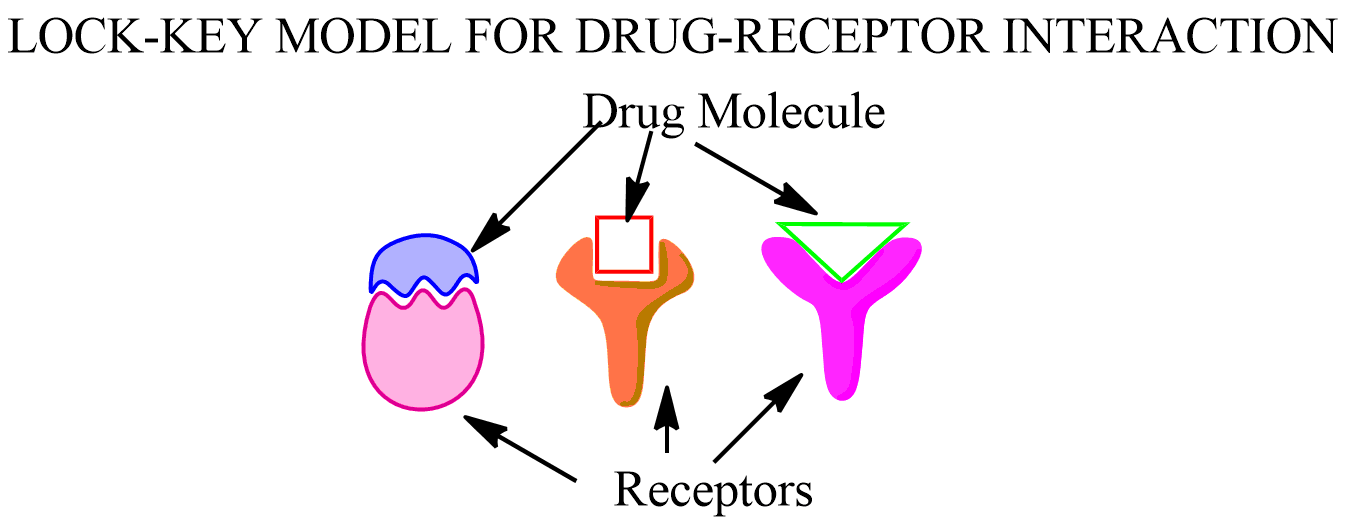
This model highlights a crucial principle: specificity. A particular drug key will only fit into a specific receptor lock. This is why different drugs produce very different effects in the body—they are binding to and activating different sets of receptors.
The "fit" between the drug and receptor is not just about shape, but also about the chemical bonds that form between them. The strength of this binding is called affinity.
Chapter 1 Pharmacokinetics & Pharmacodynamics
To understand the formal definition of affinity and how it fits into the broader picture of pharmacodynamics, please read the introductory paragraphs of this chapter from an open-access pharmacology textbook.
Please read the two paragraphs under the heading 'Pharmacodynamics'. Focus on the definition of affinity and how it relates to the lock and key model.
As the text explains, affinity describes how strongly a drug binds to its receptor.
- High affinity means the "key" fits snugly in the "lock" and a strong bond is formed. These drugs are effective even at low concentrations.
- Low affinity means the binding is weaker and more transient. Higher concentrations of the drug are needed to ensure enough receptors are occupied at any given time.
2. Basic Interactions: Agonists and Antagonists
When a drug (the key) binds to a receptor (the lock), one of two things can happen. This is the central principle of receptor theory.
-
Agonist: The key fits, turns, and opens the lock. An agonist is a drug that binds to a receptor and activates it, producing a biological response. This is the drug's intended effect. Most drugs you think of are agonists.
- Example: Morphine is an agonist at opioid receptors in the brain. When it binds and activates these receptors, it triggers a cascade of events that leads to pain relief.
-
Antagonist: The key fits in the lock, but it doesn't turn. An antagonist is a drug that binds to a receptor but does not activate it. By occupying the receptor, it physically blocks an agonist from binding. Antagonists are often called "blockers."
- Example: Naloxone is an antagonist at opioid receptors. If someone has overdosed on morphine, naloxone can be given to rapidly displace the morphine from the receptors, reversing its effects. It blocks the receptor without producing any effect of its own.
These two fundamental concepts explain how drugs can either initiate an effect or prevent one from happening.
Chapter 1 Pharmacokinetics & Pharmacodynamics
This resource provides a clear, concise explanation of agonist and antagonist actions, including a helpful diagram.
Please read the section titled 'Agonist and Antagonist Actions' and examine Figure 1.7. This will reinforce the difference between these two primary types of drug-receptor interaction.
Test your understanding!
The Ayurvedic herb Sarpagandha (Rauwolfia serpentina) contains the alkaloid reserpine. Reserpine was one of the first modern drugs used to treat high blood pressure. It works by blocking a specific protein that transports neurotransmitters like norepinephrine into storage vesicles within a neuron. When norepinephrine cannot be stored, its levels in the synapse decrease, leading to lower blood pressure.
Based on this description, would you classify reserpine's action on the transporter protein as more similar to an agonist or an antagonist? Why?
Show answer
Reserpine's action is similar to an antagonist. It binds to the transporter protein and blocks its normal function (transporting norepinephrine). It doesn't activate the transporter to do more work; it prevents it from working. This "blocking" action is the hallmark of an antagonist.
3. The Major Families of Receptors
Our bodies have thousands of different receptors, but they can be grouped into a few major "superfamilies" based on their structure and mechanism. Drugs have been developed to target all of them.
Let's watch a short video that introduces the four main families of receptors. This will give you a sense of the different "types of locks" that exist in our cells.
Pharmacology - PHARMACODYNAMICS (MADE EASY)
This video from Speed Pharmacology provides a quick and clear overview of the four main receptor types that are most relevant to drug therapy.
Please watch from 00:47 to 01:20. The goal is simply to be introduced to the names and general idea of the four families.
As the video outlined, the four major receptor families are:
-
Ligand-Gated Ion Channels: These are like gates on the cell surface. When a drug (ligand) binds, the gate opens, allowing ions (like sodium or chloride) to rush into or out of the cell. This is a very fast process, with responses occurring in milliseconds. Many drugs acting on the nervous system use these channels.
-
G Protein-Coupled Receptors (GPCRs): This is the largest and most common family of receptors. When a drug binds to a GPCR on the cell surface, it activates an intermediary "G protein" inside the cell, which then triggers a cascade of further signals via "second messengers." This process is slightly slower, taking seconds to minutes. A huge number of modern drugs, from antihistamines to blood pressure medications, target GPCRs.
-
Enzyme-Linked Receptors: These receptors have an enzyme component. When a drug binds to the outside, it activates the enzyme activity on the inside of the cell. The most common type is the tyrosine kinase receptor. Insulin, for example, works by binding to this type of receptor. The response time is in minutes.
-
Intracellular Receptors: Unlike the others, these receptors are located inside the cell, in the cytoplasm or nucleus. A drug must be lipid-soluble to cross the cell membrane and reach them. Once activated, the drug-receptor complex travels to the DNA and changes gene expression (which genes are turned on or off). This is the slowest mechanism, taking hours to days to see an effect. Steroid hormones and drugs like corticosteroids work this way.
4. Receptor Theory and Herbal Medicine
The principles of receptor theory are not limited to synthetic drugs. The bioactive molecules in plants, often called secondary metabolites, produce their effects through the very same mechanisms. This is a key area where Ayurvedic knowledge and modern pharmacology converge.
Alkaloids, flavonoids, and terpenoids found in medicinal herbs are essentially nature's "keys," evolved over millions of years to interact with the "locks" in animal and human cells.
Modes of Action of Herbal Medicines and Plant Secondary ...
This review article, 'Modes of Action of Herbal Medicines and Plant Secondary Metabolites', discusses how compounds from plants interact with molecular targets in the body. Reading a small part will show you how relevant receptor theory is to herbal pharmacology.
Please read the last paragraph of Section 2 ('General Modes of Action...') starting with 'A number of plants...'. Then, read the first two paragraphs of Section 3.2.1 ('Alkaloids...'). Focus on how often these plant compounds are described as targeting neuroreceptors, ion channels, and enzymes.
As you can see from the article, the language used to describe the actions of plant compounds is the language of receptor theory. The article explicitly mentions that the molecular targets of alkaloids are often neuroreceptors and ion channels. This scientific framework allows us to investigate and explain the Karma (action) of a Dravya (substance) at a precise, molecular level. For instance, morphine (from the opium poppy) is an agonist, while atropine (from Atropa belladonna) is an antagonist.
Conclusion
In this lesson, we have established the foundational principles of how drugs work. We've moved beyond observing an effect (pharmacodynamics) to understanding the underlying cause (receptor theory).
Key Takeaways:
- Receptor theory states that drugs produce their effects by binding to specific molecular targets in the body, most commonly protein receptors.
- This interaction is specific, often described by the lock-and-key model. The strength of this binding is called affinity.
- A drug can be an agonist, which binds to and activates a receptor to produce an effect.
- A drug can be an antagonist, which binds to a receptor without activating it, thereby blocking it.
- The major receptor families (ion channels, GPCRs, enzyme-linked, and intracellular) provide different mechanisms and timescales for drug action.
- These principles are universal and apply equally to synthetic drugs and bioactive compounds found in medicinal herbs.
Preview of the Next Lesson:
We have learned the basic difference between an agonist and an antagonist. In the next lesson, we will refine this understanding. We will differentiate between full agonists, partial agonists, and inverse agonists, and explore how their interactions with receptors lead to different effects on the dose-response curves you learned about previously. This will give you a more sophisticated toolkit for analyzing drug action.