Hello! Welcome to our second lesson.
In our last session, we explored the four major classes of biomolecules. We learned that phospholipids, with their water-loving heads and water-fearing tails, are the primary building blocks of cell boundaries, and that proteins are the versatile "workhorses" of the cell.
Today, we will see these molecules in action as we explore the structure and function of the cell membrane. Our learning outcome is to describe the fluid mosaic model of the cell membrane and differentiate between passive, facilitated, and active transport.
The cell membrane is the gatekeeper of the cell. It maintains the cell's internal integrity, a state of balance known as homeostasis. Understanding how this gate works is fundamental to understanding everything from how a single cell gets nutrients to how a nerve impulse is transmitted. In Ayurvedic terms, you can think of this selective barrier as the crucial intelligence that distinguishes what is nourishing for the cell from what needs to be kept out or expelled, a foundational process for building and maintaining healthy tissues (Dhatus).
The Fluid Mosaic Model: A Dynamic Barrier
The cell membrane is not a rigid wall. Instead, it's a dynamic and flexible structure, best described by the fluid mosaic model. Let's break down what this means.
To get a visual introduction to this concept, please watch the first part of the following video.
Structure Of The Cell Membrane: Active and Passive Transport
This video from Professor Dave Explains provides a clear and concise introduction to the phospholipid bilayer and the fluid mosaic model.
Watch from 00:56 to 03:08. Pay close attention to how the properties of phospholipids lead to the bilayer structure and what makes the membrane a 'fluid mosaic'.
As the video explained, the model has two key parts:
- Fluid: The phospholipids and most of the proteins are not fixed in place. They can move laterally, like people milling about in a crowd. This fluidity is crucial for the membrane's function and is regulated by cholesterol, another type of lipid, which prevents the membrane from being too fluid or too rigid.
- Mosaic: The membrane is a collage of different molecules. It is primarily a phospholipid bilayer, but embedded within it or attached to its surface are various proteins, cholesterol, and carbohydrates.
This detailed illustration shows all the components we've discussed.
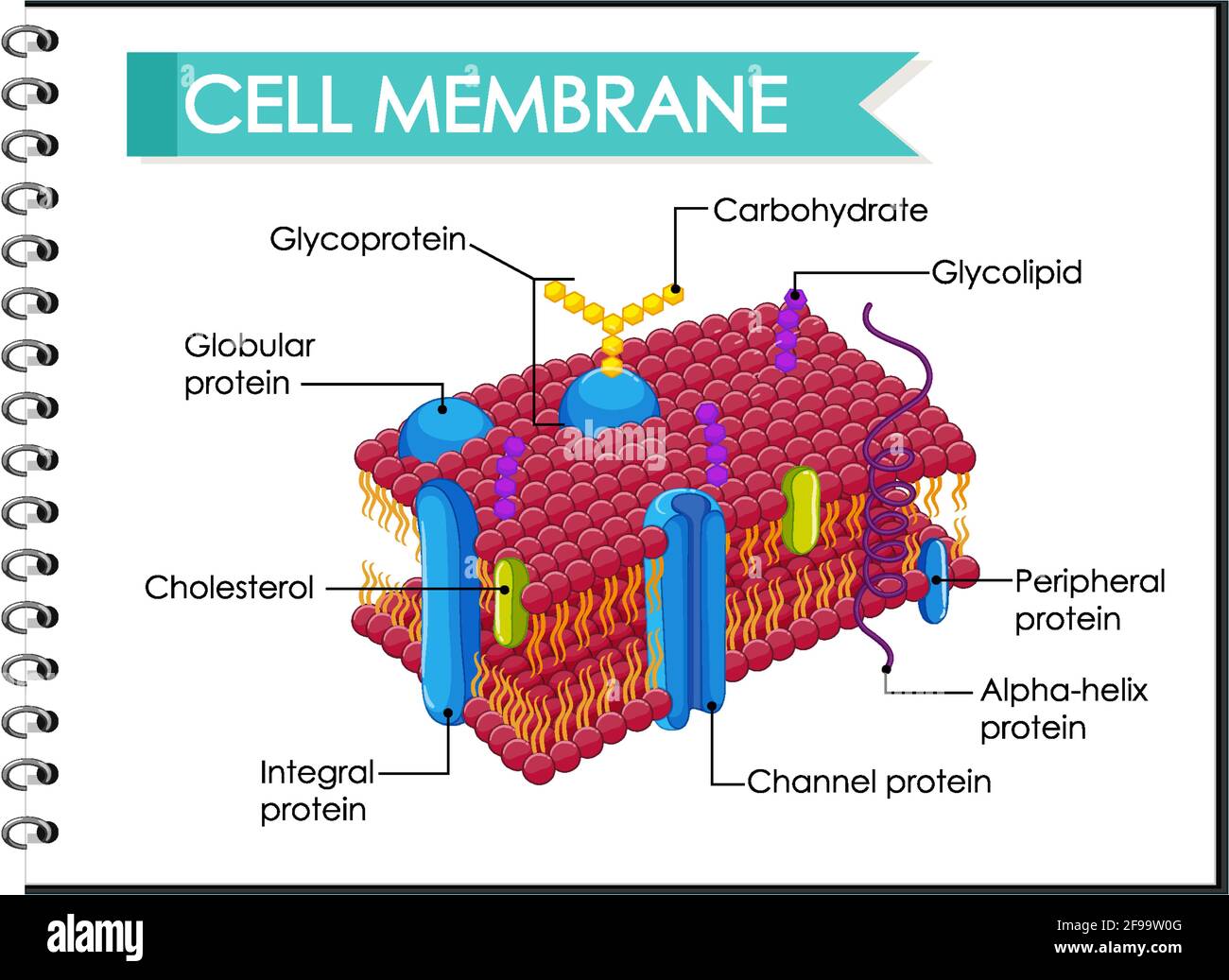
The main components and their roles are:
- Phospholipid Bilayer: Forms the basic fabric of the membrane. Its hydrophobic interior acts as the primary barrier to water-soluble substances.
- Proteins: These are the functional components.
- Integral proteins are embedded within the bilayer and often span the entire membrane (transmembrane proteins). They act as channels or transporters.
- Peripheral proteins are loosely attached to the surface and often act as enzymes or for structural support.
- Carbohydrates: Attached to proteins (forming glycoproteins) or lipids (forming glycolipids) on the cell's outer surface. This carbohydrate layer, called the glycocalyx, acts as a cellular "identity tag," crucial for cell-cell recognition and immune responses.
Transport Across the Membrane: The Gatekeeper's Rules
The cell membrane's most critical function is regulating what passes through it. This property is called selective permeability. Some substances can cross easily, while others need help or are barred entirely.
Transport mechanisms are broadly divided into two categories based on whether they require energy.

Let's watch a video that walks through these different types of transport.
This video from Amoeba Sisters clearly explains and animates the different ways substances move across the cell membrane.
Please watch from 01:38 to 05:15. This covers simple diffusion, facilitated diffusion, and active transport.
Now, let's review and solidify these concepts.
1. Passive Transport: Going with the Flow
Passive transport does not require the cell to expend any energy. Substances move spontaneously down their concentration gradient, from an area of higher concentration to an area of lower concentration.
There are two main types of passive transport:
- Simple Diffusion: This is the unassisted movement of small, nonpolar molecules (like oxygen, O₂, and carbon dioxide, CO₂) directly through the phospholipid bilayer. Cells get the oxygen they need for metabolism and get rid of waste CO₂ through this simple process.
- Facilitated Diffusion: This is for substances that cannot easily cross the lipid bilayer on their own, such as ions (e.g., Na⁺, K⁺) and polar molecules (e.g., glucose, water). They still move down their concentration gradient, but they require the help of transport proteins.
- Channel Proteins: These proteins form a hydrophilic pore through the membrane. Aquaporins, for example, are special channel proteins that allow water to pass through very quickly.
- Carrier Proteins: These proteins bind to a specific molecule, change their shape, and shuttle the molecule across the membrane. An example is the glucose transporter, which brings glucose into most of our cells.
2. Active Transport: Moving Against the Current
Sometimes, a cell needs to move a substance against its concentration gradient—from an area of lower concentration to an area of higher concentration. This is like pushing an object uphill; it requires work and energy.
- Requires Energy: This energy is supplied by ATP (adenosine triphosphate), the cell's primary energy currency.
- Uses Protein "Pumps": Active transport is carried out by specific carrier proteins that act as pumps.
- Example: The Sodium-Potassium Pump: This is a vital active transport system found in almost all animal cells. It uses ATP to pump three sodium ions (Na⁺) out of the cell and two potassium ions (K⁺) into the cell. This action maintains a low Na⁺ and high K⁺ concentration inside the cell, which is crucial for nerve function and maintaining cellular volume.
Test your understanding!
A muscle cell uses glucose for energy.
- When you've just eaten a meal, blood glucose is high. The glucose concentration outside the muscle cell is higher than inside. What type of transport is used to move glucose into the cell? Is energy required?
- Hours later, the glucose concentration inside the muscle cell might be higher than outside, but the cell still needs to hoard more glucose for later use. What type of transport would be required to move more glucose into the cell now? Is energy required?
Show answer
- Facilitated Diffusion. Glucose moves down its concentration gradient (from high to low) with the help of a carrier protein (a glucose transporter). Since it's passive transport, no cellular energy (ATP) is required.
- Active Transport. To move glucose against its concentration gradient (from low to high), the cell must use energy (ATP) to power a pump. This is an example of secondary active transport, where the gradient created by the sodium-potassium pump is often used to pull glucose in.
Bulk Transport: Moving Large Cargo
For very large particles or large quantities of small molecules, the cell uses two other energy-requiring processes:
- Endocytosis: The cell membrane engulfs a substance from the outside, forming a vesicle to bring it into the cell ("endo" = in). This includes "cell eating" (phagocytosis) and "cell drinking" (pinocytosis).
- Exocytosis: A vesicle inside the cell fuses with the cell membrane to release its contents outside the cell ("exo" = out). This is how cells secrete hormones, neurotransmitters, and waste products.
For a more in-depth exploration of these topics, the following reading is a valuable resource. It covers the fluid mosaic model and all the transport mechanisms in greater detail.
The Cell Membrane - Anatomy and Physiology 2e
This chapter from the 'Anatomy and Physiology 2e' textbook by OpenStax offers a comprehensive written account of the cell membrane and its transport functions. It's a great resource to reinforce and deepen your understanding.
You can skim through the sections 'Structure and Composition of the Cell Membrane' and 'Transport across the Cell Membrane' to review the concepts from the videos. Pay special attention to the figures, as they provide excellent visual summaries.
Conclusion
In this lesson, we established how the cell membrane functions as a sophisticated, dynamic barrier. It is far more than a simple container; it is a critical interface that actively manages the cell's relationship with its environment.
Key Takeaways:
- The fluid mosaic model describes the cell membrane as a flexible layer of phospholipids with a variety of embedded and attached proteins.
- The membrane has selective permeability, allowing some substances to pass freely while regulating the passage of others.
- Passive transport (simple and facilitated diffusion) moves substances down their concentration gradient without energy.
- Active transport uses energy (ATP) to pump substances against their concentration gradient.
- Bulk transport (endocytosis and exocytosis) moves large materials in and out of the cell.
These transport mechanisms are the physical reality behind how cells acquire nutrients, expel waste, and maintain the precise internal balance necessary for life.
Preview of the Next Lesson:
Now that we understand the structure of the cell and how it gets the molecules it needs, our next question is: how does the cell use these molecules to power its activities? In the next lesson, we will explore the role of enzymes in catalyzing and regulating the thousands of chemical reactions that make up a cell's metabolism. This will bring us one step closer to understanding the modern scientific basis of concepts like Agni.