Hello! Welcome to your third lesson in the module on Human Physiology.
In our last session, we explored how the cardiorespiratory system masterfully delivers oxygen—the "fire" for our cellular engines—throughout the body. We concluded that every fire also needs fuel. Today, we turn our attention to how the body acquires that fuel.
This brings us to our learning outcome: to outline the processes of digestion and absorption of major nutrients in the gastrointestinal tract. We will follow the journey of food from the moment it enters the mouth to the point where its essential components are absorbed into the body.
For you, this lesson offers a fantastic opportunity to build a bridge between your knowledge of Ayurveda and modern physiology. We will see how the Ayurvedic concept of Avasthapaka—the three stages of digestion—provides a beautiful framework for understanding the modern scientific model of enzymatic breakdown and absorption. This journey will help you translate concepts like Jatharagni (digestive fire) into the language of biochemistry.
1. An Overview of the Digestive Journey
The digestive system is essentially a long tube, the gastrointestinal (GI) tract, with several associated organs that produce critical substances for digestion. Food undergoes two types of digestion:
- Mechanical Digestion: The physical breakdown of food into smaller pieces (e.g., chewing in the mouth, churning in the stomach).
- Chemical Digestion: The chemical breakdown of food into small molecules by enzymes and acids.
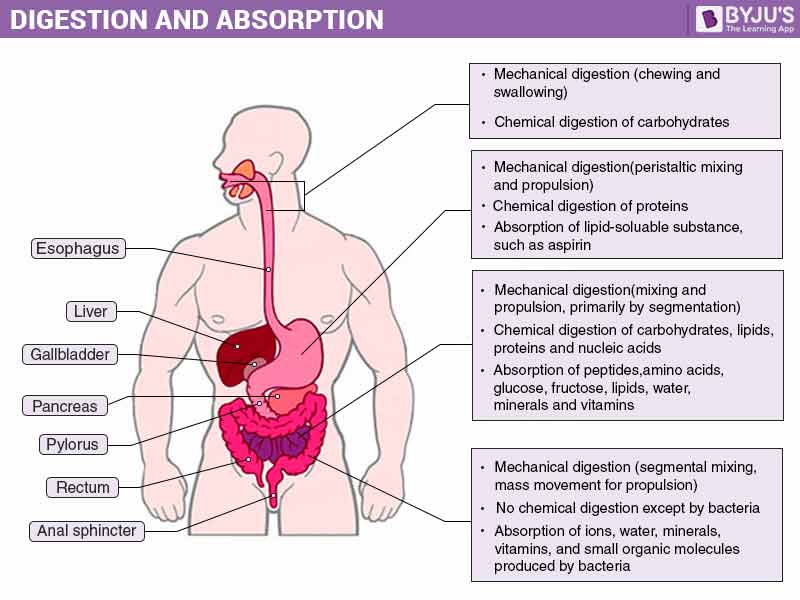
To get a dynamic overview of this journey and the key players involved, please start by watching the first few minutes of this video.
Digestive System Physiology Overview
The video 'Digestive System Physiology Overview' by Armando Hasudungan provides a clear, step-by-step visual explanation of the digestive process. We will watch the first part to trace the path of food from the mouth into the stomach.
Please watch from the beginning to 05:21. This will cover: The role of the mouth, saliva, and the enzyme amylase. The process of swallowing and movement through the esophagus. The functions of the stomach, including its acidic environment and the protein-digesting enzyme, pepsin.
This video introduces the key anatomical stages and some of the first chemical agents involved. Now, let's connect this sequence to the Ayurvedic framework you are familiar with.
2. Avasthapaka: The Bridge Between Ayurveda and Modern Science
In Ayurveda, digestion is not a single event but a three-stage process of transformation called Avasthapaka. Each stage is dominated by a specific Dosha and is characterized by a particular taste (Rasa). This ancient model provides a surprisingly accurate map of the modern physiological processes occurring in the GI tract.
The following article was written to explore exactly this correlation. It will serve as our guide for the rest of the lesson.
Avasthapaka: Modern and Ayurvedic Concept of Digestion
The review article 'Avasthapaka: Modern and Ayurvedic Concept of Digestion' directly compares the stages of digestion from both perspectives. We will use it to create a conceptual map.
Please read the 'INTRODUCTION' and the 'DISCUSSION' sections of the article, stopping just before the section titled 'Modern Scientific View of Digestion.' Focus on understanding the description of the three stages: Madhura Avasthapaka (Sweet phase, dominated by Kapha) Amla Avasthapaka (Sour phase, dominated by Pitta) Katu Avasthapaka (Pungent phase, dominated by Vata)
As the article explains, we can draw clear parallels:
| Ayurvedic Stage | Dominant Dosha | Modern Equivalent | Key Activity |
|---|---|---|---|
| Madhura Avasthapaka | Kapha | Oral Cavity & Upper Stomach | Moistening, mixing, initial carbohydrate digestion |
| Amla Avasthapaka | Pitta | Stomach & Small Intestine | Acid secretion, enzymatic digestion of all nutrients |
| Katu Avasthapaka | Vata | Large Intestine | Water absorption, waste formation, and elimination |
With this framework in mind, let's dive into the specifics of how each major nutrient is broken down and absorbed.
3. Digestion and Absorption of Major Nutrients
Food is composed of large molecules (polymers) that are too big to be absorbed by the body. Chemical digestion is the process of breaking these down into their small building blocks (monomers).
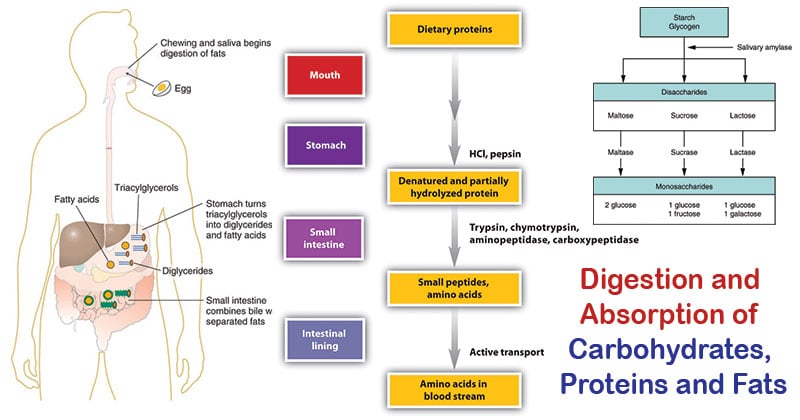
Let's examine the process for each nutrient class. A comprehensive resource for this section is the "Digestion and Absorption" chapter from the Human Physiology open textbook. We will refer to its specific sections as we go.
A. Carbohydrates (The Madhura to Amla Transition)
Digestion begins in the mouth, which corresponds to the start of the Madhura Avasthapaka. The sweet taste of carbohydrates is immediately apparent, and the moist, heavy qualities of Kapha Dosha are mirrored by the secretion of saliva.
Digestion and Absorption – Human Physiology
The 'Carbohydrates' section of the 'Digestion and Absorption' textbook chapter details the enzymes and transport mechanisms for sugars.
Please read the section titled 'Carbohydrates'. Pay attention to: The role of salivary amylase (in the mouth) and pancreatic amylase (in the small intestine). The final breakdown into monosaccharides (glucose, fructose, galactose) by brush border enzymes. The concept of absorption via specific transporters in the intestinal wall.
Summary of Carbohydrate Digestion:
- Mouth (Madhura Avasthapaka): Salivary amylase begins breaking down large starches (polysaccharides) into smaller sugars.
- Stomach: The high acidity of the stomach stops salivary amylase. No significant carbohydrate digestion occurs here.
- Small Intestine (Amla Avasthapaka): Pancreatic amylase continues breaking down starches. Enzymes on the intestinal wall (brush border enzymes) complete the job, breaking down disaccharides (like sucrose and lactose) into monosaccharides (glucose, fructose, galactose).
- Absorption: These monosaccharides are absorbed into the intestinal cells via specific protein transporters and then enter the bloodstream.
B. Proteins (The Heart of Amla Avasthapaka)
As food enters the stomach, the process enters the Amla Avasthapaka. The environment becomes acidic (amla means sour), reflecting the secretion of hydrochloric acid (HCl). This stage is dominated by Pitta, and its hot, sharp nature is perfectly embodied by the powerful protein-digesting enzymes.
Digestion and Absorption – Human Physiology
Now, let's explore protein digestion in the 'Protein' section of the same textbook chapter.
Please read the section titled 'Protein'. Focus on: The activation of pepsin by stomach acid (HCl). The role of pancreatic enzymes like trypsin in the small intestine. The final breakdown into amino acids for absorption.
Summary of Protein Digestion:
- Stomach (Amla Avasthapaka): HCl denatures proteins (unfolds them) and activates pepsin, an enzyme that starts breaking large protein chains into smaller pieces called peptides.
- Small Intestine (Amla Avasthapaka): The pancreas releases a suite of protein-digesting enzymes (like trypsin) that continue to break down proteins and peptides.
- Absorption: Enzymes on the intestinal wall break the final peptides into individual amino acids, which are then absorbed into the cells and passed into the bloodstream.
C. Lipids (Fats) (A Special Case in the Amla Avasthapaka)
Fat digestion presents a unique challenge: fats are oily and do not mix with the watery environment of the gut. The body's solution to this involves bile, a substance whose function aligns perfectly with the transformative power of Pachaka Pitta.
Digestion and Absorption – Human Physiology
The 'Lipids' section of the textbook explains how the body handles water-insoluble fats.
Please read the section titled 'Lipids'. Note these key steps: Emulsification: How bile salts from the liver break large fat globules into tiny droplets. Digestion: The action of lipase enzymes on these droplets. Absorption: The formation of micelles to transport fatty acids to the cell wall, and their re-packaging into chylomicrons inside the cell. The entry of chylomicrons into the lymphatic system.
Summary of Lipid Digestion:
- Small Intestine (Amla Avasthapaka):
- Bile, produced by the liver and stored in the gallbladder, is released. Bile salts act like a detergent, breaking large fat globules into microscopic droplets. This process is called emulsification.
- Pancreatic lipase, an enzyme from the pancreas, can now efficiently attack these small droplets, breaking triglycerides down into fatty acids and monoglycerides.
- Absorption:
- Bile salts help form tiny spheres called micelles, which shuttle the fatty acids to the surface of the intestinal cells.
- The fatty acids diffuse into the cell.
- Inside the cell, they are reassembled into triglycerides and packaged into larger particles called chylomicrons.
- Unlike carbohydrates and proteins, these chylomicrons are too large to enter the blood capillaries. Instead, they are absorbed into the lymphatic system (a parallel circulatory network), which eventually drains into the bloodstream. This is a fascinating parallel to the formation and circulation of Rasa Dhatu.
To see these complex steps in a simplified, animated format, the following short video is very helpful.
How Your Body Absorbs the Food You Eat
This animation, 'How Your Body Absorbs the Food You Eat,' provides a clear visual summary of the digestion and absorption of all three macronutrients.
Please watch from 01:10 to 04:08. This covers the absorption pathways for carbohydrates, proteins, and lipids, reinforcing what you have just read.
D. Water, Vitamins, and Ions (The Katu Avasthapaka)
As the digested food mass moves into the large intestine, it enters the Katu Avasthapaka. This final stage is dominated by Vata Dosha, with its dry and light qualities. Here, the primary activity is no longer digestion but absorption of the remaining water and electrolytes, and the formation of solid waste.
The textbook resource LINK describes this in the sections on 'Water', 'Ions', 'Vitamins', 'Calcium', and 'Phosphate'. The key principle is that the large intestine efficiently reabsorbs water and electrolytes, concentrating the waste into feces for elimination. The "drying" action of this stage is a direct physiological correlate of Vata's influence.
Test your understanding!
Let's connect the Ayurvedic and modern concepts. Match the Ayurvedic concept in Column A with the most relevant physiological process in Column B.
| Column A | Column B |
|---|---|
| 1. Madhura Avasthapaka | A. Absorption of water and formation of feces |
| 2. Amla Avasthapaka | B. Action of pepsin and HCl in the stomach |
| 3. Katu Avasthapaka | C. Emulsification of fats by bile salts |
| 4. Pachaka Pitta | D. Initial breakdown of starch by salivary amylase |
Show answer
- 1-D: Madhura Avasthapaka corresponds to the initial sweet phase where salivary amylase starts carbohydrate digestion.
- 2-B: Amla Avasthapaka is the acidic phase characterized by the action of pepsin and HCl in the stomach.
- 3-A: Katu Avasthapaka is the final, drying phase in the large intestine where water is absorbed and feces are formed.
- 4-C: Pachaka Pitta, the digestive aspect of Pitta, is perfectly exemplified by the transformative action of bile in emulsifying fats.
Conclusion
Today, we have journeyed through the gastrointestinal tract, outlining how the major nutrients are chemically dismantled and absorbed into the body. By mapping these processes onto the Ayurvedic framework of Avasthapaka, we can see two descriptions of the same elegant reality.
Key Takeaways:
- Digestion involves both mechanical (chewing, churning) and chemical (enzymatic) processes.
- The Ayurvedic stages of Avasthapaka align remarkably well with the modern physiological phases of digestion:
- Madhura (Kapha): Oral phase with initial carbohydrate digestion.
- Amla (Pitta): Gastric and small intestine phase with intense enzymatic activity on all nutrients. Jatharagni can be understood as the total metabolic power of the digestive enzymes and acids.
- Katu (Vata): Large intestine phase focused on water absorption and waste formation.
- Carbohydrates are broken down into monosaccharides and absorbed into the blood.
- Proteins are broken down into amino acids and absorbed into the blood.
- Lipids require a special process of emulsification by bile before being broken down and absorbed into the lymphatic system as chylomicrons.
Preview of the Next Lesson:
We repeatedly used the word "enzyme" today—amylase, pepsin, lipase. These proteins are the workhorses of digestion, the very agents of Agni. In our next lesson, we will delve into the fundamental question: What are enzymes, and how do they work? Understanding their role as biological catalysts will deepen your appreciation for the biochemical transformations that sustain life.