Hello! Welcome to our next lesson on Human Physiology.
In our previous lessons, we've explored several major systems that maintain the body's internal functions. Last time, we focused on the immune system, the body's defense force, and I introduced the overarching concept of homeostasis—the maintenance of a stable internal environment. Today, we delve into one of the master regulators of this stability: the kidneys.
This lesson's learning outcome is to explain how the kidneys regulate body fluid volume, electrolyte balance, and blood pH. These three functions are absolutely critical for life and are central to the concept of homeostasis, or Svasthya (health), in which all bodily systems are in equilibrium.
From an Ayurvedic perspective, the kidneys are the root of the Mutravaha Srotas, the channels responsible for forming and eliminating urine (mutra). This system is key to managing the body's fluids (kleda) and eliminating metabolic wastes (mala). Today, we will explore the modern scientific mechanisms that explain precisely how the kidneys perform this vital regulatory role.
1. The Kidney's Role in Homeostasis
The kidneys are much more than simple filters. They are dynamic organs that constantly adjust the composition of your blood. To begin, let's get a clear overview of their main functions.
Learning Guide: Kidney Structure and Physiology
The 'Learning Guide: Kidney Structure and Physiology' provides an excellent, concise list of the kidney's homeostatic functions. Reading this will set the stage for the rest of our lesson.
Please read the subsection titled 'FUNCTIONS' on page 7. Focus on the bullet points that describe how the kidneys regulate ionic composition, pH, osmolarity, and blood volume.
As you can see from the reading, the kidneys perform a remarkable number of regulatory tasks. This diagram provides a great visual summary of these interconnected functions.
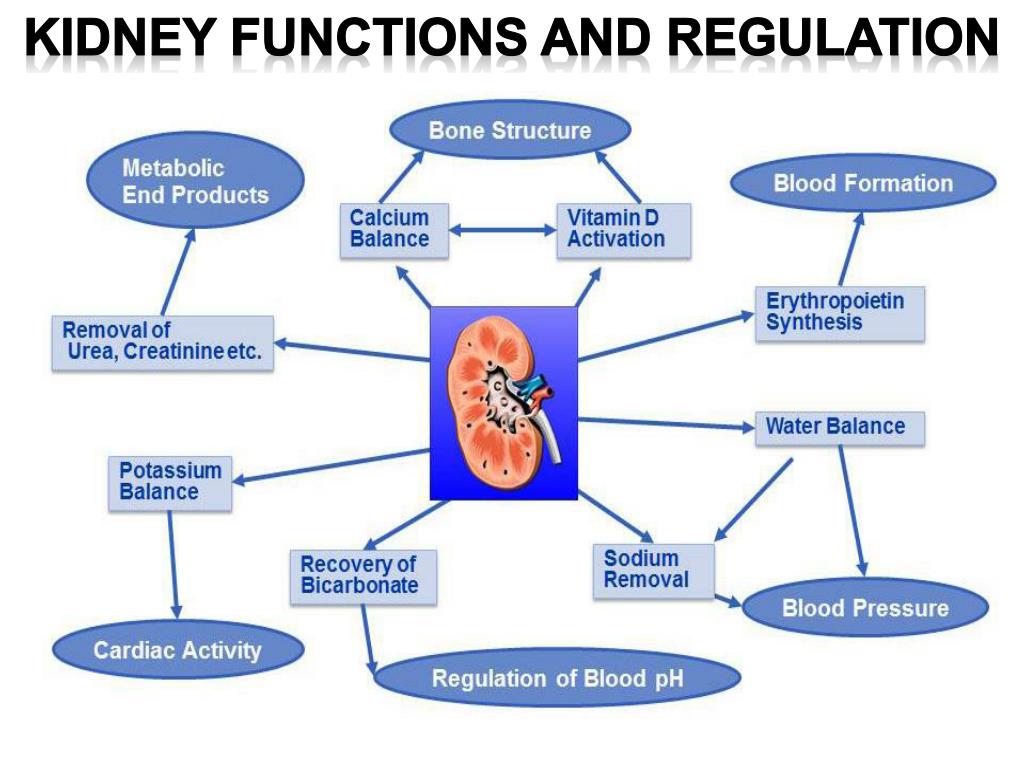
Today, we'll focus on three of these functions: fluid volume, electrolyte balance, and pH. All these actions take place within millions of microscopic functional units in each kidney called nephrons.
2. Regulating Fluid Volume and Electrolyte Balance
The regulation of body fluid and electrolytes (ions like sodium, Na⁺, and potassium, K⁺) are deeply intertwined. The guiding principle is simple: water follows solutes, especially sodium. By controlling where sodium goes, the kidneys largely control where water goes, thus regulating blood volume and pressure.
This fine-tuned control is managed by a trio of hormones. The following video provides a fantastic animated explanation of how these hormones work.
Hormones in body fluid homestasis (ADH/vasopressin, Aldosterone and Natriuretic peptides)
The video 'Hormones in body fluid homestasis' by Armando Hasudungan clearly illustrates the roles of the three key hormones that regulate fluid and electrolytes by acting on the nephrons.
Please watch from the beginning to 07:46. The video is structured around the three main hormones. Pay close attention to: Antidiuretic Hormone (ADH): What triggers its release and how it promotes water reabsorption. Aldosterone: How the Renin-Angiotensin-Aldosterone System (RAAS) is activated and how aldosterone affects sodium and potassium. Natriuretic Peptides (ANP/BNP): How they oppose the actions of ADH and aldosterone.
Let's break down this elegant system of checks and balances:
A. The Renin-Angiotensin-Aldosterone System (RAAS) and Aldosterone
- Trigger: Low blood pressure, low blood volume, or low sodium levels.
- Mechanism:
- The kidneys release an enzyme called renin.
- Renin initiates a cascade that produces the hormone angiotensin II.
- Angiotensin II causes blood vessels to constrict (raising blood pressure) and stimulates the adrenal glands to release aldosterone.
- Action of Aldosterone: This hormone acts on the distal tubules and collecting ducts of the nephron, promoting the reabsorption of sodium back into the blood. As sodium is reabsorbed, water follows via osmosis, which increases blood volume and pressure. Aldosterone also promotes the secretion of potassium into the urine, helping to lower high potassium levels.
- Ayurvedic Connection: You can think of this as a mechanism the body uses to retain fluids and salts when it senses a state of depletion, preventing an imbalance in the body's kleda and rasa dhatu.
B. Antidiuretic Hormone (ADH)
- Trigger: High plasma osmolarity (i.e., the blood is too concentrated/salty) or a significant drop in blood volume/pressure.
- Mechanism: The hypothalamus in the brain detects these changes and signals the pituitary gland to release ADH.
- Action of ADH: ADH travels to the kidneys and makes the walls of the collecting ducts more permeable to water. This allows more water to be reabsorbed from the urine back into the blood, making the urine more concentrated and diluting the blood back to normal.
- Fun fact: The word "diuresis" means increased urine production. ADH is an anti-diuretic hormone because it decreases urine production.
This flowchart illustrates how these systems work together in response to low blood pressure.

C. Natriuretic Peptides (ANP and BNP)
- Trigger: High blood pressure or high blood volume (e.g., the heart walls are stretched).
- Mechanism: The heart releases ANP and BNP.
- Action: These hormones have the opposite effect of aldosterone and ADH. They inhibit the RAAS, reduce ADH release, and directly cause the kidneys to excrete more sodium and water. This reduces blood volume and lowers blood pressure.
Test your understanding!
Imagine you drink 1.5 liters of pure water very quickly. Based on the hormonal systems we just discussed, what would you expect to happen to the levels of ADH and Aldosterone in your blood?
Show answer
- ADH levels would decrease. Drinking a large amount of water will decrease your plasma osmolarity (your blood becomes more dilute). The hypothalamus will detect this and reduce the secretion of ADH. With less ADH, the kidney's collecting ducts become less permeable to water, so less water is reabsorbed and you produce a large volume of dilute urine to excrete the excess water.
- Aldosterone levels would decrease (or stay low). The large intake of water increases your blood volume and pressure. This suppresses the release of renin from the kidneys, which in turn reduces the entire RAAS cascade, leading to lower aldosterone levels. This helps the body excrete more sodium and water.
3. Regulating Blood pH
The body's metabolism constantly produces acids. Maintaining blood pH within a very narrow range (7.35-7.45) is essential for enzymes and proteins to function correctly. A state of excess acidity in the body, which you might recognize by the term Amlata, is detrimental to health. The kidneys are the ultimate regulators of blood pH because they can physically remove acid from the body.
The kidneys accomplish this through two primary actions:
- Reabsorbing bicarbonate (HCO₃⁻): Bicarbonate is the most important buffer in the blood, acting as a "sponge" for acid (H⁺ ions). The kidneys work to conserve it, reclaiming almost all of it from the filtered fluid.
- Secreting hydrogen ions (H⁺): The kidneys actively pump H⁺ ions from the blood into the urine for excretion.
Let's watch a video that explains these complex processes with clear animations.
The role of the kidney in acid-base balance - renal physiology
The video 'The role of the kidney in acid-base balance' by Osmosis from Elsevier explains how the kidneys manage bicarbonate and hydrogen ions to maintain pH homeostasis. It also covers the clever buffer systems used in urine.
Please watch the following segments: 00:00 - 00:32: Introduction to the two main mechanisms. 01:35 - 02:56: How bicarbonate is reabsorbed. 02:56 - 05:25: How hydrogen ions are secreted and buffered in the urine by the ammonia and phosphate buffer systems.
As the video showed, the kidneys have a clever way to excrete large amounts of acid. If free H⁺ ions were simply dumped into urine, the pH would drop so low that it would damage the urinary tract. To solve this, the kidneys use urinary buffers:
- The Phosphate Buffer System: Phosphate filtered from the blood binds with H⁺.
- The Ammonia Buffer System: The kidney tubule cells produce ammonia (NH₃), which diffuses into the urine and combines with H⁺ to form ammonium (NH₄⁺).
These buffered forms of acid can be safely excreted, allowing the body to eliminate its daily acid load and keep blood pH perfectly balanced.
Conclusion
Today, we've unpacked the sophisticated mechanisms the kidneys use to act as the body's master chemists. They are central to maintaining the internal balance that is the very definition of health.
Key Takeaways:
- The kidneys regulate fluid volume and electrolyte balance primarily through the coordinated action of hormones: Aldosterone (via RAAS) retains sodium and water, ADH retains water, and Natriuretic Peptides promote sodium and water excretion.
- The principle "water follows sodium" is fundamental to how the kidneys control blood volume and pressure.
- The kidneys regulate blood pH by reabsorbing virtually all filtered bicarbonate (HCO₃⁻), the body's main buffer, and by secreting excess hydrogen ions (H⁺) into the urine.
- To excrete large amounts of acid safely, the kidneys use the ammonia and phosphate buffer systems in the urine.
Preview of the Next Lesson:
We have now examined several major organ systems in isolation: the cardiovascular, respiratory, immune, and renal systems. In our final lesson for this module, we will analyze a case study demonstrating how multiple organ systems interact to maintain physiological homeostasis. This will allow us to see how these systems you've learned about work together in a dynamic, integrated response to a real-world physiological challenge, bringing the concept of homeostasis to life.