Welcome to the third lesson in our Foundations of Arithmetic module. In our last session, we built a strong toolkit for solving comparison and distribution problems using the principles of ratio and proportion. We saw how to combine ratios and applied some powerful shortcuts for income-expenditure questions.
Today, we will build directly on that knowledge by exploring two special types of relationships: direct and inverse proportion. Your learning outcome for this lesson is to apply these concepts to solve a variety of word problems, a skill that is crucial for many topics in the SSC CGL exam, such as Time & Work and Speed, Distance, & Time. We'll focus on understanding the core logic and then, as you prefer, master the fast methods needed to excel in a competitive environment.
1. Understanding Proportional Relationships
At its heart, proportion describes how two quantities relate to each other as they change. Do they increase together, or does one decrease as the other increases? These two scenarios are known as direct and inverse proportion.
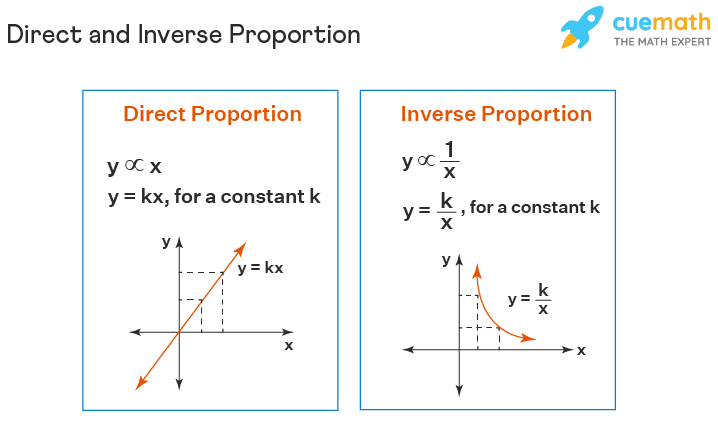
Let's formally define these two relationships.
Ratio, Proportion and Variation
This section from the "Ratio, Proportion and Variation" handbook provides a clear breakdown of direct and inverse proportion, covering their logical, graphical, and mathematical implications.
Please read the part under the heading VARIATION. Focus on the definitions and implications for Direct Proportion and Inverse Proportion. Pay close attention to the "Equation implication" for both, as this forms the basis of our problem-solving methods.
To summarize the key takeaway for problem-solving:
-
Direct Proportion: If is directly proportional to , their ratio is constant. This gives us the equation:
(Note: Some texts write this as , which is an equivalent form.) -
Inverse Proportion: If is inversely proportional to , their product is constant. This gives us the equation:
This distinction is one of the most common points of confusion, so it's vital to have it clear. A simple way to remember is: "more workers, less time" (inverse), but "more articles, more cost" (direct).
2. Applying Proportion to Word Problems
Now, let's see how to use these formulas to solve word problems typical of the SSC CGL exam.
The Unitary Method vs. Proportion Formulas
You might be used to solving these problems with the unitary method (finding the value of one unit first). While that works, the proportion formulas are often faster and more systematic, especially for complex problems.
Let's watch a short video that demonstrates solving a classic inverse proportion problem using this direct formula-based approach.
Proportionality based new type question asked in SSC CGL 2024 Tier-1 Exam| Ratio and algebra
This clip from RBE Revolution By Education clearly shows how to set up and solve an inverse proportion problem.
Watch from the beginning until the end of the first problem. The instructor shows how the relationship x \propto 1/y leads directly to the equation x_1 y_1 = x_2 y_2 (though written in a slightly different but equivalent format). This is the key process you need to master.
Joint Variation: When a Quantity Depends on Multiple Factors
Sometimes, a quantity varies in relation to several other quantities at once. This is called joint variation. The classic example in SSC exams is the Time and Work formula.
The amount of work done () is directly proportional to the number of men () working and the number of days () they work.
- More men, more work (direct).
- More days, more work (direct).
So, we can say , which leads to the formula:
This gives us the famous formula you should commit to memory:
Often, you might also see hours () and efficiency () included, extending the formula to .
Let's analyze a classic problem using this idea.
Problem: If 10 persons can clean 10 floors with 10 mops in 10 days, in how many days can 8 persons clean 8 floors with 8 mops?
Solution:
Here, the "work" is cleaning floors. The mops are extra information designed to confuse you; the work is done by the people over time.
- persons, days, floors.
- persons, floors,
Using the formula :
So, it will take 8 persons 10 days to clean 8 floors.
This structured approach is invaluable for avoiding errors in more complex scenarios, such as the one in the next video.
Proportionality based new type question asked in SSC CGL 2024 Tier-1 Exam| Ratio and algebra
This next segment from the same RBE video tackles a joint variation problem, where one quantity varies directly with the cube of another and inversely with the square of a third.
Watch from this section. Observe carefully how the relationship is constructed. If x \propto y^3 and x \propto 1/z^2, then x \propto y^3/z^2. This leads to the equation \frac{x_1 z_1^2}{y_1^3} = \frac{x_2 z_2^2}{y_2^3}, which is then used to solve the problem.
3. The "Rocket Method" for a Special SSC CGL Problem Type
There is a specific type of proportion problem that appears very frequently in SSC exams, including Mains. The question asks: What number, when added to (or subtracted from) four given numbers, will make them proportional?
While you can solve this by setting up the full algebraic equation or by testing options, there's a much faster shortcut. Aditya Ranjan Sir calls this the "Rocket Method".
Day 15 || SSC CGL CHSL 2021 || PROPORTION || 60 दिन 60 मैराथन || Maths by Aditya Ranjan Sir
This video from RANKERS GURUKUL provides a powerful shortcut for solving this specific question type. You'll learn the formula and see it applied to recent SSC CGL questions.
First, watch the explanation of the trick from this segment. The method is to find the required number x using the formula: x = \frac{|(ad - bc)|}{(a+d) - (b+c)} where a, b, c, d are the four numbers. Notice how quickly this yields the answer compared to testing options. Next, see how this is applied to solve a more complex, multi-step problem from the CGL exam, from this part. Here, you first find the value of x and then use it to calculate a mean proportion. This is a very realistic exam scenario.
This method is a perfect example of the kind of shortcut that saves critical time, allowing you to focus on more complex questions. Remember that this trick works for both addition and subtraction problems.
Conclusion
In this lesson, we have dissected the concepts of direct and inverse proportion and, most importantly, learned how to apply them to solve word problems. By moving from basic definitions to the structured formulas for joint variation and finally to a powerful exam-specific shortcut, you have developed a robust approach for this topic.
Key Takeaways:
- Direct Proportion (): As one quantity increases, the other increases. The governing equation is .
- Inverse Proportion (): As one quantity increases, the other decreases. The governing equation is .
- Joint Variation: A quantity can vary with multiple others. The Time & Work formula () is a prime example.
- SSC Shortcut: For problems asking what number 'x' to add/subtract to make a, b, c, d proportional, use the "Rocket Method": .
Our next lesson will focus on Partnership problems. This is a natural progression, as profit sharing in partnerships is calculated based on the ratio of investment and the time period for which it was invested—a direct application of the principles we've covered.