Welcome back to your second lesson.
In our first session, we introduced Karma Yoga as a powerful tool for overcoming study paralysis. The key was to shift your focus from the anxiety-producing outcome (your future rank) to the manageable process (the act of studying right now). This is the 'how' of taking action.
Today, we build on that foundation by exploring the 'why'. Why is studying for JEE your specific task right now? Answering this question deeply can transform studying from a burden into a meaningful act.
Today's Goal: By the end of this lesson, you will be able to apply the concept of Svadharma (one's personal duty) to frame your JEE preparation as a meaningful, purpose-driven activity.
Svadharma: Finding Your Own Path
In the last lesson, we saw Arjuna paralyzed by the potential outcomes of the battle. Krishna's first piece of advice was about how to act (Karma Yoga). His next major point is about why one must act: because it is one's Svadharma, or personal duty aligned with one's innate nature.
The Bhagavad Gita (3.35) makes a radical statement about this:
śhreyān swa-dharmo viguṇaḥ para-dharmāt sv-anuṣhṭhitāt
swa-dharme nidhanaṁ śhreyaḥ para-dharmo bhayāvahaḥ"It is far better to perform one's own duty, even imperfectly, than to perform another's duty perfectly. It is better to die in one's own dharma than to follow another's path, which brings fear."
This verse challenges the very idea of comparison. It suggests that the goal isn't to be the best on someone else's terms, but to be authentic to your own path.
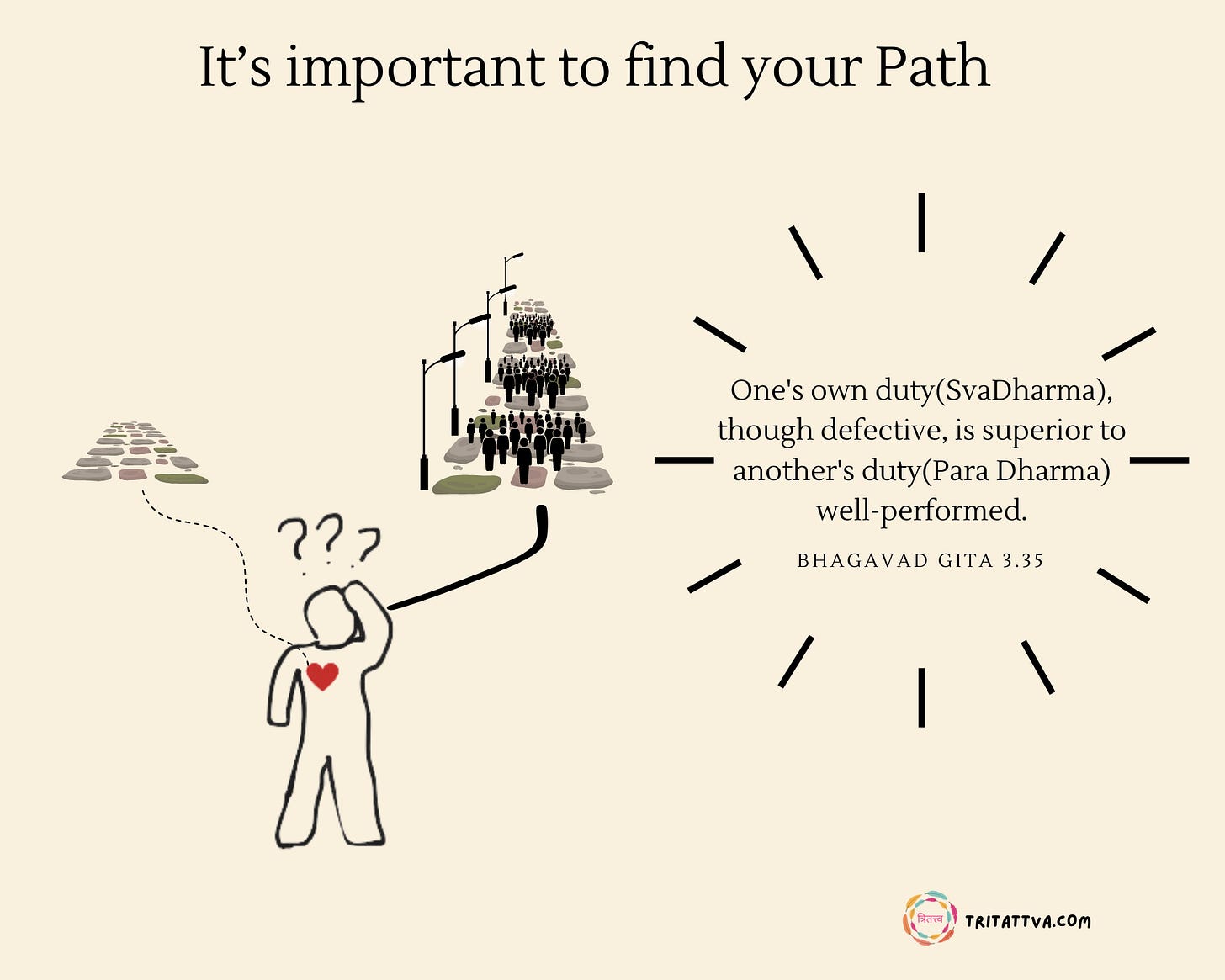
Svadharma vs. Paradharma: The Antidote to Comparison
One of the greatest sources of the "misery" you mentioned is the habit of comparison. You look at others and feel you are not as smart, disciplined, or successful. The Gita identifies this as the trap of Paradharma—trying to live or measure yourself by another's path. Svadharma is the direct antidote.
This video provides an excellent explanation of how understanding Svadharma can free you from the "inferiority complex" that comparison creates.
Why You Never Feel Complete | Gita 3.35 explained
The video 'Why You Never Feel Complete' from the channel Pause with Dharma explains Bhagavad Gita verse 3.35 as a remedy for the feeling of inferiority that comes from comparison.
Watch from the beginning to 05:10. Pay close attention to the distinction between Svadharma (your own duty aligned with your nature) and Paradharma (another's path). Notice how the video links chasing Paradharma to feelings of anxiety and emptiness, even when you succeed.
As the video explains, chasing Paradharma is "dangerous" (bhayāvahaḥ) because it disconnects you from your authentic self. This leads to a constant need for external validation and a feeling of being a "fake," which are major triggers for procrastination and inaction.
What is Your Svadharma Right Now?
This leads to the crucial question: "How do I know what my Svadharma is?" This is a common point of confusion, especially when facing major life decisions like a career path.
The answer can be broken into two parts: your long-term nature and your immediate, situational duty.
Let's start with identifying your deeper nature. The following video gives a very clear and practical method for this.
# 0033 - "How to Know My Swadharma? Bh. Geeta Guides..." Talk in English by Swami Aparajitananda.
In this talk by Swami Aparajitananda of the Chinmaya Mission, he directly answers the question, 'How to Know My Swadharma?'.
Please watch the segment from 02:07 to 04:20. The speaker defines Svadharma as that subject or activity which you love to engage with, where even challenges feel like opportunities, and for which you don't require external motivation like money or praise.
Now, let's connect this to your current situation. You have a background in Physics, Chemistry, and Mathematics, and your goal is to master the JEE Mains. At this specific stage of your life, your role is that of a student. Therefore, your Svadharma is to be a student. And the primary duty within that role is to study and prepare for your chosen goal.
This isn't just a modern interpretation; it's a classical one.
Exploring Swadharma: An Overview & Bhagavad Gita for Students
The following texts explicitly state that for a person in your position, studying is the designated duty.
In the resource 'Exploring Swadharma: An Overview', please read the 'CONCLUSION' section. Notice this direct line: 'Swadharma of a student is to study and learn.'
Bhagavad Gita for Students: Overcoming Exam Stress...
This second resource, 'Bhagavad Gita for Students', reinforces the same point.
Please read the subsection 'Study as Sacred Duty' under the 'Applying Karma Yoga to Studies' heading. It states: 'For students, studying is your svadharma - your appropriate duty at this stage of life.'
By framing your studies this way, you elevate the task. It's no longer just a stressful means to an end (getting a rank). It is the most meaningful and appropriate action you can be taking right now. It is your purpose for this phase of life. This perspective gives your daily efforts a profound sense of integrity and importance.
The Danger of Abandoning Your Post

When you procrastinate, you are, in a small way, abandoning your Svadharma. You are mentally choosing the path of inaction over the path of your prescribed duty. The Gita warns that this leads to misery.
Let's return to the talk by Swami Aparajitananda. He gives a powerful example of a student forced into a field that is not his Svadharma, illustrating the "danger" Krishna speaks of. This applies equally to someone who is in the right field but mentally deserts their duty.
# 0033 - "How to Know My Swadharma? Bh. Geeta Guides..." Talk in English by Swami Aparajitananda.
Here, the speaker explains the misery that arises from following Paradharma, using the story of a student unsuited for medical college.
Watch from 05:25 to 08:30. As you watch, consider how the feelings of misery and inferiority complex described in the medical student are similar to the feelings that arise during a 'drought of action' when you avoid your studies.
The key insight here is that the resistance and misery you feel are not just because the task is hard, but because you are in a state of internal conflict. A part of you knows your duty is to study, while another part is resisting it. This conflict drains your energy.
Embracing your study as Svadharma resolves this conflict. You are no longer fighting yourself. You are aligning your will with your purpose.
Your Second Tool: The Svadharma Intention
Let's integrate this with the Karma Yoga tool from our last lesson. Before you begin a study session, especially one you are dreading, set a clear intention.
- Acknowledge your Svadharma: Say to yourself, "At this stage of my life, my Svadharma is to be a student. My primary duty is to prepare for this exam."
- Commit to the Action: "Therefore, engaging with this topic is the most meaningful and appropriate action I can take right now."
- Apply Karma Yoga: "I will perform this duty with full concentration, without attachment to the outcome. My focus is on the process, not the fruit."
This simple, three-step mental alignment does two things:
- It provides a powerful reason to act (Svadharma).
- It gives you a non-threatening method for acting (Karma Yoga).
Lesson Summary
Let's consolidate the key ideas from today's lesson:
- Svadharma is your own authentic duty, aligned with your innate nature and current stage of life. It is better to perform your own duty imperfectly than another's perfectly.
- For you, as a student preparing for the JEE, your immediate Svadharma is to study. This reframes the task from a burden to a purpose-driven activity.
- Much of the anxiety and "misery" associated with studying comes from Paradharma—comparing yourself to others or mentally wishing you were on a different path.
- Embracing your Svadharma provides the deep "why" that fuels your action, while Karma Yoga provides the practical "how."
Preview of the Next Lesson
We have now established a powerful philosophical frame for why you should act (Svadharma) and how you should act (Karma Yoga). However, even with the best intentions, the initial moment of starting a task can be difficult due to mental noise and resistance.
In our next lesson, we will introduce a very practical technique from Advaita Vedanta: the concept of 'sakshi' or witness consciousness. You will learn to use it to observe and detach from the initial resistance to starting, making that first step much easier.